
Sell a House Quickly: Timeline, Costs & Seller Options
You can only control so much about a fast sale. You can’t set the buyer’s loan approval date, and you can’t make an appraiser hurry. What you can control is the asking price, which offer you take seriously, and how you read the terms wrapped around that price. Most of the days a home sits unsold trace back to those three decisions, which is why this guide starts with pricing and offers instead of with a list of buyer types.
To sell a house quickly, price it where the most qualified buyers are already searching, using closed comparable sales from the past several months. Decide in advance when you’ll cut the price if the first two weeks go quiet. Then compare every offer by net proceeds and expected time to close, not by the headline number alone.
That answer sounds simple, and the mechanics behind it aren’t. A $415,000 offer with a seller credit, three contingencies, and a 45-day closing can leave you with less cash, later, than a $392,000 offer with no financing risk. A price that looks aggressive can produce a bidding scramble in one neighborhood and a stale listing in the next. The only way to know which situation you’re in is to learn how comparable sales are chosen, how early market feedback should be read, and how each contract term changes your timeline.
The sections below take that in order. First comes why price is the lever that matters most, then a step-by-step comps method you can run yourself before talking to anyone. After that you’ll find decision rules for price reductions, a method for comparing offers on a net sheet, a term-by-term look at contingencies, earnest money, and closing dates, and a plan for appraisal gaps and concession requests. Later sections cover when pricing alone won’t deliver the speed you need, and how to match a route to your priority.
A quick note on scope. This guide covers retail-market pricing, offer comparison, and the contract terms that move your closing date. It touches on investor and instant-offer routes only where they change a pricing decision. For the economics of those buyers, see the separate guides on quick home sale routes and how cash offers are calculated. If you want the broader overview of every fast-sale route, start at the sell house fast hub.
One more thing before the detail: speed and price pull against each other, but not always as hard as sellers fear. A correctly priced home often attracts a first-week offer that’s close to the number you’d have held out for, while an overpriced one drifts, gets reduced twice, and sells for less than a correctly priced one would have. Part of this article is about learning to tell those two outcomes apart early, when you still have room to act.
People reach for the phrase “sell quickly” in very different situations: a job offer in another state, an estate that needs to be settled, a second mortgage payment that’s draining savings, or simply a household that wants to move on. The pressure feels different in each case, and so does the right tolerance for risk. A seller with a six-month runway can afford to test a higher price. A seller with a firm closing date on a new home can’t. Naming which one you are, honestly, is the first piece of pricing work.
Why Price Is the Fastest Lever When You Sell a House Quickly
Selling quickly isn’t one decision; it’s a chain of them. Pricing is the first link, and the one that every later link inherits. This section explains how price interacts with buyer behavior and with your own deadline, so the rest of the plan has something solid underneath it.
How Speed and Price Trade Off in a Retail Sale
Why the first weeks on the market carry the most weight
A new listing gets its widest audience at the start. Buyers who’ve set up saved searches and alerts see it right away, and agents who have been waiting for something in that price range call their clients. As the weeks pass, those pools get used up, and what remains is a thinner stream of new searchers. A home that’s priced to match the early audience can turn that attention into showings and an offer. A home that isn’t often watches the best attention pass without a single written offer.
Online search tools also sort by price bracket. Many buyers set a maximum of, say, $400,000 rather than a vague “around $400,000,” which means a listing at $409,900 may never appear for the people who would have been most interested. That’s a mechanism, not a statistic, and it’s one reason agents often discuss pricing just below a round number or a common search cutoff. Look at how your own market clusters before you pick a figure.
Season and local conditions matter too. Spring and early summer often bring more active buyers in many parts of the country, and winter can thin the field, but your own market may run on a different rhythm because of school calendars, tourism, or military and corporate moves. Rather than leaning on a national average, ask an agent for the days on market and list-to-sale price patterns for homes that sold in your neighborhood and price band over the last few months. That’s a far better gauge of how fast your price tier actually moves.
None of this means the lowest possible price sells fastest in every case. In a market where homes are moving quickly, a modest price can draw several offers and push the final number up. In a slow market, the same price might be the minimum needed to get any attention. The point is that price sends a signal to buyers within the first days, and a weak signal is hard to take back once the listing has aged.
Realistic timeline stages for a financed retail sale
It helps to see the calendar before you set a price, because a quick sale is the sum of several stages and price only influences some of them. The table below lays out planning ranges that are illustrative. Real timelines depend on your market, the buyer’s lender, local contract customs, and whether your state uses attorneys or escrow companies to close.
| Stage | Typical planning range | What drives it | Can price change it? |
|---|---|---|---|
| Preparing to list (photos, cleaning, paperwork) | 3–10 days | Your readiness and the agent’s schedule | No |
| Listing to accepted offer | 1–6+ weeks | Price position, condition, season, showing access | Strongly |
| Inspection and negotiation period | 1–2 weeks | Contract wording, repair requests | Indirectly |
| Appraisal and loan underwriting | 2–5 weeks | Lender workload, appraisal scheduling, buyer paperwork | Only through appraisal risk |
| Final signing, funding, and recording | Days | Title work, payoff, state closing customs | No |
Read the table as a reminder that the stage price affects most is the second row, and it’s also the one with the widest range. Shave three weeks there and you’ve saved more than any other single stage can give back. The guide to what slows down a home sale covers the stages price doesn’t touch.
Two details are worth knowing about the loan-dependent stages. Federal rules require lenders to deliver the Closing Disclosure to a mortgage borrower at least three business days before closing, according to the Consumer Financial Protection Bureau, so a financed buyer can’t sign the final loan papers on the same day the numbers are finalized. Also, closing mechanics differ: some states close mostly through attorneys, others through escrow or title companies, and the number of days for recording and funding varies with them. Ask your closing professional which model your state uses and how long funding typically takes in your county.
Pricing Strategies and What Each One Signals
Pricing at market, slightly below, or above
There are really three postures. Pricing at market means your number lines up with where the best comparable sales closed after adjustments. You’ll get an honest audience and probably a fair range of offers, but no special pull. Pricing slightly below market, often by a few percent, aims to create urgency and, in some markets, competing bids. Pricing above market is a bet that your home has something comps can’t capture, and it only pays off if buyers agree.
A deliberate low list price intended to trigger competing offers deserves one warning. It works only if you’re willing to accept the result. If the highest bid ends up at that low price, a seller who wouldn’t have taken it will feel trapped. So set a price you’d be willing to accept in a worst realistic case, and treat anything above it as a bonus. If you can’t say that sentence comfortably about a price, it’s the wrong price for your plan.
Each posture has a failure mode. At market, the failure is waiting: you get steady interest but no sense of urgency, so buyers take their time and negotiate. Below market, the failure is leaving money behind in a hot market, or attracting low-ball bids that treat your price as an opening for further cuts. Above market, the failure is the slow slide: a listing that sits, accumulates days on market, and gets read by buyers as a property with a problem.
If speed is the goal, the bias should usually be toward market or slightly below, with a firm plan for checking results. An aggressive price paired with a plan to review after two weeks is more flexible than a high price you’ll have to defend. You aren’t locked in either way; you’re choosing which mistake is cheaper to correct.
Backward planning: set the deadline first, then the price
Sellers often price from the number they want, then hope the calendar cooperates. Reverse it. Start with the date by which you need funds or possession, subtract the contract-to-close stage, subtract a reasonable inspection and negotiation window, and what remains is the time you can afford on the market. That leftover window tells you how aggressive the price must be.
Illustrative example (hypothetical numbers, not market data): Dana needs to close on a relocation by day 90. She assumes 40 days from contract to closing for a financed buyer and one week for inspection and negotiation. That leaves roughly 43 days between listing and an accepted offer, minus about a week of prep. She decides she can afford 14 days to learn whether her price works, and then a second 14-day window after a reduction, with a few days of buffer. Her price is set to produce showings in week one, not to test the top of the market.
Dana’s arithmetic works for any deadline. If the window is too short for a financed sale to close, that’s useful information, and it points toward the alternatives covered later, such as buyers who aren’t dependent on a lender. If the window is generous, you can afford to price closer to the top of the range and test it. Either way, the deadline decides the strategy, not the other way around.
Backward planning also produces something every seller should have before listing: a walk-away number. Add up your mortgage payoff, the selling costs you’d expect, and any repairs or concessions you’re already prepared to give, and you have the minimum sale price at which you walk away with no cash. Then decide how much cash you actually need at closing. The gap between those two numbers is your negotiating room, and knowing it protects you from accepting or rejecting offers on a hunch.
Building a Comps Analysis You Can Defend
A comparable-sales analysis, usually shortened to comps, is the backbone of nearly every pricing decision. Buyers and their agents run their own, and an appraiser will run a stricter one if a lender is involved. If your price can’t survive that scrutiny, it’ll show up as a low appraisal or a failed negotiation. Doing the work yourself, even if you also hire an agent, lets you check the number you’re given.
Selecting and Filtering Comparable Sales
What appraisal standards say about good comparables
You don’t have to guess what makes a comparable sale credible. Fannie Mae’s Selling Guide, which governs a large share of conventional mortgage appraisals, requires the appraiser to use at least three closed comparable sales. It says that sales closed within the last 12 months should be used, though that isn’t a hard cutoff, and older sales can be used when they’re the best indicator of value, with an explanation. Comps from the same market area are preferred, and distance is measured in straight-line miles.
The same guide treats contract offerings and active listings as supporting data only. They help show where the market is heading, but they aren’t proof of value because they haven’t closed. It also tells appraisers to address foreclosure and short-sale comparables explicitly and not to assume they’re equal to a normal sale. Those rules are written for lenders, but they describe the standard your buyer’s appraisal will be held to.
What does that mean for your own analysis? Lean on closed sales. Treat a neighbor’s asking price as a hint about competition, not as evidence of what a buyer will actually pay. And note that “within 12 months” is a ceiling for preference, not a recommendation to reach back that far when the market has moved. In a fast-changing market, three-month-old sales may already be stale.
Sale-price information is easier to find in some states than others. In certain states, prices aren’t recorded in public records, so you’d depend on an agent’s access to listing-service data to see closed prices at all. If you’re using a public website, remember that its sale data can lag by weeks and may leave out seller credits. That lag matters most when the market is moving fast, because the freshest sales are the ones missing from the free sources.
A step-by-step filter for choosing your comps
Work through a consistent sequence, so you aren’t just collecting flattering numbers. First, define a radius and a recency window: start tight, such as a half-mile and the last three to six months in a dense suburb, and widen only if you can’t find at least three solid matches. Rural properties will need far larger circles, and that’s normal.
- Match the property type and size band. Keep square footage within roughly 10 to 20 percent of yours and match bedroom and bathroom counts where you can.
- Match the age and style. A 2018 build and a 1962 ranch rarely compare cleanly, even a block apart.
- Match the condition tier. Sort sales into updated, average, and dated, and compare your home against its own tier.
- Watch the lot and location factors. A busy road, a flood zone, school boundaries, and views can each move price more than a bathroom remodel.
- Check how the sale closed. Note seller credits, distress sales, and related-party transfers; they can make a price look higher or lower than it really was.
- Keep a log. Record address, close date, price, concessions, and your reasons for including or dropping each sale, so the final number is traceable.
When you’re done, you should have three to six comps you’d be comfortable defending to a skeptical buyer. If you can’t find that many, say so plainly when you ask an agent for their own analysis, and ask them to explain what they used instead.
Resist the urge to filter until the answer matches the number you hoped for. Dropping the lowest comps because “that house must have had problems” while keeping the highest because “it’s just like mine” is how sellers talk themselves into a price the market won’t pay. A cleaner habit is to decide the filters first, apply them to every sale, and only then look at the result. If a sale gets excluded, write down why. And watch for single outliers: one very high or very low closing shouldn’t pull the cluster by itself.
Adjusting Comps and Turning Them Into a Price Band
How adjustments work, with a worked grid
No two homes are identical, so appraisers and agents adjust each comparable’s price up or down to reflect differences from the subject home. If the comp has a finished basement that yours lacks, you subtract a value for it; if your home has a newer roof, you add one. The adjustments are judgment calls grounded in local paired sales, not formulas, so treat the dollar values below as placeholders you’d replace with local evidence.
| Comparable | Closed price | Difference from your home | Net adjustment | Adjusted price |
|---|---|---|---|---|
| Comp 1, closed 2 months ago | $402,000 | Extra half bath; dated kitchen | −$6,000 | $396,000 |
| Comp 2, closed 4 months ago | $389,000 | Smaller lot; newer roof | +$4,500 | $393,500 |
| Comp 3, closed 3 months ago | $410,000 | Finished basement; seller paid $7,000 credit | −$11,000 | $399,000 |
| Comp 4, closed 5 months ago | $381,000 | Fewer bedrooms; same condition | +$9,000 | $390,000 |
The adjusted prices cluster between $390,000 and $399,000, and that cluster, not any one comp, is your evidence. A very large net adjustment is a warning that the comp isn’t really comparable; the more you have to adjust, the less weight the sale deserves.
Where do adjustment numbers come from? Careful appraisers and agents derive them from paired sales, which means comparing two otherwise similar homes that differ by one feature and reading the price gap. Extra bedrooms, garage spaces, finished basements, and updated kitchens each have a local value that varies a great deal from one metro area to the next. If someone hands you a comps sheet, ask where the adjustments came from. An answer like “I compared these two recent sales that differ only by the garage” is far more persuasive than “that’s typical.”
From adjusted comps to a price band, and what else to cross-check
Once you have a cluster, convert it into a band instead of a single figure. In the grid above, a defensible band might run from about $390,000 to $399,000, and the pricing posture decides where inside or around that band you land. Priced near the top, you’re betting on condition or presentation. Priced at the bottom or just under, you’re using price as the marketing tool.
Then cross-check against competition. Look at active and pending listings in your band, because those are the homes buyers will tour the same weekend as yours. If three newer-looking listings sit slightly above your band with no activity, the market may be telling you the band’s top is soft. If pending sales appear within days of listing, you have evidence of demand at that level.
Be clear about what each valuation tool is. An agent’s comparative market analysis is an opinion offered to help you price a listing. A broker price opinion is similar and is often ordered for lenders or relocation companies. An appraisal is a formal opinion of value, typically ordered by a lender and governed by appraisal standards. Online automated estimates are starting points and can be wide of the mark, particularly where homes are unusual or sales are sparse. None of these replaces your own comps log; they’re inputs you check against it.
The process map below puts this sequence on one page, from setting the deadline through checkpoints and offer comparison, so you can see where each decision sits. Its essentials are in the text above: set the date, pull closed comps, choose a band, review at fixed checkpoints, and compare offers on net proceeds.
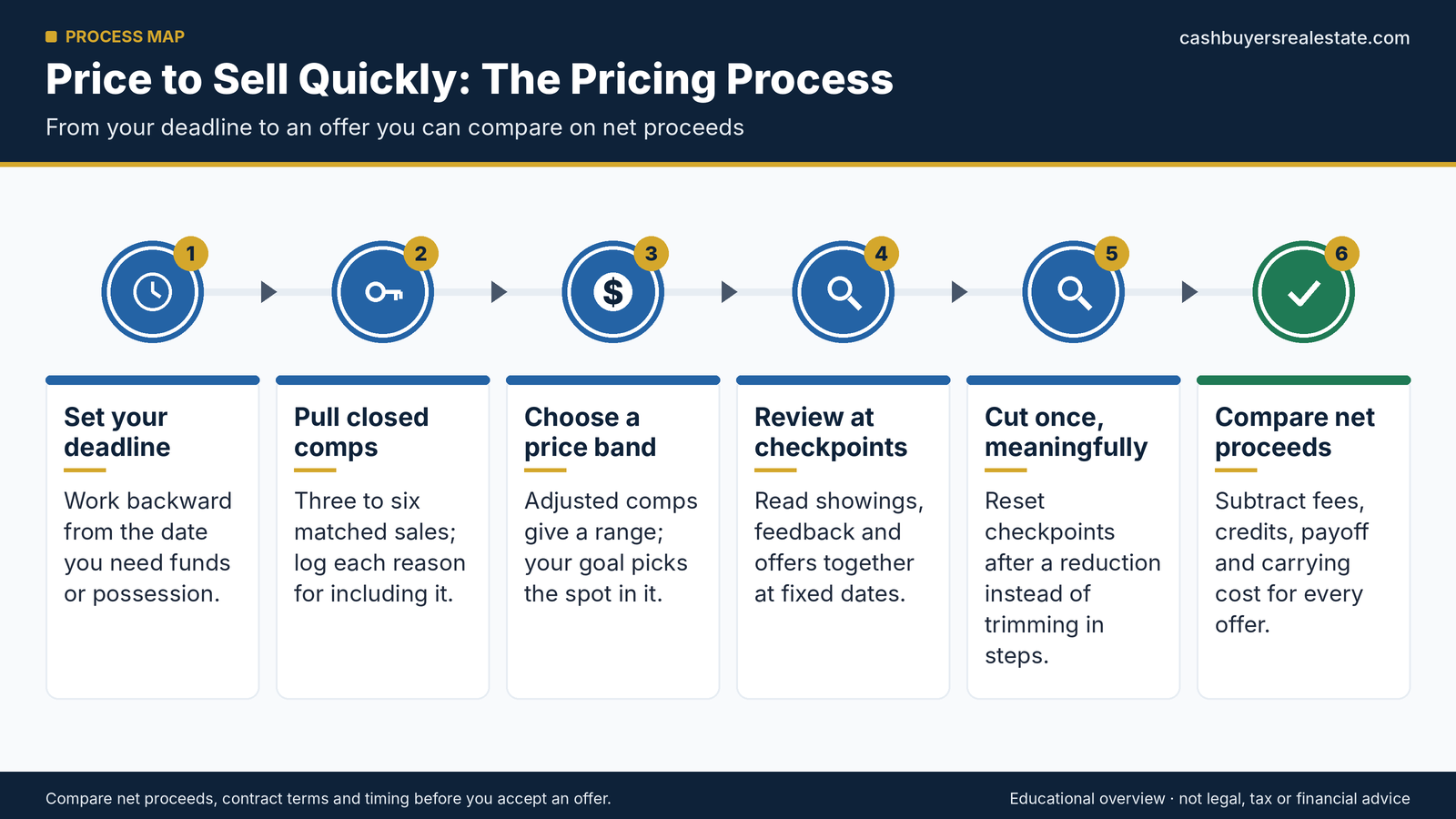
Text version of this infographic
- Set your deadline — Work backward from the date you need funds or possession.
- Pull closed comps — Three to six matched sales; log each reason for including it.
- Choose a price band — Adjusted comps give a range; your goal picks the spot in it.
- Review at checkpoints — Read showings, feedback and offers together at fixed dates.
- Cut once, meaningfully — Reset checkpoints after a reduction instead of trimming in steps.
- Compare net proceeds — Subtract fees, credits, payoff and carrying cost for every offer.
Reading the First Two Weeks: Showing, Inquiry and Offer Signals
Once the listing is live, the market starts giving you feedback, and most of it arrives in the first ten to fourteen days. The skill is reading that feedback calmly and acting on a pattern, not on a single bad Saturday. Sellers who set decision rules in advance tend to avoid the two classic errors: cutting too early out of anxiety, or waiting too long out of hope.
What Early Market Feedback Actually Tells You
Four signals worth tracking, and how to read them together
Track four things from day one: how many people view the listing online, how many show serious interest by saving it or asking questions, how many tour it in person, and what comes back in writing. Your agent or listing platform can usually report the first two, and showing activity is counted directly. No single number settles anything. The combination is what tells a story, so write the figures down at a fixed interval, such as every Monday morning.
Views without showings usually mean the photos and headline price attract clicks, but something in the details turns people away: a location problem, a price that looks high against the square footage, or a listing description that undersells the house. Showings without offers point to a different issue: the people who walked through didn’t think the home was worth the asking price once they saw its condition. Low offers, finally, are information in themselves, because a buyer who writes an offer has done the math and told you what they think the house is worth.
| What you see | Likely reading | First response | Cut price? |
|---|---|---|---|
| Few online views | Visibility problem: price bracket, weak photos, or inaccurate listing data | Audit photos, headline, and search-bracket position | Maybe, if the price sits just above a bracket |
| Many views, few showings | Price or one visible drawback is screening buyers out | Compare against active competitors; check showing access | Maybe |
| Steady showings, no offers | Buyers like the home but not at this price | Collect written feedback and look for repeated comments | Likely, if comments agree |
| Low offers only | Market value may sit below your ask | Counter once with a documented comps case | Consider it, after countering |
| Offer at or near asking within days | Price is working | Compare terms, not only price | No |
Use the table as a starting hypothesis rather than a diagnosis. A snowstorm, a holiday weekend, or a competing open house can distort a week’s numbers, so look for the pattern across two checkpoints before drawing a conclusion.
Setting review checkpoints before you list
The most useful habit is deciding your response rules before the listing goes live, while your head is clear. A simple structure is a first checkpoint around day seven and a second around day fourteen, with specific triggers tied to each. At day seven you look mainly at access and presentation: has every interested buyer been able to see the home, and are the photos and description doing their job? At day fourteen you look mainly at price.
Write the triggers down. For example: “If showings fall short of the number we agreed on by day seven, fix access and presentation first. If there are no written offers by day fourteen and at least two pieces of feedback mention price, cut to the lower end of the comps band.” The exact numbers should come from what your agent has seen for similar homes in your area, not from a national rule of thumb, because showing counts vary wildly by price tier and neighborhood.
Pre-commitment helps for another reason. Watching a listing is emotionally loaded, and it’s easy to rationalize “just one more weekend.” A rule you set in advance works like a guardrail. It also helps if you’re working with an agent: you can share the rules and ask them to hold you to them, which keeps the conversation about the data instead of about opinions.
Cutting the Price Without Losing Ground
How much and how soon: practical rules for a reduction
When the data says the price needs to move, the next question is how far. Small trims of a few hundred or a thousand dollars rarely change the audience, because they don’t move the listing into a different search bracket or past the nearest competing home. They do, however, create a record of price drops that buyers can see, and a sequence of tiny cuts can read as hesitation. A single, meaningful reduction usually tells a cleaner story.
- Cut once, then reset the clock. After a reduction, restart your checkpoints at day seven so the new price gets a fair test.
- Cut to a destination, not by a percentage. Aim for a price that crosses a search bracket or lands at the low end of your adjusted comps band.
- Check the deadline math. If the days left on your calendar are fewer than the contract-to-close stage plus a buffer, price alone can’t rescue the timeline and you should consider a different route.
- Document why. Note the feedback and comps that justified the cut so you don’t second-guess it later.
Consider an example. A home lists at $399,000 and gets steady showings but no offers by day fourteen. Feedback twice mentions that a recently renovated house a few blocks away is listed at $389,900. A cut to $389,900 puts the home at parity with that competitor and under the $390,000 search threshold some buyers use. A cut to $397,500 would change almost nothing about who sees it.
What to try besides a cut: access, presentation, terms, and relisting cautions
Price isn’t the only variable you can adjust. Sometimes the right move is to widen access: more showing windows, a lockbox, flexible hours for working buyers. Sometimes it’s presentation: professional photos, decluttering, fresh paint in one or two rooms, or addressing a smell or visible defect that appears in every set of feedback. These cost far less than a $10,000 reduction and can change how a buyer reads the same price.
Terms can also stand in for dollars. Offering a modest credit toward the buyer’s closing costs, agreeing to a flexible closing date, or shortening a contingency period may attract serious buyers without reducing the headline number. Be careful, though, because concessions for financed buyers are capped by the loan program, a topic covered further below. Whether buyer-side agent compensation is part of the offer is another negotiated term, and a later section explains how the rules around communicating it changed in 2024.
One last caution concerns relisting. Some sellers cancel and relist to make the days-on-market counter reset. Rules about how listing services treat relisting vary by area, and buyers’ agents can often see the earlier history regardless, so this trick doesn’t reliably help. If a reset is the only thing you’re hoping for, the underlying issue is usually still the price or the presentation.
Comparing Offers on Net Proceeds, Not Headline Price
The number at the top of an offer is the least reliable piece of information in the packet. Two offers can differ by $20,000 in price and end up within a few thousand dollars of each other once concessions, repairs, fees, and time are counted. A net sheet turns every offer into the same units so you can compare them fairly.
Building a Net Sheet for Every Offer
The line items that separate headline price from cash at closing
Start with the contract price and subtract everything you’d be responsible for at closing. The categories are fairly standard even though the amounts vary: your mortgage and any lien payoffs, seller-paid fees for the agent and brokerage, seller-side title, escrow, or attorney charges, transfer or recording taxes where your state or locality imposes them, prorated property taxes and HOA charges, and any credits you’ve agreed to give the buyer. A payoff letter from your lender gives you the exact amount owed through a specific date.
Agent compensation deserves its own note because the rules around it changed. Under practice changes the National Association of REALTORS® announced for August 17, 2024, offers of compensation to buyer’s agents can no longer be published on the MLS, though NAR’s own FAQ says sellers can still choose to offer compensation off the MLS, with the arrangement disclosed in writing, and sellers can still offer concessions such as help with closing costs on the MLS. The same changes require agents to state that commissions are negotiable. In practical terms, ask your listing agent how buyer-side compensation will be handled in your listing agreement and in each offer, and get the answer in writing.
Add the buyer’s requests. Repair credits, a home warranty, closing cost help, and rate-buydown credits each reduce what you net. Then list the timing items: the closing date, any rent-back or possession terms, and the days it’ll take. For a state-specific view of fees, the guide to closing costs when selling a house and the page on net proceeds calculation explain where the line items come from.
A worked comparison of three offers
The example below uses one hypothetical seller with a $240,000 mortgage payoff who values each day of delay at $95 in carrying costs (mortgage interest, taxes, insurance, and utilities). Offer A is a financed sale priced above the appraisal comps in the earlier grid. Offer B is a lower, all-cash offer with no contingencies. Offer C is a financed offer with a repair credit and a larger concession.
| Line item | Offer A: financed | Offer B: cash | Offer C: financed |
|---|---|---|---|
| Contract price | $415,000 | $392,000 | $408,000 |
| Agent and brokerage fees (5%) | −$20,750 | −$19,600 | −$20,400 |
| Other closing costs (1.5%) | −$6,225 | −$5,880 | −$6,120 |
| Seller concession | −$8,000 | $0 | −$12,000 |
| Repair credit | $0 | $0 | −$3,500 |
| Net before payoff | $380,025 | $366,520 | $365,980 |
| Days to close | 45 | 14 | 38 |
| Carrying cost at $95/day | −$4,275 | −$1,330 | −$3,610 |
| Net after carrying cost | $375,750 | $365,190 | $362,370 |
| Cash after $240,000 payoff | $135,750 | $125,190 | $122,370 |
Offer C, which looked second-best on price, nets the least, because its concession and credit eat $15,500. Offer A leads on paper by about $10,560 over B, but it closes 31 days later. Whether that gap is worth the wait depends on your deadline, which is the subject of the next subsection.
Adjusting for Time and Risk
Putting a price on each extra day
Carrying costs are the visible price of time, and they’re easy to calculate. Add your monthly mortgage interest (not the full payment, since principal builds equity), property taxes, insurance, utilities, HOA dues, and lawn or snow service, then divide by thirty. The $95 a day in the example is a placeholder; yours might be higher if you’re paying for a vacant second home or lower if costs are shared. The calculation matters because it turns an abstract wait into a figure you can compare.
The less visible price of time is personal. If you’re closing on a new home, a delay might put a deposit at risk or force you into a short-term rental. If you’re relocating for work, it might mean paying for two households. If you’re settling an estate, it might mean another month of insurance on an empty property. None of these are in the net sheet, so add them by hand. In the example, Offer A pays about $340 more per extra day of waiting than Offer B does ($10,560 divided by 31 days). If your real daily cost of waiting is above that, B is the better economic choice even though it pays less. If it’s below, A wins.
There’s also the question of how much a deadline weighs. A hard date, such as a purchase contract on a new home with a fixed closing, can make an offer unusable no matter how generous it is. A soft preference can be traded. Distinguishing the two is the focus of the guide on deadline triage when you need to sell fast.
Fall-through risk, backup offers, and a simple expected-value check
An accepted offer isn’t a sale. Financing can fall apart, an appraisal can come in low, an inspection can lead to a renegotiation, and a buyer can simply walk when contingencies allow it. A higher price with more moving parts carries more of that risk, and the cost of a failure isn’t just the lost price: it’s the days you spent under contract plus the time to find the next buyer, plus the stigma some buyers attach to a listing that returns to the market.
You can approximate this with expected value. Suppose Offer A has a 35 percent chance of failing because its price sits above your comps band, which raises appraisal risk. If it fails, you lose roughly 75 days (45 under contract plus 30 to find another buyer), or about $7,125 in carrying costs, and you might have to soften your price by another $6,000. That’s an expected cost of about $4,600. Offer B, with no lender, might carry a 3 percent failure chance and an expected cost of about $300. After risk, A still leads in this example, by roughly $6,300, but the margin shrinks and the deadline problem remains.
Backup offers are the standard way to cut that risk. A backup is a signed agreement that takes effect if the first contract ends, and many sellers accept one during the primary buyer’s contingency period. Check your state’s rules and your contract language, since a backup offer must be drafted so it doesn’t conflict with the primary one. Tell the primary buyer only what the contract requires, and ask your agent or attorney how backups are normally handled locally.
The chart below compares five routes a seller might take when speed matters, set against the pricing logic in this section. Each route’s headline facts are in the text: a retail listing priced to move, a higher financed offer, a cash offer from an investor or individual, an instant online offer, and a backup-offer stack. The right pick depends on your deadline, your net sheet, and how much risk you can absorb.
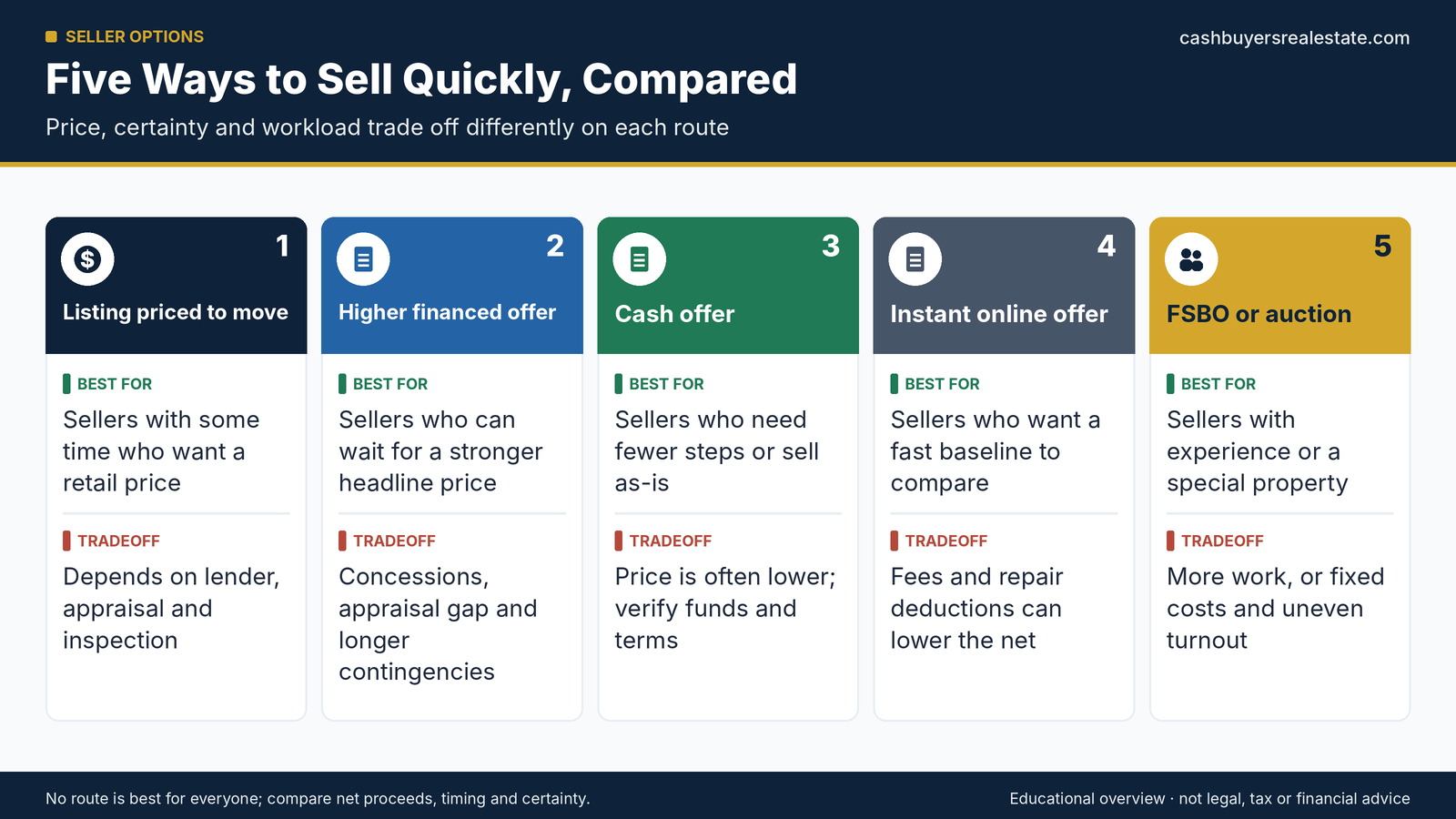
Text version of this infographic
- Listing priced to move — best for: Sellers with some time who want a retail price; tradeoff: Depends on lender, appraisal and inspection
- Higher financed offer — best for: Sellers who can wait for a stronger headline price; tradeoff: Concessions, appraisal gap and longer contingencies
- Cash offer — best for: Sellers who need fewer steps or sell as-is; tradeoff: Price is often lower; verify funds and terms
- Instant online offer — best for: Sellers who want a fast baseline to compare; tradeoff: Fees and repair deductions can lower the net
- FSBO or auction — best for: Sellers with experience or a special property; tradeoff: More work, or fixed costs and uneven turnout
Contingencies, Earnest Money and Closing Dates: What Each Term Does to Your Timeline
Once an offer clears the price test, the terms decide whether it closes in three weeks, six weeks, or not at all. Sellers who read only the first page of an offer often miss the clauses that carry the real timeline. This section walks through those clauses one at a time and shows which ones you can negotiate.
Contingency by Contingency: Where Time Is Won or Lost
Financing and appraisal contingencies, and a quick-reference matrix
A contingency is a condition that has to be satisfied, or waived, before the buyer is bound to close. The financing contingency says the buyer can exit, or renegotiate, if the loan isn’t approved in time. The appraisal contingency says the same about the appraised value. Both belong to financed buyers, and both put a clock on your sale that you can’t directly control. What you can control is how long those clocks are allowed to run, and what evidence you ask for up front.
Ask for a lender’s preapproval letter and check the lender’s name and contact information, not just the buyer’s say-so. A preapproval based on documents the lender has reviewed carries more weight than a casual prequalification built from numbers the buyer typed into a form. Then look at the dates in the offer: the number of days for the buyer to remove the financing contingency, the number of days to complete the appraisal, and the closing date. Shorter, firmer dates generally move the sale faster, though a buyer who needs a longer period may still be a good buyer if they’re well qualified.
| Contingency | What it protects | Typical effect on speed | What a seller can negotiate |
|---|---|---|---|
| Financing | Buyer’s right to exit if the loan fails | Adds weeks; risk of fall-through | Shorter deadline; lender letter; larger deposit |
| Appraisal | Buyer’s right to renegotiate or exit if value is low | Adds scheduling time; gap risk | Gap-coverage language; shorter window |
| Inspection | Buyer’s right to repairs, credit, or exit | Adds days and a negotiation round | Shorter period; pre-listing inspection; as-is wording |
| Sale of buyer’s home | Buyer needs their sale to close first | Can add weeks or months | Kick-out clause; keep showing the home |
| HOA or condo documents | Buyer’s review of rules and finances | Depends on how fast the association responds | Order documents early; set a firm review window |
| Title and survey | Clear ownership and boundaries | Usually runs in parallel; delays if defects appear | Open title early; resolve liens and payoffs |
Read the matrix from the right-hand column: the best use of your time is the “what a seller can negotiate” side, because that’s where you get days back without touching the price.
Inspection, home-sale, and other contingencies in practice
The inspection contingency typically gives a buyer a set period, often measured in days, to inspect the property and ask for repairs, credits, or a price change, or to cancel. Time lost here is mostly about negotiation. A buyer who finds a surprise on day seven then has to get quotes, and you have to decide what to give. Sellers can shorten the cycle by sharing a recent inspection report in advance, fixing obvious items, or offering a flat credit up front. You’ll still need to follow your state’s disclosure rules, which require you to tell buyers about known material defects regardless of any inspection.
A home-sale contingency is the riskiest for a seller on a deadline, because your timeline now depends on a stranger’s listing. If you accept one, ask for a kick-out clause: it lets you keep marketing the home and requires the first buyer to remove the contingency or step aside within a short window, such as 48 to 72 hours, if a better offer arrives. Some sellers decline these offers outright when their dates are tight, and that’s a legitimate choice.
Other contingencies worth reading carefully include HOA or condo document review, which depends on how fast an association responds, and attorney review in states where it is customary. Title and survey conditions usually run alongside the others, though a lien or an unclear boundary can stall everything. If you suspect title trouble, open a title search early, and read the guide on selling quickly with liens. Also look for waivers: buyers who offer to waive contingencies may close faster, but waiving the appraisal or inspection contingency shifts risk to them and is a decision for their advisers, not something you should pressure them into.
Earnest Money, Deadlines and Closing-Date Flexibility
What the earnest money deposit signals, and who holds it
Earnest money is a deposit the buyer puts up after the contract is signed to show good faith. It’s typically held by a neutral party, which may be a title or escrow company, an attorney, or a brokerage, depending on local practice. It’s usually credited toward the buyer’s closing costs or down payment at closing. What the deposit does for you is mostly psychological and contractual: a buyer who has funds at risk has a reason to follow through.
How much to expect depends heavily on the market and the contract, so don’t rely on a rule of thumb. A larger deposit signals stronger commitment, but the more important question is when it becomes non-refundable. If the buyer can recover the deposit under any contingency, the amount matters less than how long each contingency remains open. Your state’s law and the contract’s terms decide what happens to the deposit if the buyer defaults, and some contracts set a fixed amount as agreed damages. Ask your attorney or closing professional how that works locally before you sign.
Check the practical details too. Confirm the deadline for depositing the funds, and ask the holder to confirm receipt in writing. A missed deposit deadline is an early sign of trouble. Be cautious about any request to send earnest money by wire to an account you haven’t verified by phone; wire-fraud safeguards apply on the seller’s side too, and a later section covers them.
Using the closing date and possession terms as currency
Dates are one of the few terms that cost you little and matter a lot to the right buyer. A buyer who is relocating may pay a premium for a closing that matches a start date. A buyer coming out of a lease may value a particular day. If your own purchase closes three weeks after your sale, a longer closing can be valuable to you, and a post-closing occupancy agreement, often called a rent-back, lets you stay for an agreed period after funding.
Illustrative example (hypothetical numbers, not market data): Two financed offers are within $1,500 of each other. Buyer 1 offers a 30-day closing. Buyer 2 offers 35 days but also agrees to a 10-day rent-back at a daily rate the seller proposes, which lets the seller finish moving after funds arrive. If the seller’s purchase closes on day 42, Buyer 2’s package may be worth more than its slightly lower price, because it avoids paying for temporary housing. The seller needs to confirm that the buyer’s lender allows the post-closing occupancy and to settle who is responsible for insurance, utilities, and damage during the rent-back.
The flip side is an earlier closing. If you need cash by a specific date, you may ask whether a buyer can close sooner, but only a buyer with the right financing can promise that, and the federal three-business-day Closing Disclosure rule sets a floor for borrowers. A cash buyer without a lender isn’t subject to that waiting period, though title work, payoff letters, and state closing customs still have to happen. For the timing realities of very short closings, see the guide on selling a house in 14 days.
Appraisal Gaps, Concessions and the Low Offer
The hardest part of a quick sale often arrives after the contract is signed: the appraisal comes in under the price, the buyer asks for a credit, or a lower-than-expected offer lands on day three. These moments are manageable if you’ve already worked out your numbers. This section gives you a plan for each.
Handling an Appraisal Gap
How a gap appears and what the lender will fund
When a buyer uses a mortgage, the lender orders an appraisal, which the Consumer Financial Protection Bureau describes as a professional opinion of the home’s value. Lenders generally base the loan on the lower of the contract price and the appraised value. If the home appraises below the price, the loan amount shrinks, and the buyer has to cover the difference in cash, ask you to reduce the price, or walk away if the contract allows. The CFPB notes that buyers who face a low appraisal can renegotiate with the seller or cancel, and it calls paying more than the appraised value very risky.
Illustrative example (hypothetical numbers, not market data): A buyer agrees to pay $415,000 with 20 percent down, which implies an $83,000 down payment and a $332,000 loan. The appraisal comes in at $398,000. If the loan stays at 80 percent of the appraised value, it falls to $318,400. To close at the full price, the buyer would need $96,600 in cash, which is $13,600 more than planned. The $17,000 value gap turns into a $13,600 cash problem for this buyer, and the buyer will ask whether you’ll bridge some of it.
Two points are worth keeping in mind. First, appraisers rely on closed comparable sales, as the earlier section described, so a price set well above your adjusted comps cluster is the likeliest cause of a gap. Second, a cash buyer has no lender and therefore no lender-ordered appraisal, though some cash buyers get their own valuation. The absence of an appraisal is one reason cash offers feel more certain, and it’s covered further in the guide on cash sale versus listing for a fast sale.
Your options when the appraisal comes in low
You usually have more than two choices. The right one depends on how big the gap is, how motivated the buyer is, and how much time you have left. Start by getting a copy of the appraisal report and checking its comparable sales. Appraisers can miss recent sales or misjudge condition, and if you have solid evidence, the buyer can ask the lender to reconsider the value. Reconsideration processes are controlled by the lender and aren’t guaranteed to change the number, so treat them as one path among several.
| Option | How it works | Effect on your net | Effect on timeline |
|---|---|---|---|
| Lower the price to the appraised value | Contract price drops to match the appraisal | Largest reduction; clean path | Fastest if the buyer agrees |
| Split the difference | You and the buyer each cover part of the gap | Moderate | Usually quick after one round |
| Buyer pays the gap in cash | Buyer adds funds beyond the planned down payment | None, if the buyer can afford it | Quick if the buyer has cash reserves |
| Challenge the value | Buyer submits better comps to the lender | Possible upside | Adds days; may fail |
| Cancel and relist, or call a backup | Contract ends under the appraisal contingency | Depends on the next buyer | Costs weeks; backup offer helps |
The cleanest solution is usually avoiding the gap in the first place. If you set your price using the comps method earlier in this guide and accepted a few thousand dollars of cushion at most, the appraisal is likelier to hold. If you did aim above the band and the buyer wants to stay in, consider including gap-coverage language in the contract so the buyer’s commitment is explicit before the appraisal arrives.
Concession Requests and Low Offers
Seller concessions: limits, effects, and how to respond
A seller concession is a credit or payment toward the buyer’s costs. It lets a buyer with limited cash close without lowering the contract price. For financed buyers, loan programs cap how much interested parties like sellers can contribute. Fannie Mae’s Selling Guide, in a topic dated May 7, 2025, sets limits that depend on occupancy and loan-to-value ratio: 3 percent of the lower of price or appraised value when the ratio is above 90 percent, 6 percent between 75.01 and 90 percent, and 9 percent at 75 percent or below, with 2 percent for investment properties. FHA and VA have their own rules, so the buyer’s lender has the final word.
Concessions and price reductions can feel interchangeable, but they aren’t. A $10,000 price cut also reduces any percentage-based fees you owe, such as agent compensation and some transfer taxes, so you’d typically net slightly more from a $10,000 credit than from a $10,000 price cut. But a credit doesn’t help the appraisal gap, and it may be limited by the buyer’s loan. Ask your agent to run both versions on the net sheet before you answer.
Concessions also interact with the 2024 changes to agent compensation. HUD’s FHA notice of March 28, 2024 said that, when sellers keep paying buyer-side agent fees because of state or local law or custom and the amounts are reasonable, FHA policy would not treat those payments as interested party contributions, provided other requirements are met. The notice is brief, and a lender can explain how it applies to a specific loan. Your job is to ask that the buyer’s lender confirm the concession is permitted before you agree to it.
Responding to low offers and multiple offers
A low offer is not an insult; it’s a starting point from a buyer who has run their own numbers. Before you decide, compare it against your net sheet and your deadline. If the price is close, a counteroffer that holds your number but sweetens terms, such as a flexible closing date, may land the deal. If it’s far below your walk-away number, respond politely with a documented comps case, or let it sit. Don’t ignore it entirely, because buyers who don’t hear back often move on.
When several offers arrive, resist the pull to treat the highest price as the winner. Ask each buyer to submit their strongest terms by a stated deadline, commonly called “highest and best,” and compare them on net sheets with the same assumptions. Escalation clauses, which raise a buyer’s price automatically above competing offers up to a cap, can look attractive but depend on documentation of the competing bid, and a high escalated price still faces the appraisal. Check how the clause is written and whether it requires proof.
Finally, keep your options open. Accept the best offer as primary and a runner-up as a backup if your contract allows. The backup protects you if financing fails, and it costs nothing if the first sale closes. Document each offer’s terms and the date you responded, and keep the correspondence. If a dispute arises later, a clean paper trail is your best protection, and the relevant attorney can explain how your state treats offers and counteroffers.
When Pricing Alone Isn’t Fast Enough: Other Routes and Common Mistakes
Pricing and offer management can shorten a retail sale, but they can’t remove stages that depend on a lender or a state’s closing rules. If your deadline is tighter than a financed sale can meet, the honest answer may be a different route. Knowing the tradeoffs lets you choose on purpose instead of by default.
A Pricing-Led Listing Compared With Other Routes
How a retail listing stacks up against cash, investor, and instant offers
Think of the choice as a trade of price against certainty and time. A well-priced retail listing typically reaches the widest pool of buyers and therefore the best chance at a full-market price, but it depends on financed buyers, appraisals, and inspections. A cash offer from an individual or investor can remove the lender and the appraisal, which shortens the calendar and reduces fall-through risk, and it often comes at a lower price because the buyer is taking on the property’s condition and resale risk. Instant online offers sit in between: they promise speed, but the sellers’ net depends on the fees and repair adjustments the buyer deducts.
| Route | Price relative to a full retail sale | Timeline drivers | Main seller cost | Main risk |
|---|---|---|---|---|
| Listing priced to move | Closest to full retail value | Showings, lender, appraisal, inspection | Agent fees, closing costs, carrying costs | Fall-through; price misjudged |
| Higher financed offer | Often highest headline price | Same as above, plus longer contingencies | Concessions and repair credits | Appraisal gap; delay |
| Cash offer from a buyer without a lender | Frequently lower; varies widely | Due diligence, title work | Discount, plus fees that vary by buyer | Buyer verification; re-pricing |
| Instant online offer | Varies; deductions can change it | Verification, inspection | Service fees and repair deductions | Net lower than expected |
| For sale by owner (FSBO) | Potentially full price, with more work | Your marketing and contract skill | Buyer-agent costs, legal help | Pricing and paperwork errors |
This table is a map, not a prediction. The relative size of the price gap between routes changes by market, property, and buyer, which is why the net sheet comes first. The guide on how cash offers are calculated explains the buyer-side arithmetic, and the comparison page on cash buyer versus realtor sets the two routes side by side.
For instant online offers in particular, the Federal Trade Commission has warned sellers not to assume the figure reflects market value. In an August 2022 consumer alert about a settlement with a large home-buying company, the FTC advised comparing an instant offer with recent sales of similar homes, asking for the full breakdown of fees and repair deductions, and comparing net proceeds with what a traditional sale might net after its costs. That’s the same net-sheet discipline you’ve been building in this guide.
FSBO, auctions, and other special routes
Selling by owner removes the listing-side agent fee, so on a net sheet it looks attractive. The costs reappear elsewhere: you handle pricing, photos, showings, negotiations, and contract details yourself, and you still need to decide how to treat buyer-agent compensation, since many buyers work with agents. If you’re experienced with contracts and your market is strong, FSBO can work. If your deadline is short, the solo workload and the risk of a pricing or paperwork mistake can cost more time than they save. The guide on selling fast without a realtor goes into the mechanics.
Auctions are a special case. A seller sets terms and often a minimum price, and a sale can conclude on a fixed date, which gives the calendar a hard stop. But auctions aren’t suited to every property or market, they carry marketing and auctioneer costs, and bidder turnout can be unpredictable. Verify how the auction firm handles reserves, buyer’s premiums, and contract terms, and ask what the closing timeline looks like after the hammer falls.
If none of those fit, the broader landscape of tradeoffs, including some options that aren’t sales at all, is laid out in the guide to urgent home sale options. A good rule is to pick the route that fits your hardest constraint first, then optimize price within it.
Mistakes to Avoid and Offers to Verify
Common pricing and offer-comparison mistakes
Most pricing errors are variations on a few themes. The first is anchoring on an automated online estimate. These tools use public records and recent sales, but they can miss condition, upgrades, and local nuance, and the error range can be large, particularly for unusual homes. The second is pricing from a neighbor’s asking price. Asking prices are hopes, not outcomes, and a neighbor’s unsold listing is evidence of competition rather than value.
A third mistake is pricing by cost: assuming that because you spent $30,000 on a kitchen, the home is worth $30,000 more. Buyers pay for what they value, and renovation recoups vary. A fourth is ignoring the condition tier, comparing your dated house against updated ones and wondering why it won’t hit their numbers. A fifth is cutting in small steps, which spreads the signal across many weeks and trains buyers to wait for the next drop.
On the offer side, the common errors are comparing headline prices instead of nets, overlooking contingency length, and forgetting that agent compensation and concessions are negotiated terms. Another is signing an extension without asking what the buyer is giving in return. A final one is hurrying a decision because someone said there’s a deadline. Honest buyers can give you time to review a contract, and pressure to sign without comparison is a signal to slow down.
Verifying the buyer and protecting your funds
Whichever route you choose, verify before you commit. For financed buyers, a lender letter you can confirm independently is the baseline. For cash buyers, ask for proof of funds, such as a recent bank or brokerage statement or a letter from the financial institution, and confirm it matches the buyer named in the contract. A document alone doesn’t prove the funds are available, so verify it with the institution when you can, and read the page on proof of funds for what to look for. Confirm that earnest money has actually been deposited with a neutral holder.
Read the contract completely, including any assignment clause, inspection rights, and cancellation terms. Watch for last-minute price changes that aren’t tied to a documented finding, and for requests to move closing to a different company you haven’t researched. None of these proves bad faith on its own, but each deserves a direct question and a written answer.
The Federal Trade Commission’s general advice also applies: honest businesses give you time to decide, while pressure to act immediately, or to pay in unusual ways, is a common feature of scams. For a fuller checklist of how to vet a buyer, see the hub on cash home buyer scams and verification.
The checklist below condenses the verification and pricing points above into six checks to run before you accept any offer: how well the price matches your comps, the buyer’s financing or funds, the contract’s contingencies, the mortgage payoff and title status, closing readiness, and your own deadline. The key facts are repeated in the surrounding text, so the graphic works as a quick reference, not the only place they appear.
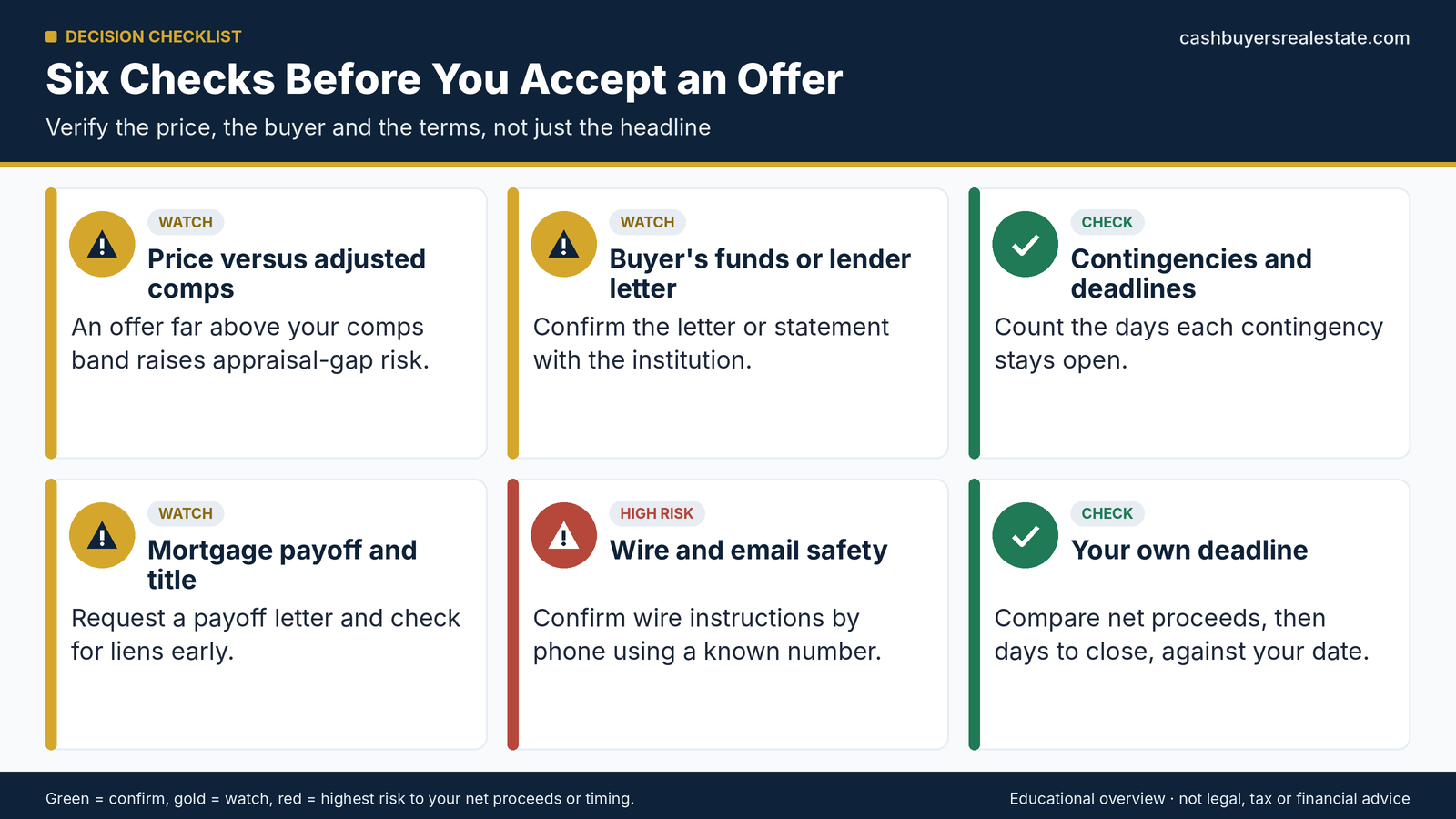
Text version of this infographic
- Price versus adjusted comps — An offer far above your comps band raises appraisal-gap risk.
- Buyer's funds or lender letter — Confirm the letter or statement with the institution.
- Contingencies and deadlines — Count the days each contingency stays open.
- Mortgage payoff and title — Request a payoff letter and check for liens early.
- Wire and email safety — Confirm wire instructions by phone using a known number.
- Your own deadline — Compare net proceeds, then days to close, against your date.
Frequently Asked Questions About Pricing and Comparing Offers
Pricing and Timing Questions
Questions about setting the price
- How many comparable sales do I need to price my house?
Appraisers working under Fannie Mae’s rules must use at least three closed comparable sales, so that’s a sensible minimum for your own work. Three to six well-matched sales are usually enough. More isn’t better if the extra sales are from different neighborhoods, sizes, or conditions, since every mismatch adds an adjustment you have to justify.
- Can I rely on an online home-value estimate?
Treat it as a rough starting point. Automated estimates use public records and recent sales and often miss renovations, condition, and local features. Check it against actual closed sales for similar homes, and ask an agent to explain any large difference.
- Should I price just under a round number?
It can help if buyers in your market search by price brackets, because a listing just under a common cutoff shows up in more searches. It isn’t magic, though. If the number you’d choose is far above your adjusted comps, a clever ending won’t fix it. Choose the band first, then look at where the brackets fall.
- Is it smart to list high and leave room to negotiate?
Sometimes, but the risk is real: a high price can reduce showings early, when attention is greatest, and you may end up cutting later from a weaker position. If speed matters, a price at or slightly below your band with a review plan is usually less risky than a high start.
Questions about timing and price reductions
- How long should I wait before reducing the price?
There’s no universal number. Many sellers set checkpoints around the end of the first and second weeks and tie the decision to showings and feedback. If you have a hard deadline, work backward from it so a reduction still leaves time for a contract to close.
- Will a price cut make buyers think something is wrong?
A single, well-supported reduction usually reads as a seller responding to the market. A series of small cuts is likelier to suggest that the home is overpriced or has an issue. If you’re going to cut, make it meaningful and explain it with comps.
- Is a seller credit better than lowering the price?
It depends on what the buyer needs. A credit can help a buyer with limited cash, but it’s capped by their loan program and doesn’t solve an appraisal gap. A price cut helps the appraisal but lowers your sale price for fees calculated on it. Run both on the net sheet.
- Does canceling and relisting reset my days on market?
Practices vary by area and by listing service, and buyers’ agents can often see the history anyway. Don’t count on a reset as a strategy. If the listing needs a fresh start, the better fix is to change the price, the photos, or the terms.
Offer and Contract Questions
Questions about contingencies and appraisals
- Which contingency slows a sale the most?
It varies, but a home-sale contingency is the hardest for a seller because it ties your timeline to another transaction. Financing and appraisal contingencies matter most with lender-dependent buyers. Inspection contingencies are usually short but can reopen price negotiations.
- What happens if my house appraises for less than the contract price?
The lender will generally lend on the lower value, so the buyer must cover the gap, renegotiate, or cancel if the contract allows. You can lower the price, split the gap, or ask the buyer to challenge the value with better comps. The Consumer Financial Protection Bureau lists renegotiating or canceling among a buyer’s options.
- Can I accept a backup offer while I’m under contract?
Often yes, if the primary contract and your state’s rules allow it and the backup is written so it only takes effect if the first contract ends. Ask your agent or attorney to draft it carefully so it doesn’t create conflicting obligations.
- Does “as-is” mean the buyer can’t inspect or negotiate?
No. As-is generally means you won’t make repairs, but buyers can usually still inspect and decide whether to proceed, depending on the contract. Disclosure rules also still apply in most states, so you can’t conceal known material defects.
Questions about cash offers, concessions, and fees
- Are cash offers always lower than financed offers?
Not always, and often they are, depending on the buyer and the property’s condition. The only reliable comparison is net proceeds after fees, credits, and time. Some cash buyers are individuals paying close to market, while others price in repairs and resale risk.
- Who pays the buyer’s agent now?
It’s negotiated. NAR’s practice changes effective August 17, 2024 ended offers of compensation on the MLS, but sellers may still offer buyer-agent compensation outside it, and commissions are negotiable. Ask your listing agent to explain your agreement and the buyer’s agreement in writing.
- How do I estimate what I’ll actually net?
Start with the contract price, subtract your payoff, agent fees, closing costs, concessions, and credits, then add or subtract prorations. A net proceeds calculator or a title company’s estimate gives you a closer figure, and your payoff letter fills in the exact amount owed.
- Do I get the earnest money if the buyer backs out?
It depends on the contract, the contingencies in effect when the buyer cancels, and state law. If the buyer cancels within a contingency period, the deposit is often returned. If the buyer defaults without a contingency, the contract’s remedy clause usually decides. Ask a local attorney before you assume either outcome.
Choosing Your Route and Taking the Next Step
By this point you have a method for pricing, a net sheet for comparing offers, and a clear view of how each contract term moves the calendar. What’s left is deciding. The right choice depends on which constraint is hardest for you, so start there and let the numbers confirm it.
Match the Route to Your Priority
A priority-by-priority decision framework
Most sellers have one dominant priority, even if they list several. Naming it keeps you from chasing the highest price when you need certainty, or from accepting a steep discount when you have time. The table below pairs common priorities with the routes that tend to fit, along with the main watch-out for each.
| Main priority | Route that often fits | Why | Watch-out |
|---|---|---|---|
| Highest net proceeds, with some time | Retail listing priced to the comps band | Widest buyer pool; competition can lift price | Fall-through and carrying costs |
| A firm closing date | Cash or well-documented financed offer with short contingencies | Fewer steps that can slip | Verify funds and title early |
| Minimal repairs and showings | As-is sale to a buyer who accepts condition | Less preparation and disruption | Discount for condition; compare nets |
| Lowest upfront cost | FSBO or negotiated lower fees | Avoids some listing-side costs | More work; pricing and contract risk |
| Flexibility on possession | Offer with rent-back or flexible closing | Aligns your move with your purchase | Insurance and damage terms |
If two priorities collide, such as the highest price and the firmest date, pick the one with real consequences if it fails. A missed closing date on a new home can have a cost the sale price can’t offset, while a few thousand dollars of net is usually a smaller loss than a broken contract.
Three scenarios, worked through
Illustrative example (hypothetical numbers, not market data): A relocating seller has a job start in 50 days and a lease on a new home beginning on day 45. A financed sale needs about 40 days from contract to close, which leaves five or six days to find a buyer. The seller prices at the low end of the comps band, plans a day-seven checkpoint, and asks a cash buyer for a conditional offer as a fallback. The routes are weighed against the date, not the price, and a cash fallback is arranged before the first showing.
Illustrative example (hypothetical numbers, not market data): An heir inherits a home that needs cleanout and repairs and wants to close within a few months. The comps for updated homes in the area are well above the property’s likely price. The heir compares three paths on net sheets: a modest cleanup and a retail listing, a listing as-is, and an offer from a buyer who takes it in its current condition. Because the cleanup would cost time and effort the heir doesn’t want to spend, the as-is routes win on speed, and the net sheets show how much the condition discount costs. Probate and ownership rules vary by state, so the heir confirms authority to sell first; see the guide on selling quickly in probate.
Illustrative example (hypothetical numbers, not market data): A seller with a well-kept home and no firm date wants the best price but also wants to be done by summer. The seller prices at the top of the comps band, sets checkpoints at days seven and fourteen, and plans a single meaningful cut if the data supports it. Since time is available, a backup offer is welcome but not essential.
In each case the plan comes from the constraint. That’s the point of the framework: it replaces the vague question “what’s the best way to sell quickly” with a specific one you can answer with numbers.
What to Do Next
A first-week action plan
The first week sets the foundation for everything else. The sequence below works for most sellers whether they eventually list, sell by owner, or take a cash offer, and it doesn’t commit you to anything.
- Write down your deadline and your walk-away number. Include the date funds are needed, your payoff, and your cash target.
- Request a payoff letter from your lender. It gives the exact amount owed through a specific date.
- Pull your own comps. Use the filter in this guide and log four to six closed sales with reasons.
- Ask two or three real estate agents for pricing opinions. Compare their comps and ask how they chose them.
- Gather your documents. Collect the deed, mortgage statement, tax bill, HOA details, utility information, and any repair records or permits.
- Set your checkpoints. Decide in writing when you’ll review price and what you’ll do.
- Price the alternatives. Request at least one cash or instant offer so you can compare net proceeds with the listing path.
If you’re unsure about title, liens, or tenants, start those conversations now because they can slow every route. The guides on selling fast with a mortgage and selling quickly with tenants cover two common complications.
Questions to ask agents, buyers, and your closing professional
Good questions bring out the details that determine your net and your timeline. To an agent, ask how the comps were selected, how long similar homes took to sell at that price, what the plan is if the first two weeks are quiet, and how buyer-agent compensation will be handled in the listing agreement. Ask what happens to fees if you accept a cash offer from a buyer outside the listing.
To a buyer, ask whether the offer is contingent on financing, an appraisal, an inspection, or the sale of another home; how much earnest money will be deposited, with whom, and when; how the buyer will verify funds; and what the buyer expects you to repair. Ask for the contract in writing and read the assignment, inspection, and cancellation sections. To your title or closing professional, ask what documents they need from you, how payoffs are handled, which closing model your state uses, what the seller’s closing costs will be, and how they confirm wire instructions.
Keep notes of every answer. If something doesn’t line up later, a written record is the simplest way to sort it out. And if a conversation starts to feel rushed, remember that you’re allowed to pause, compare, and get a second opinion. The right buyer will still be there after you’ve run the numbers.