
House Buyers Near Me: Offers, Process & Red Flags
When an owner types “house buyers near me” into a search box, the question underneath is almost never about geography. It is closer to “who will actually pay for this house, how soon, and what will I be handed at the end?” The results that come back make the question harder, because they mix together very different kinds of buyers: agents advertising to families who want a home to live in, companies advertising a quick purchase, auction houses, builders, listing portals, and a scattering of lead-generation pages that exist mainly to pass your phone number along. A homeowner who treats all of those as one category tends to compare the wrong things, such as a retail price against a speed promise, and then feels cheated when the two do not match.
The plain answer is that there are several distinct kinds of house buyers within reach of almost any property, and each one pays for something different. A family using a mortgage pays for a home they can live in. An investor pays for a project and a margin. A neighbor may pay for a larger yard or a driveway. A builder pays for land and what can be built on it. A land bank or nonprofit may take a vacant or distressed property because it serves a public purpose. A bidder at an auction pays whatever the room will bear on that day. The right buyer for your house depends on its condition, your deadline, how much you owe, and how much uncertainty you can tolerate, and the most reliable way to decide is to compare what you would actually net from each route, not what each one advertises.
House buyers near you fall into several groups: retail owner-occupants, investors, wholesalers, instant-offer platforms, neighbors, builders, land banks and nonprofits, and auction bidders. Each trades price against speed and certainty differently, so compare your net proceeds across them rather than choosing by headline price or proximity.
This article is organized as a map. It begins with the buyer families themselves and what motivates each, then walks through the retail market and the agent networks that reach it, the investors, wholesalers, and instant-offer platforms that pay cash, the neighbors and builders who want the land, and the public and nonprofit channels such as land banks. It continues with auctions as a sales channel, a side-by-side comparison of speed, price, and certainty, and a plain-language look at how to describe the same property to different kinds of buyers without contradicting yourself. The later sections cover the path from first contact to closing and the warning signs that apply to every buyer type, followed by common questions and a framework for choosing.
What this guide deliberately leaves to its siblings is the detail of any one route. Cash buyers appear here as one source among many, with only enough description to place them on the map; the full explanation of how they work, price, and close lives in the guide to cash home buyers, and the question of who they are is taken up in who actually buys houses for cash. If your main concern is speed regardless of buyer type, the pillar on selling a house fast covers the whole spectrum, and if you are leaning toward skipping a listing agent, selling without a realtor lays out that path. Think of this article as the place to start when you do not yet know which of those doors to open.
One more framing point before the details. Nobody on the buyer side of a real estate deal is neutral, and that is not an insult; it is simply how the transaction is built. A buyer’s agent works for a buyer, an investor works for their own margin, and an auctioneer works for the sale event. Your advantages are time to compare, the ability to ask for written terms, and the right to say no. The sections below are meant to help you use all three without turning the search into a second job.
Who Counts as a House Buyer: Eight Kinds of Buyers Within Reach of Your Property
It helps to begin with the idea that “buyer” describes a role, not a type of person. The same company can buy one house to renovate and another to rent, and the same individual can buy a house for their family one year and an investment property the next. What matters to you as a seller is the purpose behind a specific purchase, because purpose determines how the buyer pays, how much risk they will accept, what they will inspect, and how flexible they can be on timing and terms.
Why a Nearby Search Returns Such Different Answers
A search for nearby buyers returns whatever has been optimized to appear for those words, which is a different thing from the set of people who might buy your house. That gap is the first thing to understand, and it explains both the confusion and some of the risk in the process.
A search box groups buyers who have little in common
Search engines match words, and “house buyers” is a phrase that real estate agents, investors, auction companies, relocation firms, and lead-generation websites all want to rank for. The page that appears first is therefore the page that was built to appear first, not necessarily the buyer best suited to your property. Some of those pages belong to actual purchasers, some belong to agents who hope to list your house, and some belong to marketers who collect your details and forward them to whoever pays for the lead. None of that is automatically improper, but each has a different relationship to the sale, and you can only weigh the response you receive if you know which one you are dealing with.
The practical consequence is that the first question to ask any respondent is a simple one: are you buying this property yourself, or will you introduce it to someone else? A direct purchaser can make an offer and sign a contract in their own name. An intermediary may be perfectly legitimate, as an agent or a wholesaler can be, but their role changes what they can promise and what the paperwork should say. Owners who skip this question often discover three days later that the “buyer” they spoke with planned to market the house to a different buyer entirely, and that the price they were quoted depended on finding one.
A second effect of the search box is that it flattens geography. A buyer who is physically nearby may know your street, your school district, and the recent sales within a few blocks, and that local knowledge can translate into a more confident price. A buyer who is only nearby in the advertising sense, because a page names your city, may be working from a spreadsheet and a county record. Neither is wrong, but you will want to know which one is on the other end of the phone, and a polite question about their last few purchases in your area is a fair way to find out without making an accusation.
Proximity matters less than purpose
Distance does matter in a few specific ways. Neighbors and nearby owners can see the property every day and may have an interest no one else shares. Builders and developers tend to work within a limited radius because they know which zoning boards, utilities, and contractors they can count on. Retail buyers often care deeply about a commute or a school boundary. But for most other buyers, particularly those who pay cash and renovate, the property’s condition, its likely resale value, and the repair budget matter far more than how close their office is. A buyer two states away who has bought a hundred similar houses may be better positioned to price yours than a local individual who has never done it.
Purpose is the better lens because it predicts behavior. A buyer who intends to live in the house will usually pay the most, because they value things a spreadsheet cannot: a good kitchen, a fenced yard, a quiet street. They also arrive with a lender, an inspection, and an appraisal, and each of those is a place where the deal can slow down or fall apart. A buyer who intends to resell will discount the price to cover repairs, carrying costs, and profit, but they often remove those same hurdles. A buyer who intends to hold the property as a rental will focus on the rent it can produce. Understanding which of these you are talking to is more useful than knowing how many miles away they are.
A related point deserves a sentence of its own: the same property can be attractive to several purposes at once, and that is where a seller’s leverage comes from. A house with a sound structure, dated finishes, and a large lot might appeal to a first-time buyer, a flipper, a landlord, and the neighbor who wants the land. Each will value it differently, and a seller who has heard from more than one kind of buyer can see the real shape of demand instead of a single number.
Eight Buyer Families, Compared by Motive and Method
The groups below are not legal categories, and in practice they overlap, but they are a workable way to sort the people and organizations that might purchase a house. The first half of the list is made up of buyers who intend to use the property; the second half is made up of buyers who intend to resell, rent, redevelop, or transfer it.
Buyers who intend to use the property themselves
Retail owner-occupants are the largest group in most markets. They buy with a mortgage, a down payment, or occasionally cash, and they usually find homes through an agent and the multiple listing service, known as the MLS. Because they plan to live in the home, they will pay for condition, location, and the feeling of a house that is ready to move into. They also come with contingencies, which are conditions that let them cancel or renegotiate: a home inspection, an appraisal that supports the price, and loan approval. The next section covers this group and the agent networks around it in detail.
Neighbors and adjacent owners buy for a reason that has little to do with the house: they want the land, the driveway access, the extra parking, the buffer, or the chance to keep the property from becoming something they would not like. Builders and small developers sit at the edge of this category, since many of them are buying to build and either live in or sell the finished structure; they appear in their own section because their appetite follows the lot, the zoning, and the permits more than the existing house. Both groups can be unusually flexible about condition, because the building may be worth little to them, and both can be unusually particular about boundaries and approvals, which matters when you discuss terms.
The remaining use-oriented buyers are community-minded ones, such as nonprofit housing organizations that rehabilitate homes for income-qualified families. They tend to be selective about condition and title, move at the pace of grant funding and board approvals, and often prefer a donation or a below-market sale to a competitive purchase. They are rare matches but can be a real fit for the right property and the right owner.
Buyers who intend to resell, rent, or redevelop
Investors who renovate and resell, landlords who buy to rent, and funds that buy in volume make up the group most owners picture when they hear “cash buyer.” Wholesalers belong nearby: they place a property under contract and then look for another buyer to take over the contract or purchase it from them, which makes the first agreement conditional on a second one. Instant-offer platforms, often called iBuyers, use data models to price and purchase homes, generally in a defined set of metropolitan areas and price ranges. Each of these has its own pricing logic, and each is explained in the section on investors and cash purchasers.
Auction bidders and public-sector acquirers are the last pair. At an auction, the buyer is whoever bids highest on the day, under the rules the auctioneer or the foreclosing party has set. Public-sector acquirers, such as land banks, are created by state law to take vacant or tax-delinquent properties and return them to productive use, and they do not behave like market participants at all. The table below places all of these families side by side so you can see what each is typically paying for, how it usually pays, and what the paperwork tends to hinge on.
| Buyer family | What they are paying for | How they usually pay | What the deal tends to hinge on |
|---|---|---|---|
| Retail owner-occupant | A home to live in | Mortgage plus down payment; sometimes cash | Inspection, appraisal, loan approval |
| Investor (flip or rental) | A project with a margin | Cash, private or hard-money financing | Repair estimate, resale value, contract terms |
| Wholesaler | A contract they can pass on | Cash from the end buyer, if one is found | Assignment terms and a second buyer |
| Instant-offer platform | A resale of a typical home | Company funds | Home fit, post-inspection adjustments, fees |
| Neighbor or adjacent owner | Land, access, or privacy | Cash or a home-equity source | Survey, boundaries, simple terms |
| Builder or developer | A lot and its entitlements | Cash or construction-oriented financing | Zoning, utilities, due diligence period |
| Land bank or nonprofit | A public or community purpose | Public or grant funds | Clear title, program fit, board approval |
| Auction bidder | A property at a competitive price | Deposit on the day, balance at closing | Auction rules, minimums, reserve terms |
Read the table across, not down. A single row tells you what a buyer wants, but the useful information comes from comparing the last column, because each hinge point is also a place where the sale can slow, shrink, or fail. A retail buyer’s deal can unravel at the appraisal; an investor’s can change after a walkthrough; a wholesaler’s can disappear if no end buyer shows up; an auction sale can fall through if a reserve is not met. None of this makes any family a bad choice. It means that matching your property and your deadline to the right family matters more than hunting for the single best-looking offer.
Condition and urgency are the two variables that sort these families fastest. A house in sound shape, with time to wait, will usually reach its highest price in front of retail buyers. A house with deferred maintenance, an occupant to relocate, or a short deadline will find its natural audience among buyers who are comfortable with repairs and uncertainty. A vacant lot or a teardown may be worth more to a builder or neighbor than to anyone who wants the structure. When your property straddles categories, as many do, the sensible approach is to let two or three of these families see it and compare what comes back in writing.
Retail Buyers and Agent Networks: The Largest Pool and How It Gets Reached
Most houses in the United States are still sold to people who intend to live in them, and most of those buyers arrive through a real estate agent. That makes the retail market the natural benchmark for every other route: when an investor, an auction, or an instant-offer platform quotes a price, the question underneath is usually how that figure compares with what a prepared, listed house would have brought from an owner-occupant, minus the costs and time of getting there. Understanding how retail buyers behave is therefore useful even if you never intend to list.
How Financed Owner-Occupant Buyers Evaluate and Buy a House
A buyer using a mortgage does not simply decide to purchase your home; they ask a lender to agree, and the lender asks for evidence about both the buyer and the property. That arrangement shapes the whole timeline, and it is the main reason retail sales take longer than cash sales on average.
What a mortgage adds to the timeline and the risk
When a buyer finances, the sale agreement is usually written with a loan contingency, which allows the buyer to cancel if approval is not obtained, and an appraisal contingency, which ties the price to a lender-ordered valuation. The lender will want income and asset documents, an appraisal by a licensed appraiser, a title search, and proof of homeowner’s insurance, and each step has its own turnaround. If the appraisal comes in below the contract price, the usual outcomes are that the price is renegotiated, the buyer brings extra cash, or the deal ends. A seller who understands this can judge how solid a particular buyer is by looking at the preapproval letter, the down payment, and the lender’s reputation, instead of simply trusting a high number on the first page of an offer.
Loan type matters too. Government-backed programs such as FHA and VA loans come with property condition standards that a worn-out house may not meet, which can narrow the pool of financed buyers for a home with a failing roof, missing handrails, or peeling paint on an older structure. Conventional loans have their own appraisal expectations. If your property has obvious deficits, an experienced listing agent will usually tell you early which financing types are realistic and which are not, and that conversation is often the clearest signal of whether the retail route is a fit or whether the buyers who can handle the condition are in another family altogether. You can find a deeper comparison of the two kinds of purchasers in the article on how a cash buyer differs from a financed buyer.
Timing is the third effect. The contract-to-closing period in a financed sale is usually measured in weeks rather than days, and the real figure varies with the lender’s workload, the appraisal schedule, the season, and the state. The more reliable way to think about it is that every dependent party in the chain, from the appraiser to the underwriter to the title examiner, is another place where a delay can enter. That is not a flaw; it is how a buyer’s money is protected. It does mean that if your deadline is hard, you should treat the length of the financed timeline as a risk to price in, not an inconvenience to hope away.
Price, condition, and the repair-request conversation
Retail buyers pay the most when a house looks and functions like the homes around it. Fresh paint, clean floors, working systems, and a decluttered interior all move the offer, and so does the presence of a pre-listing inspection that removes surprises. Once an offer is accepted, though, the buyer’s own inspector usually produces a report, and the buyer then asks for repairs, a credit, or a price reduction. This conversation is where many sellers feel the retail route has quietly taken back some of the headline price. It is a normal feature of the market, not a trick, and sellers who anticipate it with a pre-inspection, a realistic repair allowance, or a clear “as-is” agreement avoid the sense of being ambushed.
The decision of whether to repair before listing is a calculation, not a moral question. A repair is worth making when the added sale price and the reduced friction exceed its cost and the time it takes. Cosmetic work often pays back unevenly, while fixing a defect that frightens lenders or inspectors, such as an active roof leak, can matter far more than updating a countertop. Where repairs are unaffordable or the timeline is short, the better choice may be to sell to a buyer who is comfortable with the condition and to accept a lower price in exchange; the guide to selling a house fast without repairs works through that trade.
Illustrative example (hypothetical numbers, not market data): A homeowner with a remaining mortgage balance of $214,000 receives a financed offer of $318,000 on a house that needs a new water heater and some exterior paint. After the inspection, the buyer asks for a $4,500 credit, and the appraisal confirms the price. At a closing-cost and commission total the owner estimates at 7% of the price, the owner would net roughly $318,000 minus $4,500, minus about $22,260 in costs, minus the $214,000 payoff, or about $77,240, before any prorated taxes or utilities. A second route, an investor offer of $281,000 with the buyer covering repairs and a lower cost estimate of 2%, would net roughly $61,380 on the same arithmetic. The financed sale produces more, but takes longer and carries the appraisal and loan risk; the owner’s deadline and appetite for uncertainty decide whether the extra $15,860 is worth the wait.
The point of the arithmetic above is not the numbers themselves, which are invented for the illustration, but the method. Always subtract costs and credits from the price before comparing, and always subtract what you owe. A $37,000 gap in headline price can shrink to $16,000 once costs and repairs are counted, and it can shrink further or grow depending on timing, taxes, and carrying costs. The related article on cash sale versus listing carries this comparison further.
Agent Networks, Off-Market Listings, and Buyer Lists
Beyond the public listing there is a quieter layer of the market in which agents talk to other agents and to buyers they already know. This layer is easy to misunderstand, so it is worth separating what it genuinely offers from what it is sometimes advertised to offer.
What an agent’s network can and cannot do before a public listing
An agent who has spent years in a neighborhood usually knows several buyers who are actively looking: a couple who lost a bid last month, an investor who wants another rental on a particular street, a relocating family with a tight window. Telling those people about a house before it appears on the MLS, or without ever placing it there, is what people call an off-market or private sale. For a seller, the appeal is discretion and a faster introduction to people who are already motivated, and for some properties, such as a house with a tenant or an estate where privacy matters, that can be a real advantage.
The limits are equally real. A smaller audience generally means fewer competing offers, and competition is the main thing that pushes a price up. Some brokerages and local MLS rules set expectations about how long a property can be marketed privately before it should be entered into the broader system, and those rules differ by market, so it is fair to ask any agent which rules apply to them and why they recommend a private approach. A reasonable compromise some sellers choose is a short, defined private period with a written plan to go public if a satisfactory offer has not arrived, which keeps the benefit of discretion without leaving the house sitting out of sight. What you should be wary of is a promise that a private network will outperform the open market with no evidence, or an agent who asks you to sign a long exclusive agreement for the privilege of being introduced to a buyer list.
Buyer lists deserve a similar note of care. Many agents and some investor groups maintain lists of people who are looking, and a listing agent who says “I have three buyers for a house like this” may be telling the truth. It is reasonable to ask how many of those buyers are preapproved, whether any have toured comparable houses in the past month, and what they have paid. Concrete answers separate a working network from a hopeful phrase.
Agent compensation and what changed in 2024
Agent pay is part of the cost side of the retail route, and the rules around it changed recently. According to the National Association of Realtors’ settlement FAQ (October 2024), practice changes that took effect on August 17, 2024 mean that listing brokers and sellers can no longer post offers of compensation to buyer agents on an MLS, though compensation can still be offered or negotiated elsewhere, and sellers can still offer concessions such as help with closing costs. Buyer agents working with MLS participants must have a written agreement with the buyer before touring a home, and that agreement must state compensation clearly and note that fees are negotiable and not set by law. These changes apply to MLSs that adopted them, and local practice varies.
For a seller, the practical meaning is that commission is a negotiation, not a fixed rate, and that you should ask each prospective agent to put in writing what they charge, what they propose to offer a buyer’s agent, and what you are free to change. Compare those terms across two or three agents just as you would compare offers from buyers. The article on selling without a realtor covers the alternative of handling the sale yourself, which saves a commission but shifts pricing, marketing, negotiation, and paperwork to you.
An agent can also be a bridge to other buyer families. Experienced agents often know which investors are active, which builders are looking for lots, and which auction firms operate in the area, and a good one will tell you when a different route suits your property better than a listing. That candor is worth testing during an interview: ask what kind of buyer they expect for your house and what they would do if no such buyer appeared in the first three weeks. An agent who has a plan for the second question tends to have thought about the first.
Every route from first inquiry to recorded deed follows the same broad stages, whichever buyer family ends up on the other side. You decide what you want from the sale and what you owe, you identify the buyer families that fit the property, you assemble the documents a buyer will ask for, you compare written offers on a net basis, you verify who the buyer is and what the contract really says, and you close with a neutral party handling the funds and the deed. The image below lays out those stages in order, and the rest of this guide fills in the detail at each one.
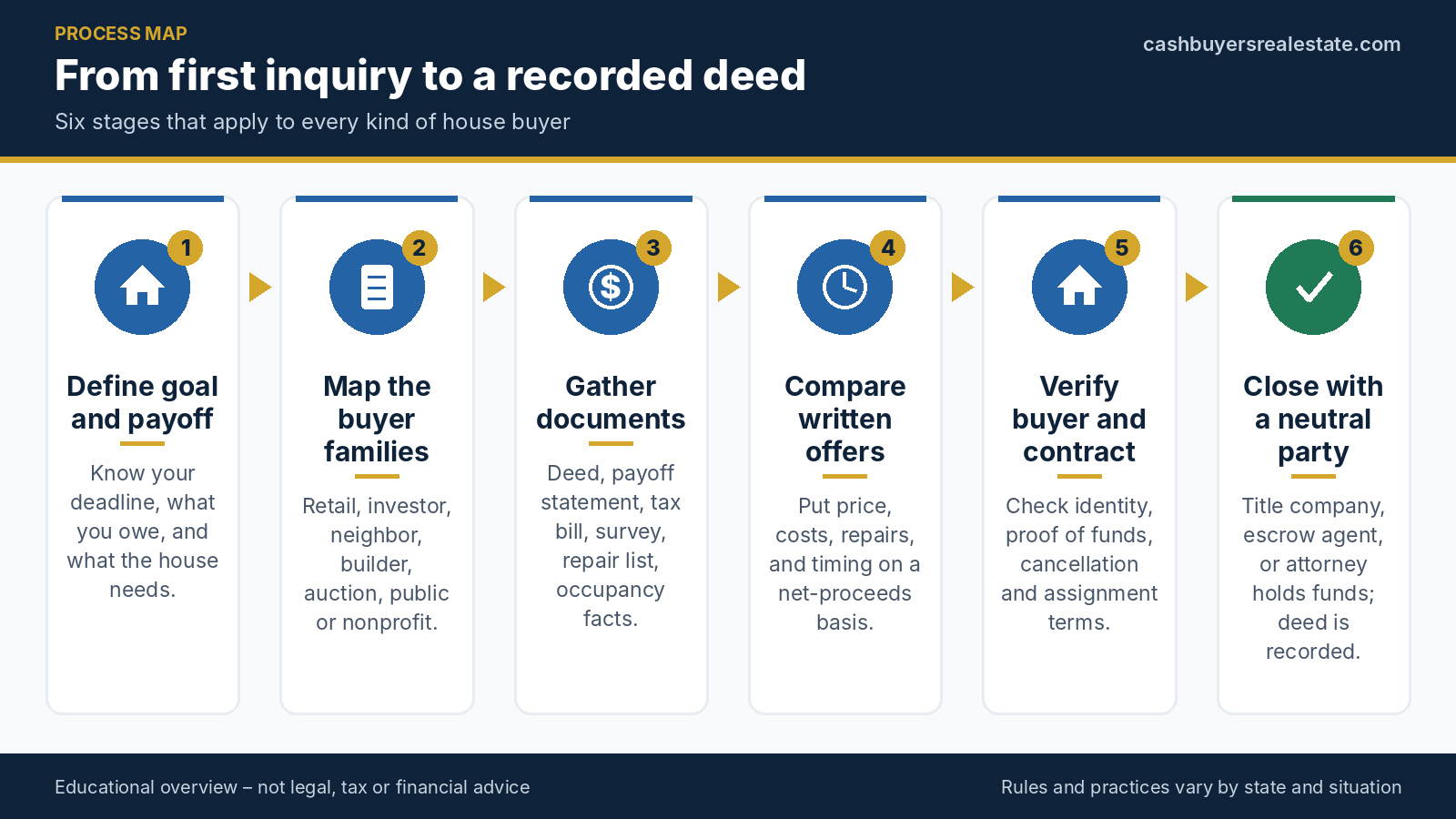
Text version of this infographic
- Define goal and payoff — Know your deadline, what you owe, and what the house needs.
- Map the buyer families — Retail, investor, neighbor, builder, auction, public or nonprofit.
- Gather documents — Deed, payoff statement, tax bill, survey, repair list, occupancy facts.
- Compare written offers — Put price, costs, repairs, and timing on a net-proceeds basis.
- Verify buyer and contract — Check identity, proof of funds, cancellation and assignment terms.
- Close with a neutral party — Title company, escrow agent, or attorney holds funds; deed is recorded.
Investors, Wholesalers, and Instant-Offer Platforms: The Cash Side of the Map
Cash purchasers are the group most search results are built to attract, which is why they get their own section, but they are one source among many and they are best understood in relation to the other families. They pay without a mortgage, which removes the loan contingency and often the appraisal, and they price the house against what they expect to do with it. That is all they have in common. A renovator, a landlord, a middleman holding a contract, and a company running a pricing model behave differently, and the differences show up in your net proceeds and in the amount of paperwork you should read.
Investors Who Renovate, Rent, or Hold
An investor who buys to renovate and resell, or to rent, is making a business decision. They are comparing the cost of acquiring and improving your house against what they can sell or rent it for, and they will pay only what that comparison supports after leaving room for risk and profit.
How an investor builds a price from the resale value backward
Most investor offers start with an estimate of the after-repair value, usually abbreviated ARV, which is the price the house might sell for once it has been brought up to the standard of nearby renovated homes. From that figure the investor subtracts a repair budget, the costs of buying and selling, the expense of carrying the property while work is done, such as taxes, insurance, utilities, and interest, and a margin that compensates them for the chance that the estimate is wrong. What remains is the amount they can offer. Because every deduction involves a judgment, two investors looking at the same house can produce offers that differ by tens of thousands of dollars without either being dishonest, and a seller who has only one number has no way to judge whether it is reasonable.
The good news for a seller is that the formula is not a mystery, and a thoughtful buyer will explain it. Ask what ARV they used and which comparable sales support it, how they estimated repairs and whether they walked the house, and how much they assumed for carrying costs and profit. A buyer who is happy to walk you through those numbers is easier to trust than one who says the figure is “just what we pay.” The article on how cash buyers calculate offers goes through the pricing logic line by line, so this guide will not repeat it.
Landlords and buy-and-hold investors price differently. They care about rent, vacancy, taxes, insurance, and maintenance, and they may be willing to pay more than a flipper for a house with sound bones in a rental neighborhood, or less for one that will need extensive work before it can be occupied. If your property is already tenant-occupied, a landlord buyer may value the lease and the income, which is a point in favor of this family and a reason to read the article on cash buyers for rental properties before you talk to anyone.
Where an investor is a good fit and where it is not
Investors tend to be the best match when the house has problems that make retail financing difficult: an old roof, a failing foundation, extensive water damage, a hoarding situation, a dated interior throughout, or code violations that would block a lender. They are also a natural fit when time matters more than price, as with an estate that needs to be settled, a relocation with a start date, or a home that has been vacant for a while and is costing money every month. In those cases the investor’s willingness to accept condition and uncertainty is exactly what the seller needs, and the discount is the price of that service.
They are a weaker fit when the house is in good condition, the market is active, and there is no deadline. A sound, updated home with several weeks of runway will usually do better in front of retail buyers, because owner-occupants value things an investor cannot monetize. Sellers sometimes find the contrast useful: collect an investor offer as a floor, and then decide whether a listing would plausibly beat it by enough to justify the extra time, showings, and risk. If it would not, the investor offer may well be the sensible choice, and nothing about that choice should feel like a compromise. The article on investors who buy houses explores the different investor profiles in more detail.
Wholesalers and Instant-Offer Platforms
Two buyer types sit in an unusual position between you and the final owner of the house. A wholesaler is an intermediary who contracts to buy and then looks for someone else to take the deal. An instant-offer platform is a company that uses a pricing model and its own capital to buy and resell homes at volume. Both can be legitimate, and both have features that a seller should understand before signing.
Wholesalers, assignment, and why the first buyer may not be the last
A wholesaler signs a purchase contract with you at a price they believe they can improve on, and then markets the contract itself, or the property, to an end buyer, usually an investor. If the end buyer takes over the contract through an assignment, the wholesaler earns the difference between the two prices. If the wholesaler instead buys the property and resells it immediately, the arrangement is sometimes called a double close. Neither structure is automatically improper, and state rules about whether and how wholesaling may be done differ, with some states regulating the activity or requiring disclosures, so it is sensible to ask about the rules where the property is located and to confirm them with a local attorney or the state real estate regulator.
What makes wholesaling risky for a seller is dependency. The wholesaler’s ability to close often depends on finding a second buyer, and if the search fails, the contract may be canceled, renegotiated, or left in limbo while you wait. A well-written agreement addresses this by stating whether the buyer may assign the contract, how long the buyer has to cancel, what happens to the deposit, and whether you are told who the end buyer is. A weak one lets the buyer walk away at nearly any time for nearly any reason while holding you to your side. Read any clause that mentions assignment, cancellation, or an inspection period as though it were the most important page of the contract, because it often is. The article on the cash home buyer contract goes through those clauses in order.
Illustrative example (hypothetical numbers, not market data): An owner signs a contract at $176,000 with a buyer who then lists the contract to investors and assigns it for a $14,000 fee. The investor closes at $176,000 and pays the assignment fee to the original buyer, so the owner’s check is unchanged. If the owner had instead called two investors directly and learned that one would pay $184,000 for the same house, the first contract would have left $8,000 on the table. In another version of the story, no investor steps in, the original buyer asks to lower the price to $162,000 near the end of the inspection period, and the owner has to decide whether to accept it or restart the search with weeks gone. Neither outcome is certain; the point is that a contract that depends on a second buyer carries a second source of delay and a second chance for the price to move.
This does not mean sellers should refuse any wholesaler’s offer. It means the offer should be compared as a conditional one, with the cancellation period, assignment terms, and deposit treatment put next to the price. If the number is good and the terms are fair, the arrangement may be perfectly sensible, particularly in a market where a wholesaler’s marketing reaches investors you would not find yourself. The guide to selling directly to an investor is useful here, because it explains how to approach end buyers yourself and what that changes.
Instant-offer platforms and how their offers change after inspection
Instant-offer platforms, often called iBuyers, use automated valuation models and local data to give homeowners a price quickly, then inspect the home and adjust. They tend to prefer houses that are close to the average of their neighborhood in age, size, and condition, and they may decline houses that fall outside their pricing models. Their offers frequently arrive with a service fee and a repair adjustment after an inspection, so the number you see first is not always the number you receive. The essential discipline is to ask for the offer in writing, with every fee and adjustment stated, and to compare the final net figure with other routes.
This part of the market also moves. Zillow, for one, announced on November 3, 2021 that it was winding down its Zillow Offers program, saying its forecasts of home prices had proved far less reliable than expected, according to reporting from Builder at the time. That episode is a useful reminder that platform availability changes, that some operate in only certain metropolitan areas and price ranges, and that a service you read about last year may not be available now. Treat any platform as one more buyer, check whether it serves your location and home type before investing time, and expect that a very typical house in a strong market is the case where it works best.
| Buyer type | Where it usually fits | Where it can disappoint | First question to ask |
|---|---|---|---|
| Renovating investor | Houses with condition problems or tight deadlines | Sound houses with time to wait | What ARV and repair budget did you use? |
| Landlord or hold investor | Rental-ready or tenant-occupied properties | Houses needing heavy work before occupancy | How do you value the lease and rent? |
| Wholesaler | Reaching investors you cannot find yourself | Deals that depend on a second buyer | Can you assign this contract, and to whom? |
| Instant-offer platform | Typical homes in served areas | Unusual houses; post-inspection adjustments | What fees and adjustments apply to the final figure? |
The last column is the one to keep. Each question is designed to bring out the part of the offer that the headline price hides, and the answers belong in writing before any contract is signed. A buyer who answers vaguely, or who treats the question as an insult, has given you information about how the rest of the transaction may go. For the broader question of how to evaluate any company that advertises quick cash purchases, see the guide on whether cash home buyers are legitimate.
Neighbors, Builders, Land Banks, and Nonprofits: Buyers Who Want the Land or Have a Mission
Some of the most overlooked buyers are the ones who are not shopping for a house at all. A neighbor wants the yard. A builder wants a buildable lot. A public land bank wants a tax-delinquent eyesore turned into something productive. A housing nonprofit wants a structure it can rehabilitate for a family. These buyers are not usually found through a general search for “house buyers,” which is exactly why they can be worth the effort for certain properties: when they exist, they bring a reason to buy that has little to do with the retail market and may be steadier than it.
Neighbors and Builders Who Value the Lot
When land is scarce or well located, the ground under a house can be worth more to a particular buyer than the house itself. Two kinds of buyers think this way, and they look at your property very differently from a family shopping for a home.
Approaching an adjacent owner without creating a problem
An adjacent owner may want your lot to expand a yard, add a garage, protect a view, secure a driveway, or simply to keep a neighboring house from being rented or demolished. Because the motive is personal, the price is often negotiated person to person, and the deal can be simple: no agent, a short contract, a title company or attorney handling the closing. The speed and low friction are the appeal. The risk is that informality tempts both sides to skip steps that matter, such as a survey, a title search, and a check of the local rules on dividing or combining lots.
If the buyer wants only part of the property, the sale usually involves a boundary change, and municipalities commonly require some form of review before a lot line can move or a parcel can be split. The rules differ by city and county, and they may involve a survey, a fee, and a waiting period, so the first call is to the local planning or zoning office, not to a lawyer or a friend. If the buyer wants the whole property, the transaction is a conventional sale between two parties who happen to know each other, and the same protections apply: a written contract, a title search, a payoff of any mortgage, and a closing handled by a neutral party. Friendly buyers are no reason to drop those safeguards, and the sale price should still be grounded in something outside your conversation, such as an agent’s opinion of value, an appraisal, or offers from other buyer families.
A practical way to open the conversation is to say honestly that you are considering selling and ask whether they would like to see the numbers. That keeps the exchange transparent, avoids pressure on either side, and leaves room to say no. Sellers who go door to door with a price they have not tested may find the response awkward, whereas sellers who frame the neighbor as one of several buyers to be heard tend to keep a good relationship whatever happens. The same caution applies in reverse: if a neighbor approaches you with an unsolicited offer, treat it as you would any other, get it in writing, and compare.
Builders and developers: why a teardown can be worth more than a house
A builder or small developer looks at a property and asks what can legally and economically be built there. If the existing house is old, small, or in poor repair, and the lot is large, well located, or zoned for more than what is there, the structure may have little or no value to them and may even carry a demolition cost. The lot’s value then depends on zoning, utility connections, setbacks, flood zones, soil conditions, and local permitting, none of which a typical homeowner can judge unaided. A builder’s offer reflects those factors and the cost of building, and it can be higher than an investor’s offer for the same property when the land is the prize.
Builders typically want time to confirm that their plan is feasible before they are bound to buy, which is why contracts with them often include a due diligence or feasibility period and a closing date tied to approvals. In some cases a developer may propose an option, which pays you for the exclusive right to buy within a set time, or may ask you to wait until a rezoning or permit decision is made. Those arrangements can work, but they shift timing risk onto you, so you should compare the length of the wait, the non-refundable portion of any payment, and what happens if the approvals are denied. A real estate attorney who works with development contracts is worth the fee in this situation.
Illustrative example (hypothetical numbers, not market data): An owner inherits a small, worn-out house on a lot that the local zoning would allow to be split into two building sites. Retail buyers and investors see a house with an outdated interior and a failing roof and offer in a range the owner considers low. A small builder, after checking with the planning office, offers a price that reflects two lots, with a 60-day feasibility period and a deposit that becomes non-refundable after 30 days. The owner compares this against an investor’s quick offer and a listing as-is, and finds that the builder’s offer wins on price but loses on timing by about two months. Whether that trade is attractive depends on carrying costs, since taxes and insurance continue during the wait, and on whether the owner is comfortable that the builder has the funds and experience to finish.
The same logic applies to vacant lots and houses that are not worth saving. If you own something that fits that description, the guide to cash buyers for vacant houses and the broader vacant house selling hub cover the related questions of carrying costs, insurance, and condition, which can influence how quickly a builder or investor will want to move.
Land Banks, Community Programs, and Nonprofit Buyers
A smaller set of buyers exists to serve a public or community purpose, and they work very differently from the market. They are not a realistic match for most sellers, but for a property with unpaid taxes, a vacant structure, or an owner who wants a particular outcome, they are worth knowing about.
What a land bank is, and what to check before relying on one
Community Progress, a national nonprofit that supports land banking, describes a land bank as a public entity with special powers to return vacant, abandoned, and deteriorated properties to productive use: it acquires such properties, holds and maintains them for a time, and transfers them to new, responsible owners. Land banks often acquire tax-foreclosed property, can clear title problems and extinguish liens, and make decisions based on community goals instead of simply the highest price. A HUD-sponsored research report on land banks describes them as governmental or nonprofit entities that acquire, hold, and manage foreclosed or abandoned properties, enabled by state law and set up by local ordinance, and notes that some run side-lot programs that transfer vacant lots to adjacent owners for a nominal fee. Community Progress reports that more than 300 land banks and land banking programs have been created over the past decade and keeps a national map of where they operate.
For a seller, the most important point is that many land banks acquire property through tax foreclosure or from owners who donate or sell a problem property, and they do not usually compete in the market as active retail buyers. A few will consider purchases of vacant or abandoned properties in targeted neighborhoods, and some run programs that favor adjacent owners, local nonprofits, or buyers who commit to rehabilitate a house. If your property is in a neighborhood where a land bank works and it is vacant, damaged, or burdened with back taxes, a phone call is cheap and may reveal an option, such as a donation or a sale at a modest price, that closes cleanly and ends your carrying costs. If it is a sound house in a healthy market, a land bank is unlikely to be the right audience, and your time is better spent elsewhere.
Nonprofit buyers, donations, and the tax questions behind them
Housing nonprofits, community development corporations, and some local affiliates of national organizations accept donated homes or buy them at a modest price to rehabilitate for income-qualified households. Policies vary by affiliate. As one example, Habitat for Humanity Detroit states on its donation page that it accepts homes and real estate, and that the property must have all back taxes paid, no past-due utility bills, no mortgage liens, and be in habitable condition. That shows how selective a nonprofit can be about condition and title, and why a donation is not a universal solution for a troubled property. Each affiliate or organization sets its own criteria, so the first step is a direct conversation with the group you have in mind.
Donating a house raises tax questions that deserve professional attention. The IRS explains in Publication 526 that charitable contributions of property are generally deductible at fair market value on the date of the gift, subject to adjustments depending on the type of property, and to percentage-of-income limits that differ by case. Noncash gifts above certain amounts require additional reporting, and the publication states that Section B of Form 8283 must be completed for items above $5,000, with the receiving organization signing part of the form. Whether a deduction helps you depends on whether you itemize, your income, and how long you owned the property. Compare that against selling the home, where IRS Topic No. 701 explains that a person may exclude up to $250,000 of gain on the sale of a main home, or $500,000 for a joint return, if ownership and use tests are met. A tax professional can run the two scenarios side by side with your actual figures.
If the property came to you through an estate, the questions multiply, because title, probate, and the date of inheritance all affect the picture. The guide on selling an inherited house covers that terrain. For this article, the takeaway is modest: public and nonprofit buyers are a narrow channel, but one worth a single inquiry when the property is troubled, the neighborhood is targeted, and a mission-driven outcome would suit you.
Taken together, the buyer families in this guide offer five practical routes. A listing in front of retail buyers is best when the house is in good shape and you have time, and its trade-off is showings, repairs, and the financing timeline. A sale to a cash investor is best when condition or deadline is the problem, and its trade-off is a lower price. A sale to a neighbor or builder is best when the land has special value to a particular person, and its trade-off is a narrow audience and sometimes long approvals. An auction is best when you want a defined sale date and are comfortable with an uncertain price, and its trade-off is variability and fees. A land bank or nonprofit is best for troubled properties and mission-aligned owners, and its trade-off is eligibility, selectivity, and little room to negotiate. The image below summarizes those five routes so you can see them together.
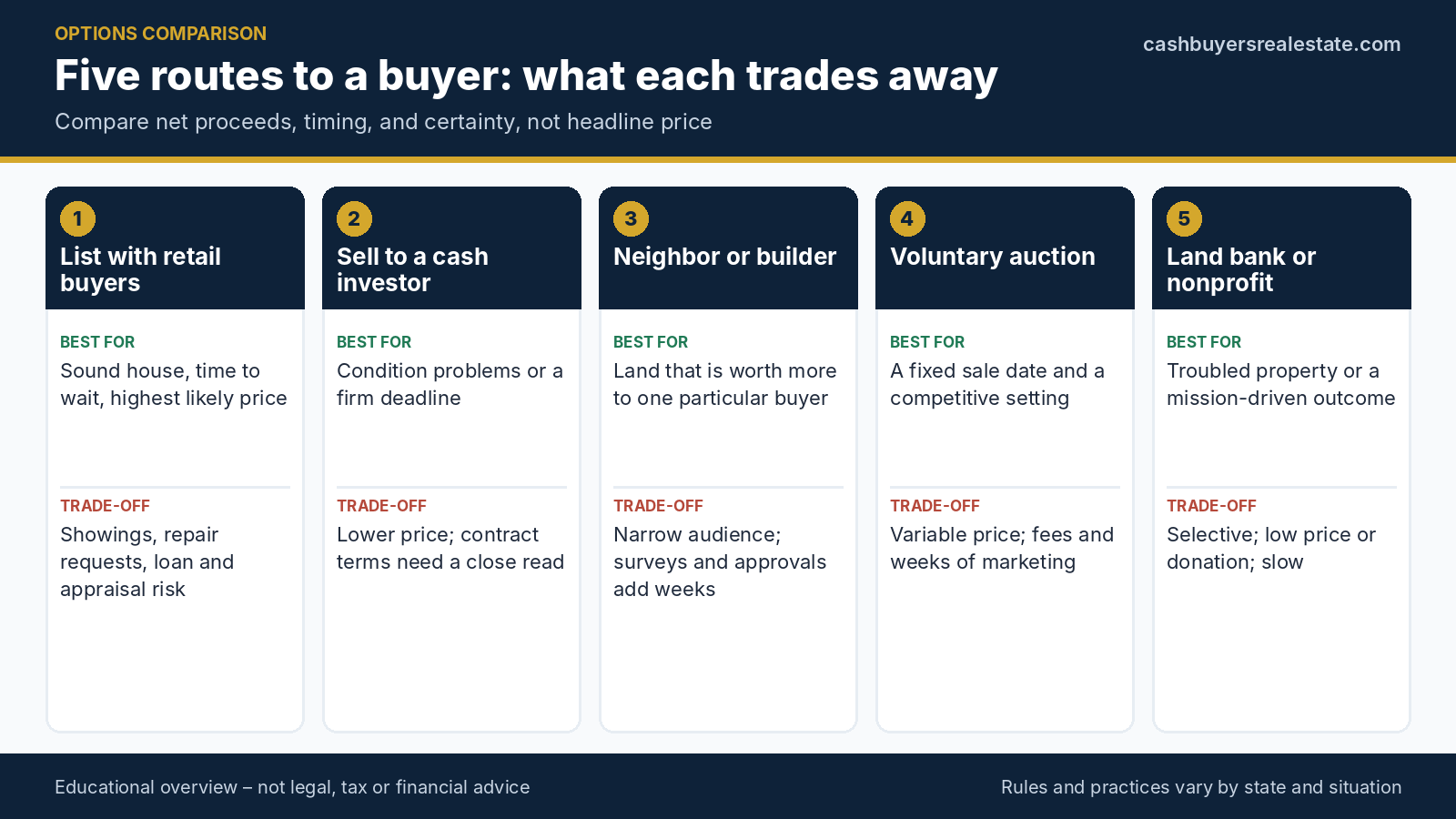
Text version of this infographic
- List with retail buyers — Best for: Sound house, time to wait, highest likely price. Trade-off: Showings, repair requests, loan and appraisal risk.
- Sell to a cash investor — Best for: Condition problems or a firm deadline. Trade-off: Lower price; contract terms need a close read.
- Neighbor or builder — Best for: Land that is worth more to one particular buyer. Trade-off: Narrow audience; surveys and approvals add weeks.
- Voluntary auction — Best for: A fixed sale date and a competitive setting. Trade-off: Variable price; fees and weeks of marketing.
- Land bank or nonprofit — Best for: Troubled property or a mission-driven outcome. Trade-off: Selective; low price or donation; slow.
Auctions as a Sales Channel: Choosing One and Understanding the Ones You Don’t Choose
The word auction covers two very different situations. In one, an owner decides to sell on a fixed date through a licensed auction firm, and the auction is simply a marketing and pricing method. In the other, a lender or a taxing authority sells the property because a debt has gone unpaid, and the owner has little say in the terms. Both put houses in front of bidders, and both are part of why investors and builders appear in the market, so a seller should know how each works and what the consequences are for them.
Choosing to Sell Your House at a Voluntary Auction
A voluntary auction compresses the process of attracting bidders and setting a price into a single event. For the right property and seller, it offers a defined timetable and a competitive setting. For the wrong ones, it adds variability and expense without much benefit.
Absolute, minimum-bid, and reserve auctions compared
The National Association of Realtors describes three common auction structures. In an absolute auction, also called an auction without reserve, the property goes to the highest bidder at any price, so the seller is guaranteed a sale and the certainty tends to draw strong participation. In a minimum-bid auction, bids are accepted only at or above a published minimum, which lowers the seller’s risk of a very low price but must be set low enough to attract bidders. In a reserve auction, sometimes described as subject to confirmation, the highest bid is treated as an offer that the seller may accept or reject within a set period, and the seller keeps a private price below which they are not obligated to sell. NAR notes the drawback of the reserve format: buyers may skip thorough due diligence because they cannot be sure of winning the property.
The National Auctioneers Association frames the choice similarly. Its guidance says that an absolute format brings more bidders and can lead to bidding wars, but that sellers who depend on the proceeds, such as for retirement, may find the risk too stressful and that auctioneers may not recommend it to them. It also says reserves protect against selling below a chosen level but that, particularly if the reserve is published, they can discourage attendance, and many auctioneers advise keeping a reserve private. Neither organization claims one format always produces the best price; the better format depends on how much price risk you can accept, how much time you have, and how well the property attracts a crowd.
| Format | How the price is set | Seller protection | Certainty of sale | Main trade-off |
|---|---|---|---|---|
| Absolute (no reserve) | Highest bid wins, whatever the amount | None on price | Sale is certain | Price can land below expectations |
| Minimum bid | Highest bid at or above a published floor | A visible floor | Likely, if bidders meet the floor | A high floor can reduce turnout |
| Reserve (subject to confirmation) | Highest bid is an offer; seller may accept or decline | A private minimum | Not guaranteed | Bidders may do less homework |
To use the table, begin with the row that matches your tolerance for price risk and then read across to see what you give up. A seller who must sell and can live with a range of outcomes may find the absolute format attractive. A seller with a firm number in mind, who can accept the possibility of no sale, may prefer a reserve. A minimum bid sits between them and is often used when the seller wants to advertise a starting figure. In every case, the auction contract and the terms of sale, including who pays what, deserve a careful read, and the auctioneer should be asked for written answers about fees, which this guide cannot state because they vary by firm and by state.
Costs, preparation, and the closing that follows the gavel
An auction is not a shortcut around the rest of a sale. Marketing takes time, since the auction firm needs weeks to advertise and to schedule viewings, and the winning bidder signs a purchase contract at or soon after the event, usually with a deposit. The closing, with its title work, payoff of existing mortgages and liens, and transfer of the deed, then follows on a timetable set in the contract. If the property has a title problem, an unresolved lien, or an occupant who has not agreed to move, the same problems that delay other sales will delay this one. Auctions do not erase disclosure duties either: whatever your state requires a seller to disclose in an ordinary sale generally still applies, and an auctioneer who suggests otherwise should be asked to explain in writing.
Costs are the other thing to ask about. Auction firms commonly charge for marketing and for their services, and the structure of those charges, whether a commission, a buyer’s premium added to the winning bid, a flat fee, or some combination, differs among firms. The right habit is to request a written schedule of every fee and to run the net-proceeds calculation with those figures included, the same way you would with a listing. If a firm will not provide that in writing before you sign, treat the hesitation as meaningful information.
Illustrative example (hypothetical numbers, not market data): An owner with a $96,000 loan balance has a house that two agents say could list in a range of $240,000 to $260,000 if repaired, or sell for less as-is. An auction firm suggests a reserve format. The highest bid at the event is $218,000, which falls under the owner’s private reserve of $225,000, so the owner declines it and the house does not sell. Eight weeks later the owner holds a second event with no reserve and a published minimum of $190,000, and a bidder wins at $231,000. After an assumed fee package of $17,000 and a payoff of $96,000, the owner nets about $118,000. In a different version, the second event produces only $194,000, and the net falls to roughly $81,000. The same house, and the same owner, can land in very different places depending on the format chosen, the turnout, and the weeks lost.
An auction is rarely the right default for an ordinary suburban home in a healthy market, and it more often suits unusual properties: land, estates with many parties, houses with wide appeal but hard-to-price features, or sales where a firm date is part of the plan. A good auctioneer will say so honestly if your property is a poor candidate.
Foreclosure and Tax-Sale Auctions: When the Auction Is Not Your Choice
The second kind of auction is the one an owner hopes to avoid. These sales exist to recover unpaid debts, and they follow rules set by state law, not by the owner’s preferences.
How foreclosure auctions work and why they matter to an owner
The Consumer Financial Protection Bureau explains that foreclosure is the process by which a lender recovers a debt by selling the home, and that the rules vary by state. In a judicial foreclosure, the lender files a lawsuit and the case goes through a court, where the borrower can raise defenses. In a non-judicial foreclosure, the lender proceeds without a court by following the steps set out in state law and in a power-of-sale clause in the mortgage or deed of trust, including written notices. After the required procedures, the property is generally sold at public auction to the highest bidder, and the lender may bid and become the owner. State law then governs how the sale is completed and the property transferred.
Why does this matter to someone researching buyers? Because an owner who sells before the auction usually keeps more control and often more value than one who waits. A sale on the open market, even an investor sale at a discount, can pay off the loan, avoid the credit and legal consequences of a completed foreclosure sale, and leave remaining equity with the owner. An auction sold at a price below the debt may leave a deficiency, which some states allow lenders to pursue, and which depends on state law. The CFPB advises contacting your lender or a housing counselor as soon as you expect trouble, and points to HUD-approved counselors and the HOPE Hotline at (888) 995-HOPE (4673). The articles on selling before foreclosure and selling fast before foreclosure take up the timeline, the options, and the decision points in detail, and they are the place to go if a sale date has been set.
Tax sales, redemption, and surplus proceeds
Local governments recover unpaid property taxes through their own sale processes, and the details differ widely by state and even by county. In general terms, some jurisdictions sell a tax lien certificate to an investor who pays the owed taxes and then collects them from the owner with interest, while others foreclose and sell the property itself in a tax deed sale. Many states give the owner a redemption period during which they can recover the property by paying what is owed with interest and costs, and the length and rules of that period vary. Because these rules are specific to each state and county, the only reliable source is the county treasurer, tax collector, or the relevant state statute.
Two practical points follow. First, an owner with unpaid property taxes should find out early whether their jurisdiction sells liens or deeds and what the timetable is, because a voluntary sale, even to an investor at a discount, may leave more money in the owner’s hands than a tax sale. Second, if a tax-sale auction price exceeds the amount owed, some states allow the former owner to claim the surplus, subject to deadlines, so owners who have lost property to a sale should ask the county whether any surplus exists and how to request it. Investors and builders often source properties from these auctions, which is one reason local tax-sale calendars matter. If you have received a notice, treat it with the same seriousness as a court letter, and consider speaking to a local attorney, a HUD-approved housing counselor, or the county office named on the notice.
The common thread in both kinds of auction is that the process, not the buyer, drives the outcome. A voluntary auction lets you choose a format and a date; an involuntary one sets them for you. Either way, the best protection is to learn the rules where the property is located and to compare any auction outcome against selling by agreement, because an open-market or negotiated sale usually offers more room to choose the buyer, the timing, and the terms.
Comparing Sources by Speed, Price, and Certainty, and Describing One Property to Many Buyers
Once you know who the possible buyers are, the work shifts from discovery to comparison. That comparison has two layers. The first is structural: which kinds of buyers tend to be fast, which tend to pay more, and which are most likely to actually close. The second is personal: what each route would leave in your bank account after your mortgage, costs, and carrying expenses, and how you describe the property to each audience so that everything you say is accurate and consistent.
Source Versus Speed, Price, and Certainty
No source wins on all three measures, and any buyer who claims otherwise is either describing an unusual property or leaving something out. The useful skill is to know which measure matters most for your situation and to accept that you will pay for it in another.
Reading the comparison table honestly
The table below rates each source in general terms for speed, price relative to the retail market, and certainty that the deal will close as agreed. The ratings are qualitative and describe tendencies, not guarantees: a particular investor may be slower than a particular financed buyer, and a particular auction may beat a listing. They are meant to orient you, so that when you receive real offers you know where each one sits and which questions to put to it.
| Source | Speed | Price vs. retail | Certainty | Main risk to watch |
|---|---|---|---|---|
| Retail buyer through a listing | Slower; weeks from listing to closing at best | Usually the highest for a sound house | Moderate; depends on loan and appraisal | Repair requests and financing delays |
| Agent network or private sale | Can be faster than a public listing | Can match retail; fewer competing bids | Moderate | Narrow audience; unproven buyer lists |
| Cash investor | Often fastest once under contract | Usually below retail | Higher without a loan, but terms vary | Re-trading the price; weak contract terms |
| Wholesaler | Fast to sign; closing depends on a second buyer | Often below an investor’s own offer | Lower; conditional on assignment | Cancellation and delay |
| Instant-offer platform | Fast for eligible homes | Typically below retail after fees and adjustments | Moderate to high for typical homes | Fees and post-inspection changes |
| Neighbor | Fast if simple; slower if a lot split is involved | Varies widely; can exceed market for a small lot | Depends on the buyer’s funds | Informality; skipped survey or title work |
| Builder or developer | Slow if tied to approvals | Can exceed investor offers for land-driven value | Moderate; contingent on feasibility | Long due diligence; option payments |
| Voluntary auction | Fixed date after weeks of marketing | Highly variable | High for absolute; lower for reserve | Fees; price below expectations |
| Land bank or nonprofit | Slow; follows board or grant timing | Often low or a donation | Depends on eligibility | Selectivity; narrow fit |
Look first at the column that matches your main constraint, then at the risk column. Someone who needs money by a firm date should be most interested in speed and certainty and willing to accept a lower price. Someone with several months of flexibility and a sound house should be most interested in price, and the retail and auction rows are where the upside lies. If the property has title or condition problems, certainty rises in importance, because a buyer who agrees to the situation upfront is worth more than one who tolerates it until the inspection. The pattern is consistent with the articles on how cash offers compare with market value and how to compare cash offers, which treat speed and certainty as things worth paying for, within limits.
One more caution about the speed column. Speed comes from two places: the buyer’s process and the seller’s readiness. A buyer who can close in a short window cannot do so if your title has an unresolved lien, if the mortgage payoff statement has not been ordered, if an occupant is still living in the house, or if a co-owner has not signed. Much of the delay sellers experience is theirs, and it is cheaper to fix it before the first buyer arrives than after the contract starts a clock.
From headline price to net proceeds
The only fair way to compare routes is to take each price through the same steps: subtract the commissions or fees that apply, subtract credits and repair costs, subtract the cost of carrying the house until closing, and subtract what you owe on the property. What is left is the amount that actually reaches you, and it is the number to compare. A net sheet, which many title companies and agents will prepare on request, performs this calculation for a given price, and you can build your own by listing every cost you expect. The article on net proceeds from a cash offer and the comparison in cash sale versus traditional sale proceeds include more detail on line items.
| Route | Price | Costs and credits | Carrying cost | Net after payoff |
|---|---|---|---|---|
| Retail listing, four months | $300,000 | $30,000 | $6,000 | $144,000 |
| Cash investor, one month | $255,000 | $5,100 | $1,500 | $128,400 |
| Builder buying for the lot, three months | $275,000 | $8,250 | $4,500 | $142,250 |
| Voluntary auction, two months | $262,000 | $23,580 | $3,000 | $115,420 |
The assumptions behind the table are simple and invented: a listing with a total selling cost near eight percent plus a $6,000 repair credit, an investor purchase with a small closing cost, a builder sale with modest costs, and an auction with a fee package of about nine percent, all on a house carried at $1,500 per month. The lesson is not that listing wins; change the assumptions and the order shifts. The lesson is that a $45,000 spread between the highest and lowest price becomes a spread of roughly $29,000 between the best and worst net result, and that the time cost differs by months. The IRS also reminds owners in Topic No. 701 that up to $250,000 of gain on a main home, or $500,000 on a joint return, may be excludable if ownership and use tests are met, and that a sale must be reported if you receive a Form 1099-S. Taxes depend on the facts, so ask a tax professional how the sale you are weighing would be treated.
Messaging the Same Property to Different Kinds of Buyers
Each buyer family asks a different first question, and a good description answers it truthfully. Sellers who send the same paragraph to a retail agent, an investor, and a builder often find that they have emphasized the wrong things to each, and sometimes that they have said something to one that contradicts what they told another.
Choosing what to emphasize for each audience
For retail buyers and the agents who represent them, the story is about living: the layout, the condition of the kitchen and bathrooms, the age and maintenance of the roof and major systems, the neighborhood, and the sense of a house that is ready to occupy. Photographs and a clean presentation matter, and so does a candid mention of known issues, because a buyer who discovers a problem at inspection is more likely to ask for concessions than one who was told at the start. Investors want something else: the age of the roof, heating and cooling, plumbing and electrical systems, the amount and type of damage, the taxes and insurance, whether the property is occupied, and any liens or title questions, laid out plainly so that they can estimate repairs without guessing.
Builders and neighbors care about the lot. Give builders the lot dimensions, any survey you have, the zoning designation as shown by the local planning office, the utilities available, and any history of flooding, easements, or restrictions you know about. Give neighbors the same, along with the boundaries as you understand them. Nonprofit buyers and land banks want the facts about taxes, title, and condition, along with your reason for wanting a mission-aligned outcome, since that reason often shapes their interest. Auction firms need documents for the terms of sale: the deed, payoff information, and any liens or occupancy facts. Every one of these descriptions can be true and tailored to the audience at once, which is what good messaging looks like.
Keeping one truthful story: disclosures, consistency, and sequencing
The foundation of all of these descriptions is a single set of facts. Whatever you know about the roof, the foundation, the septic system, the flooding, the liens, or the occupants should be the same across every conversation, and anything your state requires you to disclose should be disclosed regardless of the buyer type. A cash sale or an as-is sale does not remove those duties, and concealing a defect is never a sensible strategy; it exposes you to claims after closing and can unwind a sale. If you are unsure what the law requires where you live, ask a local real estate attorney or check your state’s real estate regulator for its disclosure form and rules.
Sequencing matters as well. If you speak with several buyers at once, decide in advance how long you will collect offers, tell each buyer honestly that you are comparing options, and avoid promising exclusivity you do not intend to give. Do not sign a contract with one buyer while negotiating verbally with another unless you understand the cancellation terms. If you sign a listing agreement with an agent, read what it says about private buyers: some agreements entitle the agent to a commission even if you sell to someone you found yourself, and some carve out named individuals. Asking for that carve-out in writing before signing is reasonable.
Illustrative example (hypothetical numbers, not market data): A seller with a two-bedroom house on a deep lot sends three short descriptions in the same week. To an agent, the seller emphasizes the updated bathroom, the newer water heater, and a roof in its tenth year. To an investor, the seller adds that the kitchen is original, that a basement corner has had occasional moisture, and that the house is vacant. To a builder, the seller provides the lot dimensions, a copy of a survey, and the zoning shown on the city’s website. All three descriptions mention the basement moisture, the roof age, and the vacant status in the same words. A month later the seller has a financed offer at $229,000, an investor offer at $196,000, and a builder inquiry at a figure the builder says depends on a feasibility check. Because the facts were consistent, the seller can compare them without worrying that one buyer was told something different.
It is a simple discipline that protects you in several ways. Consistent statements are easier to defend if a buyer later disputes what was said. They keep you honest with yourself about the property’s real condition. And they make the comparison clearer, because each buyer is responding to the same house. The sibling guide on finding cash home buyers near you covers how to verify local buyers in particular, and the next section turns to verification for every kind of buyer.
From First Contact to Closing: The Process and the Red Flags That Apply to Any Buyer
The buyer family changes how a sale feels, but the skeleton of the transaction is the same: someone makes an offer, you agree on terms in writing, a neutral party checks title and holds the money, and the deed moves from your name to theirs. Because the same steps apply to a first-time homebuyer, an investor, and an auction winner, the same safeguards apply to all of them, and most of the warning signs that matter are visible at the same points in the process.
The Path From Inquiry to Recorded Deed
Understanding the order of events makes it easier to spot when something is out of sequence. The most common problems arise when a buyer asks you to do something early that should come late, such as signing a binding document before a price is clear, or sending money before identity has been established.
First contact, written offers, and what the contract must say
A legitimate buyer will usually ask for the address, the condition of the property, whether it is occupied, and whether there is a mortgage or a lien. Those questions are not intrusive; they are what the buyer needs in order to price the house. After any visit or review, you should receive an offer in writing. At minimum it should state who the buyer is, by their full legal name and, if a company, its legal entity name; the purchase price; the amount and holder of any deposit; the closing date or a defined timetable; who pays which closing costs; and all contingencies. A contingency is a condition that lets one party cancel, such as an inspection period, a financing condition, or the buyer’s right to terminate within a period for any reason. Read the length of each period and the consequence of cancellation.
Two items deserve special attention. The first is the earnest money deposit, which is money the buyer places at the start of the contract to show good faith. It is usually held by a title company, escrow agent, or attorney, not handed to the seller or to the buyer’s own account. The questions of how much, when it becomes non-refundable, and under what conditions it is returned are all set by the contract; the articles on earnest money in cash purchases and contingencies in cash purchases give examples of how those provisions can be written. The second is the assignment clause, which says whether the buyer may transfer the contract to someone else. As discussed earlier, an unrestricted right to assign combined with a broad right to cancel is the combination that leaves a seller most exposed.
Contracts differ by state, and in some states attorneys typically prepare or review them while in others standardized forms prepared by agents or title companies are common. If the buyer presents a contract you do not understand, you can ask a real estate attorney to review it before you sign, and a buyer who objects to a reasonable review window has told you something. For a closer look at the clauses that most often cause trouble, the guide to cash offer contract red flags goes through them one at a time.
Title work, the closing, and getting paid
Once a contract is signed, a neutral party, whether a title company, an escrow officer, or a real estate attorney depending on local practice, opens the file, orders a title search, and identifies anything that must be resolved before closing: mortgages, tax liens, judgments, unpaid assessments, and sometimes ownership questions. You or your lender will provide a payoff statement, which tells the closing agent exactly how much is needed to clear a mortgage. If a problem emerges, such as a lien you did not know about or a signature missing from the deed, closing waits until it is fixed. A seller who has already gathered the deed, the mortgage statement, tax information, and identification is far less likely to experience that kind of delay.
Closing practice is not uniform across the country. Some states conduct closings through escrow, with the buyer and seller signing separately; some through attorneys, with a closing meeting; and some use a mixture. Do not assume that your closing will look like one you saw on television or heard about from a friend in another state. What does not change is the principle that a neutral party should hold the funds and record the deed, and that you should receive your proceeds from that party, by wire or check, after the deed is recorded or according to the closing agent’s procedure. If a buyer proposes to handle the money outside that process, or asks you to deed the property before funds are verified, stop and ask a professional.
Proof of funds, meaning documentation that the buyer actually has the money, belongs in the early stages of this process. It can be a recent bank or brokerage statement, a letter from a financial institution, or, for an investor using a lender, a commitment letter, and it should show that the amount is available and the account belongs to the buyer. You will find a detailed treatment in the guide on proof of funds for cash buyers. The following list shows the six checks that apply to any buyer and any route; the image after it summarizes them.
- Confirm who the buyer is and the legal name of the entity that will sign.
- Ask for proof of funds, and verify it with the institution through a number you look up yourself.
- Read every cancellation and inspection clause, and note the dates.
- Check whether the contract can be assigned, and to whom.
- Use a title company, escrow agent, or attorney to hold deposits and run the closing.
- Never sign a form with blank spaces, and keep a copy of everything you sign.
Those six checks work as a decision checklist, and they are weighted differently from one another. Identity, proof of funds, and a neutral closing party are the foundation, because without them nothing else can be trusted. The cancellation and assignment clauses are the places where a contract most often turns out to be less firm than the price suggested. Refusing to sign blank forms is the simplest protection and costs nothing. The image below shows the six checks with a rating for how much each one matters when it is missing.
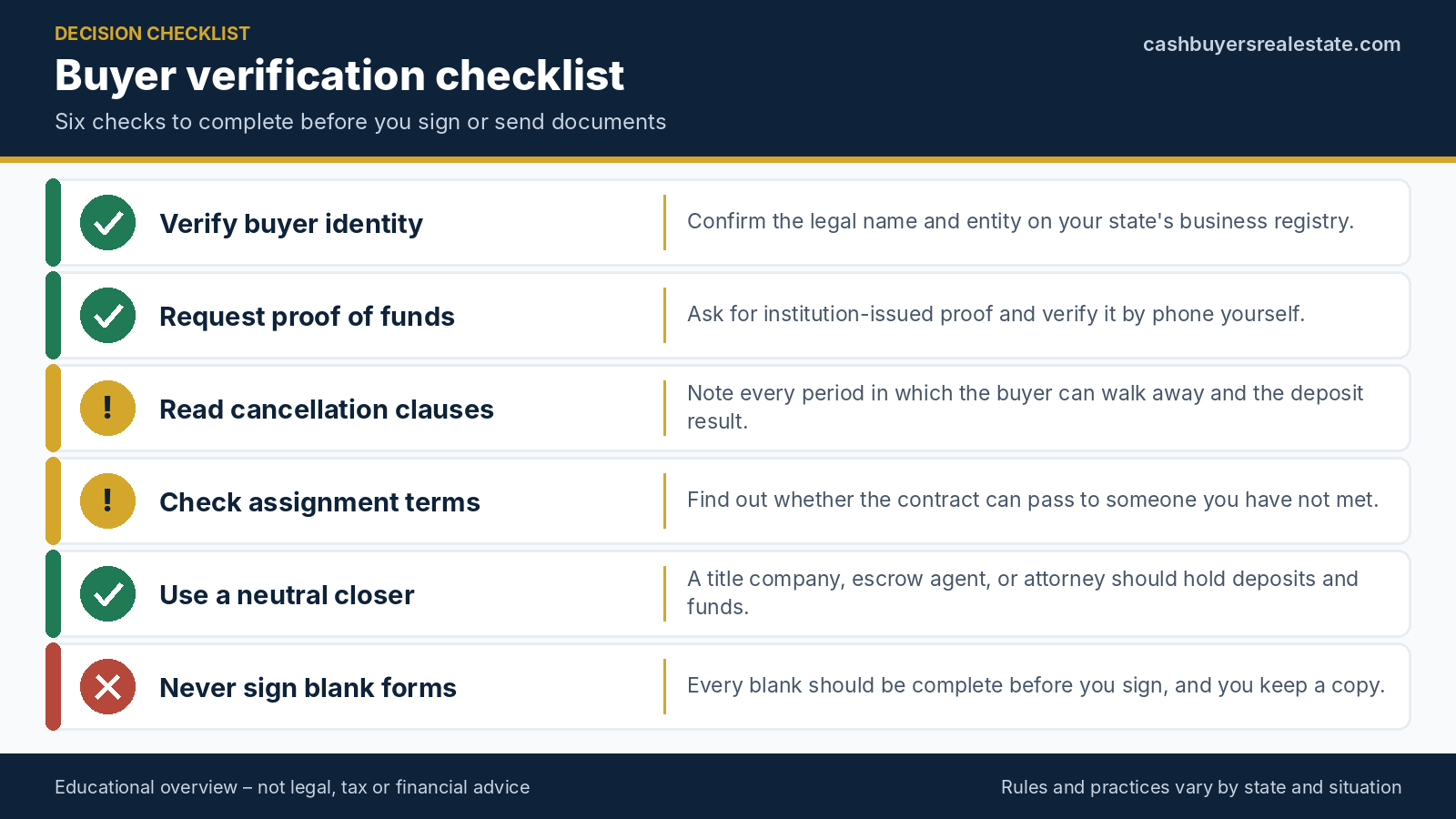
Text version of this infographic
- Verify buyer identity — Confirm the legal name and entity on your state's business registry.
- Request proof of funds — Ask for institution-issued proof and verify it by phone yourself.
- Read cancellation clauses — Note every period in which the buyer can walk away and the deposit result.
- Check assignment terms — Find out whether the contract can pass to someone you have not met.
- Use a neutral closer — A title company, escrow agent, or attorney should hold deposits and funds.
- Never sign blank forms — Every blank should be complete before you sign, and you keep a copy.
Verification and Red Flags With Any Kind of Buyer
Most buyers of every type are honest. A small number are not, and a larger number are simply careless or optimistic, which can cost you almost as much. Verification is not an accusation. It is an ordinary business step that careful buyers expect and respect, and sellers who do it consistently make better decisions and are harder to pressure.
Verifying who the buyer is and whether the money exists
Begin with identity. If the buyer is a company, ask for its exact legal name and look it up on your state’s business entity database, which is usually maintained by the secretary of state, to confirm that it exists, is in good standing, and who is listed as a registered agent. Confirm the person you are speaking with has authority to sign for it. Ask about their last few purchases in your area and, if they are willing, ask for the name of the title company or attorney they use, and then contact that closing office yourself using a phone number you find independently. Real buyers have a transaction history, a closing partner, and no reluctance to share both. The article on questions to ask a cash home buyer provides a longer script.
For the money, do not rely on a screenshot or a letter handed to you in isolation. Ask for a statement or letter on the institution’s letterhead showing the buyer’s name and enough funds, and call the institution at a number you find yourself to confirm that it issued the document. Buyers may redact account numbers, which is reasonable, but they should not refuse to show that funds exist. For a financed buyer, the equivalent is a preapproval letter from a lender, and you can phone the lender to confirm it. None of this proves anything beyond what it shows: a valid statement today does not guarantee the money will be there at closing, which is why the deposit, the closing agent, and the contract terms continue to matter.
Pressure, urgency, and the signals worth slowing down for
Pressure is the most reliable warning, and it takes many forms: an offer that expires in a few hours, a demand that you sign before showing the contract to anyone, a refusal to put terms in writing, and a refusal to let a title company or attorney handle the funds. A buyer can have good reasons for wanting to move quickly, since investors do have funds and schedules, but a reasonable buyer will give you time to read and ask questions. If speed is part of the offer, ask the buyer to explain what makes it possible and to show the timeline in writing.
The same logic applies to the search results that started this article. A page that says “near me” may belong to a local buyer, an agent, a national company, or a lead-generation site that collects your information and forwards it, sometimes to several buyers at once, which explains why calls may arrive from numbers you do not recognize. None of that is necessarily improper, but you should ask any caller whether they will buy the property themselves, who they work for, and where they are located, and you should not hand over personal details or documents until you know. The guides on cash home buyer scams and on local buyers versus national companies cover those patterns in depth. No single item below proves wrongdoing, and a single flag usually calls for a question, not a conclusion.
| Warning sign | Why it matters | A calm response |
|---|---|---|
| Offer expires within hours | Prevents comparison and review | Ask for a reasonable window in writing, or move on |
| No written terms or a blank-filled form | Terms can change after you sign | Do not sign until every blank is completed and you have a copy |
| Buyer will not name its closer | No neutral party may hold funds | Propose a title company or attorney you choose |
| Deposit goes to the buyer or an unknown account | Hard to recover if the deal fails | Require a neutral holder named in the contract |
| Wiring instructions change by email | A common pattern in closing-fund fraud | Confirm by phone at a number you already have |
| Proof of funds is vague or refused | Ability to close is unverified | Ask for institution-issued proof and verify it directly |
| Contract lets the buyer cancel at will | You are bound but they are not | Narrow the cancellation window or negotiate a deposit |
To use the table, treat each row as a prompt for a specific question and then notice how the buyer responds. A buyer who answers promptly, adjusts a clause, and welcomes a neutral closer is behaving the way a legitimate buyer does. One who becomes irritated, repeats the deadline, or suggests that asking questions is a sign of distrust is giving you the information the table is designed to surface. If you want a second opinion, a real estate attorney, a HUD-approved housing counselor, or your state’s real estate regulator can review the documents with you.
Questions About House Buyers Near Me, Answered
The questions below come up repeatedly when owners start comparing buyers. They are grouped by theme, and the answers assume a typical U.S. residential sale; rules for contracts, closings, taxes, and auctions vary by state, so treat each answer as a starting point for a conversation with a local professional.
Questions About Finding and Choosing Buyers
These answers deal with who the buyers are, how the families differ, and how to decide where to begin.
Questions about who buys and how to reach them
- Is a search for house buyers the same as a search for cash home buyers?
No. “Cash home buyers” describes only how a buyer pays, while “house buyers” includes every kind of purchaser, financed and cash alike. Many results for the broader phrase are agents, auction firms, or lead-generation sites that want to introduce you to someone else. It is reasonable to read the broader search as a request for options and to treat the cash buyers among them as one category of several.
- Should I contact more than one kind of buyer?
Usually yes, if you have a few weeks to spare. Two or three conversations with different buyer types will show the real range of value for your house far better than one offer can. Keep your descriptions factual and identical, tell each party you are comparing options, and set a date by which you will decide so that the process does not drag on.
- Can I sell to a relative, friend, or coworker?
You can, but a sale between people who know each other still needs a written contract, a title search, a payoff of any mortgage, and a proper closing. If the price is well below market value, tax or lender questions can follow, and the answer depends on the facts and on federal and state rules, so a tax professional or attorney should review the plan first. Informal arrangements are where small misunderstandings turn into large ones.
- Do I need an agent to deal with investors or builders?
Not necessarily. Many investors and builders deal directly with owners, and some prefer to. An agent can add value by finding more buyers, pricing the property, or negotiating, but it comes at a cost, and an agent who has no experience with your kind of property may not help. If you do bring one in, ask for their fee and the scope of their work in writing before you sign anything.
Questions about price, timing, and offers
- Which kind of buyer usually pays the most?
For a sound house in decent condition, retail owner-occupants who finance a purchase usually pay the most, because they value the property as a home. For land with development potential, a builder or neighbor may pay more than anyone else. For a house in poor condition, the most you can realistically get may come from an investor or a buyer who takes it as-is. Compare net proceeds, not headlines, because higher prices often come with more costs and more waiting.
- Which route is fastest?
Buyers who pay without a loan and do not need an appraisal are usually the fastest once a contract is signed, and a voluntary auction has a fixed date after marketing. Retail sales tend to be slower because of the loan process. Speed also depends on your side: an unresolved lien, a missing co-owner signature, or an occupant who has not moved can delay any buyer, however quick their process is.
- Is the first offer usually the best I will get?
Sometimes it is, but you cannot know that until you have compared it with something else. A first offer can be a fair starting point or a low figure designed to see if you will accept. Ask what the offer is based on, ask for the terms in writing, and invite at least one other kind of buyer to look before you sign. A buyer who truly wants the property will usually give you the time to do that.
- Why do some offers change after the buyer inspects the house?
Buyers price from a distance using the photos and facts you provide, and an inspection can reveal repairs they did not anticipate. Some adjustments are fair responses to real defects, and others are a tactic to lower the price after you have committed. The best protection is to disclose known problems upfront, ask what the buyer will inspect, and understand your right to cancel if the revised figure is not acceptable.
Questions About Safety, Paperwork, and Special Situations
These answers cover the contract and verification steps that apply to any buyer, and a few situations that fall outside the ordinary sale.
Questions about contracts, deposits, and verification
- How much earnest money should a buyer put down?
There is no universal amount. The figure is negotiated and written into the contract, and it varies by market, price, and the strength of the buyer’s commitment. What matters more than the amount is who holds the money, under what conditions it can be refunded, and when it becomes non-refundable. A deposit held by a title company or attorney and clearly described in the contract is a better sign than a large number held by the buyer.
- Can I cancel after I sign a purchase contract?
It depends on the contract and on state law. Most real estate contracts are binding once signed, and canceling without a contractual right can have consequences such as losing a deposit or facing a legal claim. Some contracts include cancellation periods that run in one direction only, which is why you should read those clauses before you sign. If you have already signed and have concerns, speak with a real estate attorney promptly.
- Should an attorney review the contract?
It is a good idea whenever the contract is unfamiliar, the buyer supplied it, or a lot of money is at stake, and in some states attorneys are standard parts of closings. A review is usually a modest cost compared with the value of a house. If a buyer pushes back on a short review window, that is worth noticing.
- How can I tell whether proof of funds is real?
Ask for a statement or letter from the financial institution showing the buyer’s name and a balance sufficient for the purchase, and verify it by calling the institution at a number you find yourself. Allow redaction of account numbers but not of the existence of the funds. Keep in mind that proof of funds shows what is available at one moment and does not guarantee anything about closing day.
Questions about auctions, public programs, and tricky properties
- Can I sell at auction if I still have a mortgage?
Yes, as long as the proceeds can cover the payoff at closing. The mortgage is paid from the sale proceeds, so a reserve or minimum bid set below the payoff plus costs could leave you short of cash at the closing table. Ask your auction firm to help you set a floor that works with your payoff and to explain the fee structure before you agree to a format.
- Will a land bank or nonprofit pay market price?
Often not. These organizations typically work on public or community budgets and aim for outcomes such as rehabilitation or neighborhood stabilization, and many accept donations or pay modest prices. They are also selective about condition, taxes, and title. They are best viewed as an option for troubled properties or for owners who care about a particular result, not a path to top dollar.
- What if the house is occupied by a tenant or a co-owner?
Occupancy and shared ownership both affect which buyers can proceed and how quickly. A tenant’s rights under a lease and your state’s landlord-tenant law continue through a sale unless handled properly, and a co-owner must usually sign the deed. Investors and landlords are often more comfortable with these situations than retail buyers are, but each case needs a lawyer’s guidance on the specific rules in your state.
Choosing Among House Buyers: A Decision Framework and Your Next Steps
By this point the shape of the decision should be clearer. There is no single best buyer; there is a buyer that fits your property, your deadline, your debts, and your tolerance for uncertainty, and a good decision is one you can explain to yourself in a few sentences after comparing real written offers on a net basis. The framework below turns that idea into a sequence of questions, and the second half of the section describes what to do in the days after you finish reading.
Matching a Buyer Family to Your Priorities
Start with what you cannot compromise on, because that single constraint usually removes half the options. Then look at what you would like to maximize, and only then at the individual offers.
When price and certainty pull in different directions
Most sellers feel a tension between the highest possible price and the greatest possible certainty, and the buyer families sit at different points along that line. Retail buyers with a mortgage generally anchor the price end, but their deals depend on a lender and an appraiser. Buyers who pay without a loan generally anchor the certainty end, yet their prices are lower because they absorb condition and timing risk on your behalf. Auctions can offer certainty of a date and, in the absolute format, certainty of a sale, with no certainty about price. Builders and neighbors can beat both when the land is what matters, but they may ask you to wait.
The honest way to decide is to put a dollar value on certainty. Ask what it would cost you if the sale fell through at the eleventh hour: another two months of mortgage payments, taxes, and insurance, a missed move-in date at your next home, a lost job opportunity, or simply the stress of starting over. If that cost is large, a lower but surer offer can have a higher expected value than a higher but fragile one. If that cost is small, you can afford to wait for a better price. Neither answer is wrong, and a sale that is slightly less lucrative but removes a serious risk is often the wiser choice. The reverse is also true: sellers with time and a sound house who accept the first fast offer are often giving up money they could have kept.
| If your main priority is | Families to explore first | What you will probably trade away |
|---|---|---|
| Highest likely price, with time available | Retail buyers through a listing; a builder if the lot is valuable | Weeks of showings, repairs, and financing risk |
| A firm closing date and few conditions | Cash investors; reputable instant-offer platforms for typical homes | A lower price, and the need to read the contract closely |
| Not repairing or cleaning out the house | Investors; auction for unusual properties | Price, and sometimes control over timing |
| A privacy-sensitive or discreet sale | Agent networks; neighbors; investors | Breadth of exposure and competing bids |
| A specific outcome for the property or the neighborhood | Land banks, nonprofits, neighbors | Price, speed, and negotiating room |
| Avoiding foreclosure or a tax sale | Any buyer who can close before the sale date, plus counseling | Some equity, in exchange for time and control |
Treat the table as a place to start looking, not a ruling. If two rows describe you, as they often do, you are probably choosing between two families, and the comparison of net proceeds on actual offers will usually settle it. If none describe you, you may be in a situation that deserves a professional’s help before any buyer is involved, such as a title problem or a disputed inheritance.
How condition, deadline, and debt narrow the field
Three facts narrow the field more than any others. The first is condition: a house that a lender will finance and an inspector will pass belongs in front of retail buyers, while one with major defects, deferred maintenance, or code problems belongs in front of buyers who are equipped to handle them. The second is your deadline. A real, immovable date, such as a closing on your next home or a foreclosure sale, makes uncertainty expensive and reduces the value of waiting for a retail buyer. The third is debt: the amount you owe determines the minimum price at which a sale makes sense, and if it is close to the likely value, you have less room to accept a discount and may need to consider alternatives such as negotiating with a lender, which a housing counselor can discuss.
A fourth fact sits behind these three: how many people must agree. A house owned by several heirs, a divorcing couple, or a trust may need unanimous signatures, and the buyer’s patience for that varies. Investors who regularly buy estates tend to be comfortable with the paperwork, while retail buyers on a financing timeline may not be. Whatever your situation, state law may impose steps, such as court approval in some probate cases, that no buyer can bypass. If any of this applies to you, a consultation with a local attorney before you sign anything is likely to save more than it costs.
What to Do Next: First Steps, Questions to Ask, and Documents to Gather
You do not need to make the decision today. What you can do in the next week or two is put yourself in a position to decide well, by learning the facts about your property and by speaking to a small, deliberate set of buyers.
Facts and documents to have ready before anyone visits
Gather what a buyer or closing agent will ask for before anyone asks, because it shortens the process and makes your descriptions consistent. You will want the deed or a copy of how you hold title, the most recent mortgage statement or a payoff estimate, your latest property tax bill, any homeowners association information and recent dues, utility and insurance details, any survey or plot plan, a list of repairs you have made and those you know are needed, and any permits or inspection reports. If tenants live in the home, add the lease and the rent history. If the property is part of an estate, add the death certificate and the documents showing who has authority to sell.
It also helps to write down a short, plain description of the property that you can send to anyone: the age and condition of the roof and major systems, any known water, foundation, or pest issues, whether it is occupied, and any liens or back taxes you know about. Having that on one page reduces the temptation to improvise, and it makes your answers consistent from one buyer to the next. As you collect it, do not hide anything that you would have to disclose anyway; buyers find problems, and the question is whether they find them before or after you have agreed on a price.
Keep originals safe and share copies. A buyer or closing agent needs to see documents, but identification numbers, bank account details, and full mortgage account numbers should travel only through channels you trust, and never to someone you have not verified. Where a document is missing, such as a lost deed copy or an unclear survey, note it and ask the title company or county recorder how to replace it, because a gap that takes weeks to fill is better discovered before a contract starts a closing clock. A folder, paper or digital, with everything in one place also makes it easier for a family member, attorney, or tax professional to help you on short notice.
A sensible order of operations for the next two weeks
A workable plan begins by getting a realistic sense of value, through an agent’s opinion of value, a broker price opinion, or comparable sales you review yourself, so you can recognize an offer that is far off. Next, request a payoff statement from your mortgage lender so you know the floor. Then choose two or three buyer families that match your constraints, speak to one or two buyers in each, and ask each to send a written offer with every term spelled out. Compare the offers using the same net-proceeds method, verify the leading buyers using the steps described earlier, and have an attorney or closing agent look at the contract before you commit. If the offers are not good enough, you can hold off, repair, list, or approach other buyer families, and nothing about the comparison obliges you to sell.
Throughout, keep your decision proportionate to the stakes. The house is probably one of the largest assets you own, and a few days of careful comparison is a small investment relative to the money involved. Many sellers will find that the right answer is not exotic: a listing, or an investor, or a neighbor, chosen for reasons they can state. Others will find that a combination works, such as testing the retail market for a short period with a clear fallback to a cash buyer if it does not produce an acceptable offer. Whichever path you choose, it should be one you have understood, compared against real alternatives, and agreed to without being rushed. If that takes a little longer than a buyer would like, a good buyer will wait.