
Who Buys Houses for Cash? Offers, Process & Red Flags
Type “who buys houses for cash” into a search box and the results suggest a single answer: a company with a logo, a phone number, and a promise of a quick sale. Real life is messier. The person who ends up paying cash for a tidy three-bedroom near a school is rarely the same person who pays cash for a farmhouse with a failing septic system, a double-wide in a leased lot, or a duplex with two tenants and a month-to-month lease. Different houses attract different wallets, and the wallet decides the price, the timeline, the contract terms, and how much negotiating room you will have.
That is the premise of this guide. Rather than describing “cash buyers” as one group, it sorts the market by what you are selling: property type, condition, price tier, whether anyone is living there, and whether the lot is a city parcel or ten acres of pasture. For each combination it asks who realistically shows up with cash, what that buyer is trying to accomplish, and how the buyer’s purpose turns into an offer. Once you can see the buyer’s purpose, an offer stops being a mystery number and becomes the output of a formula you can test.
Who buys houses for cash depends on the property. Move-in-ready homes draw retirees, relocating owners, and landlords; worn or damaged homes draw renovators and flippers; rural land draws builders and neighbors; tenant-occupied buildings draw rental investors. Match your property’s condition, price, occupancy, and location to a buyer’s purpose, then compare written offers on net proceeds.
The national numbers explain why the question matters more now than it did a generation ago. According to the National Association of REALTORS®, all-cash purchases made up 27 percent of existing-home sales in August 2026, and the association’s 2025 buyer profile put the average over the preceding year at 26 percent, an all-time high that compares with fewer than one in ten buyers in the years from 2003 to 2010. Cash is no longer an unusual way to buy. But a large share of that cash comes from ordinary households, especially repeat buyers carrying equity from a previous home, and not from the investors people picture when they hear the phrase. Knowing which group is likely to be interested in your particular house is the first step toward choosing a sale route sensibly.
The guide moves in the order most sellers need it. It begins with the five facts that sort almost any property into a buyer pool and with what public statistics can and cannot tell you. It then lays out a decision grid that pairs property types with the cash buyers most likely to want them, followed by a section on how price tiers change the pool, and a section on the buyer motives behind most cash offers: renovate and resell, rent, build, hold, or assign the contract. Separate sections cover tenant-occupied, vacant, and shared-wall properties, and land, rural parcels, and manufactured or mobile homes, where the rules of title can matter more than the walls. The last substantive section covers how a seller can attract the right kind of buyer and screen out the wrong one.
Some topics are deliberately left to neighboring pages. The legal and business structure of each buyer type, from owner-occupants to institutional funds, is mapped in the guide to cash house buyer types, and the way investors make money on each strategy is covered in how investors who buy houses earn their returns. Confirming that a particular buyer can actually pay is the subject of the explanation of proof of funds, and the broader question of whether a given company is trustworthy sits in are cash home buyers legit. Here those topics appear only where they help you decide who is likely to want your house.
A last framing note before the first section. Nothing in this guide assumes that a cash sale is the right choice for you. Cash buyers trade price for speed, certainty, and convenience, and whether that trade makes sense depends on your finances, your timeline, and the condition of the property. Sometimes the best answer to “who buys houses for cash” is “a buyer you do not need, because a listing would net you more.” The sections that follow try to give you enough detail to tell the difference.
Who Buys Houses for Cash Depends on Five Facts About Your Property
Before you can predict who will pay cash, you have to describe what you are selling in the way a buyer would. Buyers do not think in terms of your memories of the kitchen or the years you spent paying the mortgage. They scan for a short list of facts, and those facts sort the property into one pool of potential buyers or another within the first minute of a phone call or a drive-by. This section identifies those facts and then checks them against what national data does and does not say.
Why One Question Has Many Different Answers
The search phrase “who buys houses for cash” sounds like a question about people, but the answer is mostly about property. The same buyer who eagerly pays cash for a worn-out bungalow may have no interest in a renovated condo, and the retiree who would love your ranch house has no use for a house with an unpermitted addition. Starting with the property keeps you from chasing buyers who were never going to want it.
Cash is a method of payment, and the house decides the audience
Paying in cash tells you how the closing will be funded, not who the buyer is or why they want the house. A buyer without a mortgage can be a widow selling her condo and moving to a smaller place, a contractor who renovates six houses a year, a landlord with a portfolio of forty rentals, or a small company that intends to sell the contract to someone else. All of them can show a bank statement. What differs is the thing they are buying: some want a home to live in, some want a repair project with a resale at the end, some want a monthly rent check, and some want a spread between the price they negotiate with you and the price they can get from another buyer.
Because the purposes differ, the offers differ, and they differ in ways that follow directly from the property. A house that a family could move into next month attracts people who plan to live there and who will pay close to retail value because they value the home itself. A house with a collapsed ceiling attracts people who price repairs for a living and who will subtract the cost, the time, and a profit margin from what the finished house would be worth. Neither kind of buyer is more honest than the other. They are solving different problems, and a seller who understands which problem the house solves can predict where the offers will land long before they arrive.
There is a practical consequence for how you gather offers. If you contact only the kind of buyer who specializes in damaged houses, you will get damaged-house prices even if your property needs only a coat of paint and a new water heater. The reverse mistake is just as common: marketing a house that needs a new roof and foundation work to buyers who want a finished home, and then wondering why nobody makes a serious offer. Part of selling to a cash buyer well is aiming the conversation at the people whose needs your house actually meets.
The five facts buyers sort a property by
Experienced buyers run through the same five checks, usually in this order. The first is condition: whether the house is move-in ready, dated but sound, or in need of major repair, which determines both the repair budget and whether a bank would lend on it. The second is property type, meaning a detached house, a townhome, a condo, a two-to-four-unit building, a manufactured home, or land with or without a structure. The third is price tier, because the amount of money at stake changes who can pay it and how much margin they need. The fourth is occupancy: whether you live there, it sits empty, or someone else holds a lease. The fifth is location and land, covering the neighborhood, the rural setting, and any factors such as a well, septic system, or leased lot.
None of these facts is decisive by itself. A dated house in a strong neighborhood may attract so many buyers that its condition barely matters, while the same house in a place with few sales gets very few offers. What matters is the combination, which is why the decision grid in the next section crosses property type with condition and occupancy rather than listing them separately. As you read, it helps to write down your own answer to each of the five questions, in a sentence each. That short description is the one a serious buyer will want from you anyway, and having it ready makes your first phone calls shorter and more productive.
It also helps to be honest in the description, since the five facts are exactly the ones a buyer will verify during a walk-through, a title search, and a check of county records. A seller who calls a house “needs a little TLC” when the inspector will find a failing roof and old wiring does not get a better price. That seller gets a renegotiation after the buyer has already spent money and time, which is a worse position than an accurate description would have produced at the beginning. In many states, sellers also have legal disclosure duties that the buyer type does not change, and a cash sale does not remove them.
What the National Numbers Do and Do Not Tell One Seller
Public data is useful for orientation and risky as a forecast. Different sources count different things, and almost none of them speak to the question that matters most to you: who is likely to buy this house, in this place, this season. Reading the numbers correctly keeps you from assuming that a statistic about the country describes your block.
All-cash share: what the 27 percent measures
The figure quoted at the start of this guide is the share of existing-home sales, as reported by the National Association of REALTORS® from its member data, in which the buyer paid without a mortgage. The August 2026 reading was 27 percent, up from 26 percent in July and down from 28 percent in August 2025, according to a summary of the release published by the National Association of Home Builders. The same release put the median existing-home price at $429,100 and the median time on market at 31 days. These are sales that closed through the multiple listing service channels the association tracks, which means they skew toward listed, retail transactions and under-count off-market purchases that never appear in an MLS.
That matters for interpretation. The statistic tells you that roughly one in four buyers of listed homes had cash, and the association’s 2025 buyer profile adds that nearly one in three repeat buyers paid all cash, using equity from the home they sold. For a seller, the implication is encouraging and slightly counterintuitive: a nicely kept house in a decent neighborhood is likely to find cash buyers among ordinary households, without any investor involved. Such buyers often expect to inspect the house, to negotiate on repairs, and to use an agent. They are cash buyers in the narrow sense of having no lender, but they behave much like the traditional buyers a listing would have attracted.
The statistic says little about the segment this guide cares about most, the sale that happens off-market or at a steep discount because the house needs work. Those transactions are harder to count and are not captured cleanly by any national number. So treat the all-cash share as a sign that cash is common, not as a measure of how many buyers would pay cash for a house like yours, or as a guide to what such a buyer would pay.
Investor and flip shares: why local mix beats national averages
Two other public statistics circulate widely, and each captures a different slice. Redfin’s first-quarter 2026 investor report found that investors bought 19 percent of homes that sold in the quarter, compared with 20 percent a year earlier, and that investor purchases of low-priced homes fell 10 percent from a year earlier to the lowest first-quarter level in a decade. The report’s method counts a buyer as an investor if the buyer’s name or deed ownership code includes terms such as LLC, Inc, Trust, Corp, or Homes, which means family trusts used for personal purposes can be counted. ATTOM’s second-quarter 2026 flipping report, released October 1, 2026, counted 77,991 flips, or 6.2 percent of all home sales, with a typical gross profit of $60,526, a typical profit margin of 21.5 percent, and a typical time of 161 days between purchase and resale.
Three lessons follow for a seller. First, “investor” is a broad bucket that includes landlords, flippers, builders, and some households; it does not mean one strategy. Second, the typical flip takes more than five months and earns a margin that can thin quickly if the resale drops or the repairs run over, which explains why flippers negotiate hard on price and want a contract with room to walk away. Third, these shares move from quarter to quarter and from metro to metro, so what was true last year in a booming market can look different in a cooling one. The investor share nationally says almost nothing about whether investors are active in your zip code this month.
The honest way to use these numbers is as background, then to test your own market directly. Look at recent sales near you, notice which ones were purchased by entities with business names, and talk to a local agent or title professional about which buyers are active. A quick review of recorded deeds in your county can show how often LLCs bought houses like yours in the past year. That local picture, together with the five facts about your property, is far more predictive than any national percentage.
A Decision Grid for Matching Property Types to Likely Cash Buyers
A decision grid does for a seller what a map legend does for a hiker: it turns a pile of possibilities into something you can scan. The grid in this section crosses the property situations sellers describe most often with the cash buyers who tend to want them, the reason cash suits those buyers, and the factors that pull an offer down. It is a tool for forming expectations, not a prediction of any particular offer, and the paragraphs around it explain how to read it and where it stops working.
How to Read the Grid Without Over-Trusting It
A grid is only as useful as the assumptions behind it. This section explains what “likely buyer” means here, what information the grid deliberately leaves out, and how to adjust it when your situation sits between two rows.
What “likely buyer” means, and what the grid leaves out
When the grid says a group of buyers “often” pays cash for a certain kind of property, it describes who tends to show up and why, based on how financing, repairs, and rental income work in general. It does not say those buyers are active in your area, that they will offer a particular price, or that they are trustworthy. Plenty of properties attract several types at once, and the type that ends up winning is usually the one willing to take on the most uncertainty at the lowest price, which is not always the one that would treat you best. Each row is therefore a starting hypothesis to test with real conversations and written offers.
The grid also leaves out several variables that matter enormously in practice. Local market strength is the largest: in a neighborhood where houses sell within days, even a dated property draws retail buyers who push investor offers upward, while in a slow market the same house may draw only investors. Seasonality, interest rates, and the supply of competing listings move the pool as well. Title problems, unpermitted work, code violations, and unpaid liens cut across every row and tend to push the buyer pool toward people with the experience to resolve them. Those subjects get their own treatment in sibling guides, and the discussion here assumes a property with a reasonably clean title.
When your property falls between two rows, work from the row that describes its biggest obstacle. A tenant-occupied duplex with a bad roof is first a tenant-occupied building, because the lease and rent roll shape what a rental investor will pay, and second a house that needs a roof. A vacant house in a flood-prone low spot is first a location problem. Choosing the dominant obstacle gives you a more realistic list of buyers to talk to, and it makes the first conversation more productive because you can name the issue before the buyer discovers it.
The grid: twelve property situations and the cash buyers who tend to want them
The table below is the heart of this guide. Read across a row to see who tends to pay cash for that kind of property and why, then read the last two columns for the main forces that push offers down and the most useful preparation. The rows are ordered roughly from properties that need the least explanation to those that need the most.
| Property situation | Cash buyers who often show up | Why cash suits them | What pulls the offer down | Best preparation |
|---|---|---|---|---|
| Move-in-ready house, ordinary neighborhood | Downsizing retirees, relocating owners, repeat buyers with equity, small landlords | No loan approval step and a simpler closing | Usually little; some discount for speed | Compare against a listing’s net proceeds |
| Dated but sound house | Cosmetic flippers, owner-occupants who plan to update, small landlords | Cosmetic work is predictable and cheap to price | Cost of updates plus the buyer’s margin | Get a contractor’s rough estimate before negotiating |
| House needing major repairs (roof, foundation, systems, fire or water damage) | Rehabbers, flippers, contractors, investors with repair crews | Lenders may not finance, so financed buyers drop out | Repair budget, risk reserve, and time | Gather two or three bids and any inspection reports |
| Condo or townhome in an association | Investors, owner-occupants with cash, relatives of residents | Project-level lending rules can block financed buyers | Special assessments, delinquent dues, rental caps | Collect association documents early |
| Tenant-occupied house or duplex | Landlords and rental funds | An existing tenant means income from day one | Below-market rent, short leases, deferred maintenance | Assemble leases, rent history, and deposit records |
| Vacant house | Flippers, landlords, owner-occupants | Immediate access for inspection and repairs | Holding costs, vandalism risk, insurance limits | Keep it secured, insured, and utility-ready |
| Inherited or estate house, often dated and full of belongings | Investors, local landlords, family or neighbors | They can buy as-is and handle cleanout | Cleanout cost, deferred maintenance, timing of legal authority | Confirm who has authority to sell before marketing |
| Vacant lot or buildable land | Builders, adjoining owners, land investors | Land loans are harder to get than home loans | Zoning, access, utilities, survey questions | Order a survey and gather zoning and tax records |
| Manufactured home on land you own | Cash owner-occupants, local investors, neighbors | Financing depends on title and foundation | Age, title status, foundation, condition | Confirm whether the home is titled as real property |
| Mobile or manufactured home in a leased park lot | Cash buyers who will keep it in place, park-area investors | Chattel loans are costly and not always available | Lot rent, park approval rules, age of the home | Ask the park for its buyer standards in writing |
| Rural house with acreage | Neighbors, hobby farmers, recreational buyers, builders | Few comparable sales make bank appraisals harder | Distance, well and septic questions, access | Gather well, septic, survey, and easement records |
| High-priced or luxury home | Wealthy individuals, trusts, relocating executives | Privacy and speed matter more than a few percent | Thin buyer pool and long marketing times | Compare cash offers with a well-priced listing |
Here is how to use the table. Find the row closest to your situation, then ask whether the “what pulls the offer down” column describes something you can reduce before you talk to buyers. A seller who gathers association documents, leases, or well and septic records ahead of time removes uncertainty, and buyers price uncertainty as risk. Also notice how often the second column includes more than one buyer type. When two or more kinds of buyers want the same property, competition among them is your leverage, and the more narrowly you market the house, the more of that leverage you give up. A seller who calls only one kind of buyer hears only one kind of formula, and has no way to tell whether the number is generous or merely typical for that buyer.
One more caution about the grid: it describes tendencies in the people who buy, not rules about how they behave. A small landlord who looks perfectly reasonable can still ask for a long inspection period, and a flipper may offer more than a landlord does for a given house if resale prices are rising. The grid helps you decide whom to call first and what to expect. The offers, and the paperwork behind them, still need to be judged one at a time.
Single-Family Houses: Three Conditions, Three Different Crowds
Most sellers reading this have a detached house, so it deserves a closer look. Condition splits the single-family market into three distinct crowds of cash buyers, each with its own logic. Where your house sits on the spectrum from polished to damaged determines which crowd you are talking to.
Move-in-ready and lightly dated houses
For a house that a family could occupy tomorrow, the largest group of cash buyers is not investors at all. It is households, many of them older, many of them selling a previous home. They want a place to live, they value the house for what it is, and they have little reason to demand a deep discount beyond the modest value of skipping a mortgage approval and a long closing. Small landlords form the second group. They run a simple calculation of rent against price and carrying costs and will often pay a fair amount for a house that needs nothing, because nothing needing repair means rent starts immediately.
Investors who specialize in distressed houses can still bid on these properties, but they have to price against buyers who will live in the home and who therefore value it at close to its full retail worth. That competitive pressure is the reason a house in good shape often does better on the open market, where a wide range of buyers can compete, than in a private cash sale to a single bidder. A cash offer from a household buyer can still make sense when speed or privacy matters, and the price may land close to a listing’s net once you subtract agent commissions and repair requests. But the seller should run that comparison with real numbers rather than assuming cash means a discount, or that it does not.
A practical wrinkle: owner-occupant cash buyers usually expect an inspection and will ask for repairs or a price adjustment based on what the inspector finds, just as financed buyers do. If you have a recent inspection report, receipts for major work, and a clear list of what is included in the sale, you shorten that negotiation and reduce the chance of a late surprise. Sellers who equate “cash” with “no inspection” are sometimes disappointed, and the topic of when cash buyers do and do not inspect is covered in more detail in the guides on cash-buyer contingencies and inspections.
Cosmetic projects through major rehabilitation
As condition worsens, the buyer pool narrows to people who price repairs for a living. Cosmetic projects, such as old carpet, dated cabinets, and tired paint, attract flippers and landlords who can estimate the work almost to the dollar. Houses with failing roofs, foundation movement, outdated or unsafe electrical systems, water intrusion, or fire damage attract fewer buyers, because the scope is uncertain and a surprise behind a wall can erase a margin. Those buyers carry a reserve for unknowns, and the reserve comes out of your price.
Financing is part of the story. Under the Fannie Mae Selling Guide, a home that an appraiser rates C6, meaning substantial damage or deferred maintenance with defects severe enough to affect safety, soundness, or structural integrity, is not eligible to be sold to Fannie Mae as it stands, and the loan can be sold only after repairs bring the rating to at least C5. Lenders that follow that guidance generally cannot close a conventional loan on a C6 house until the repairs are done. Other loan programs and portfolio lenders have their own rules, and the details change over time, but the effect is common: the more serious the defects, the fewer buyers can use a mortgage, and the more the field shifts toward cash and short-term business loans. For sellers of such houses, cash home buyers for fixer-uppers are often the most realistic buyers, and the question becomes how to price the repairs fairly.
Illustrative example (hypothetical numbers, not market data): A 1960s ranch needs a new roof, an electrical panel upgrade, and a full interior refresh. Finished houses on the same street have sold for about $265,000. A renovator estimates $52,000 in repairs, 8 percent of the resale price ($21,200) for selling and closing costs, $11,000 for financing and holding costs over five months, and a target profit of $28,000. Subtracting all of those from $265,000 leaves $152,800, which is the most that renovator can pay and still hit the target. If the roof turns out to need decking replacement, the repair line rises and the supportable offer falls dollar for dollar. Hearing “$150,000” in this situation is not an insult; it is the arithmetic of the project. The seller’s comparison is a listing at $265,000 after repairs the seller would fund and manage, which could net more, but only if the seller has the money, time, and patience for it.
The lesson from the example is not that every renovator uses these exact figures, but that their offers are built backward from a resale value and that each line in the build is open to challenge. If you can show that the roof is already replaced, or that the electrical work was permitted and signed off, you remove an item from the build and move the supportable price up. The mechanics of those calculations are unpacked in the sibling guide on how cash buyers calculate offers.
When these houses are sold, buyers who specialize in them will expect an as-is contract with a short list of contingencies. That does not mean you can hide defects. Disclosure laws in many states still require sellers to share known material problems, and a buyer who later learns of something you concealed can bring claims no matter how the house was paid for. A sound approach is to disclose what you know, document what you can, and let the buyer’s own inspection fill in the rest.
Once you have described the house, placed it in the grid, and inferred what each likely buyer wants, the process settles into a sequence. Describe the property using the five facts, find the pool the grid suggests, work out the purpose behind each buyer’s interest, gather more than one written offer, compare them on net proceeds and contract terms, and close through the title company, escrow agent, or attorney that your state’s practice requires. The first map in this guide lays out that sequence at a glance.
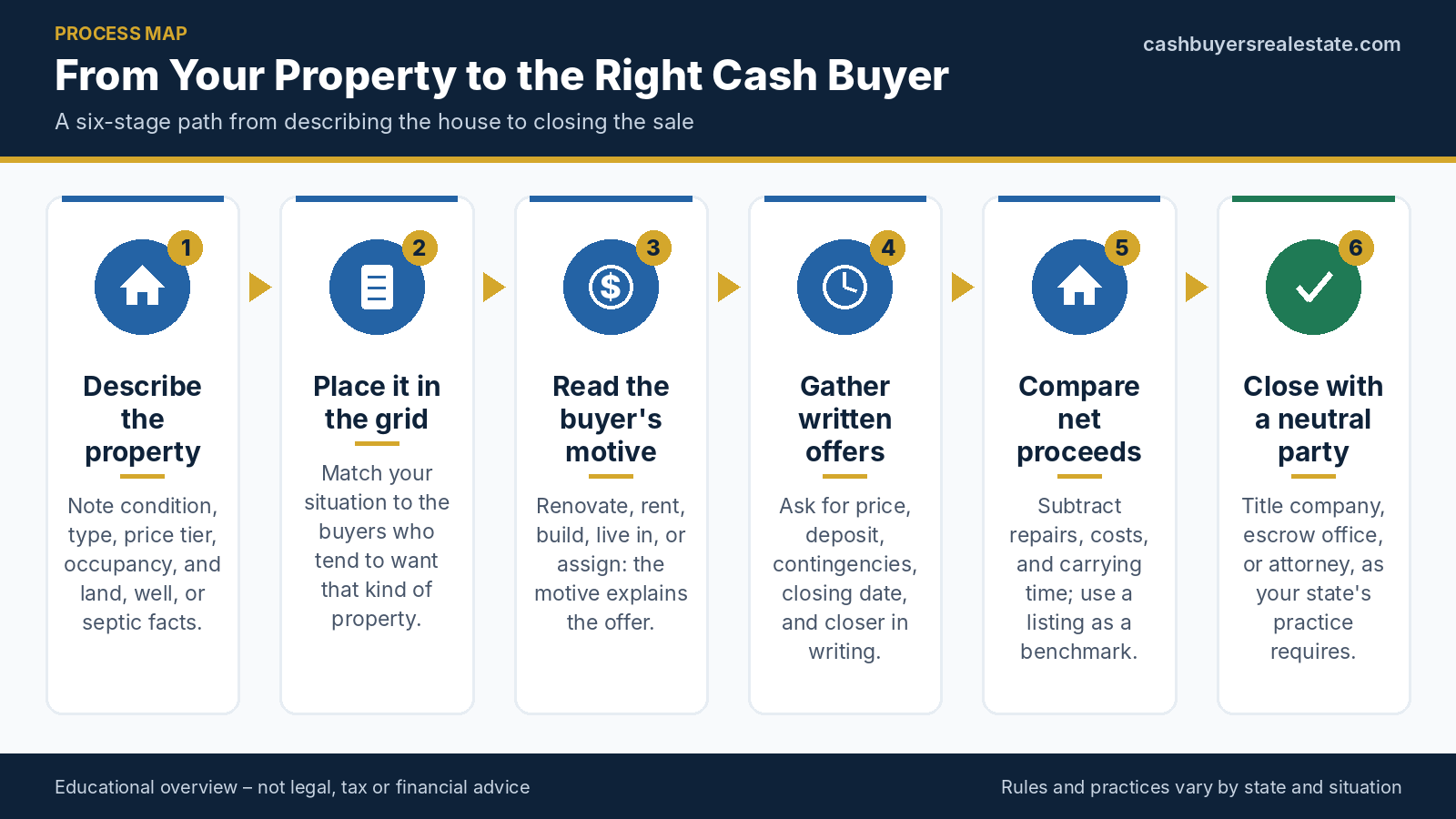
Text version of this infographic
- Describe the property — Note condition, type, price tier, occupancy, and land, well, or septic facts.
- Place it in the grid — Match your situation to the buyers who tend to want that kind of property.
- Read the buyer's motive — Renovate, rent, build, live in, or assign: the motive explains the offer.
- Gather written offers — Ask for price, deposit, contingencies, closing date, and closer in writing.
- Compare net proceeds — Subtract repairs, costs, and carrying time; use a listing as a benchmark.
- Close with a neutral party — Title company, escrow office, or attorney, as your state's practice requires.
Price Tiers Reshape the Cash Buyer Pool From Entry-Level to Luxury
The dollar value of a house changes who can write the check, how much margin that buyer needs, and how many competing buyers there are. A $120,000 house and a $1.4 million house may both sell for cash, but almost nothing else about the two transactions is alike. Price tiers are always relative to the local market, since a mid-priced house in one metro area would be a luxury purchase in another, so the tiers here are defined by where a house sits against the local median and not by a fixed dollar figure.
Entry-Level and Below-Median Homes
The lower end of a local market is where investor activity is typically densest, and it is also where margins are thinnest in percentage terms. Sellers here often face a mix of competing buyers: first-time buyers using small down payments, landlords hunting for yield, and renovators looking for projects. Understanding how those groups behave helps you see why offers fall where they do.
Why the bottom of the market draws so many investors
Lower-priced houses attract investors for a straightforward reason: the ratio of rent to price is generally more favorable on cheaper homes, and the cost of buying a property outright is small enough for individuals and small companies to handle without a bank. A landlord with $150,000 in savings can buy one inexpensive rental in cash; the same money covers only a fraction of a house in a high-priced neighborhood. Renovators like these houses because a modest purchase price leaves room for repairs while keeping the finished house in a range where many retail buyers can still qualify for a loan.
The pool is not constant, and recent data shows how it can shift. Redfin reported in May 2026 that investor purchases of low-priced homes in the first quarter of the year were down 10 percent from a year earlier, the lowest first-quarter level in a decade, even while investors accounted for about 19 percent of all home purchases. In plain terms, the share of investors was roughly stable, but the volume at the low end fell, which suggests that investors had become choosier. For a seller, a quieter investor market means fewer competing offers and possibly lower ones, and a busier one means the opposite, so pay attention to how many serious inquiries you get in the first week or two.
Competition from owner-occupants also matters. First-time buyers made up 21 percent of buyers in the National Association of REALTORS® 2025 buyer profile, the lowest share since the survey began in 1981, with a median age of 40. Those buyers are often shopping in the same price range as investors, and they generally need a house that passes a lender’s appraisal and an inspection. When a house at the lower end of the market is in good enough shape for a loan, it can attract bids from both groups, and the investor’s cash offer has to compete with a household’s willingness to pay full price. When the house is not loan-ready, the household buyers drop out and the investors are left.
Rent math and the price an investor can support
Landlords build their offers from the rent a house can produce. They estimate the monthly rent, subtract property taxes, insurance, maintenance, vacancy, and any management fee, and divide the annual result by the total cost of buying and preparing the house. That ratio tells them whether the investment meets their return target. If the number falls short at your asking price, they either offer less or walk away. The calculation is unsentimental, and it is also useful to you, because it shows what a rental investor is likely to pay for a house like yours before any offers arrive.
Illustrative example (hypothetical numbers, not market data): A small landlord expects to rent a two-bedroom house for $1,250 a month, or $15,000 a year. After property taxes, insurance, a maintenance reserve, and an allowance for vacancy, the landlord assumes operating costs of about 45 percent of rent, leaving $8,250 a year. The landlord wants a return of at least 7 percent on total cash invested. Dividing $8,250 by 0.07 gives roughly $117,900 as the all-in cost the landlord can support. If the house needs $8,000 of work to be rentable, the landlord’s supportable offer is about $109,900. A seller asking $130,000 would give the landlord a return of about 6.3 percent before repairs, which falls below the target, so the landlord might counter low, offer terms instead, or pass.
Two things stand out in that example. First, the investor’s price is anchored to rent, not to the sales price of the neighbor’s renovated house, so a house in a neighborhood where renovated homes sell high but rents are modest can attract much lower landlord bids than a flipper’s. Second, every input is an assumption the investor made, and you can test them: ask what rent the buyer assumed, check it against listings of comparable rentals, and notice if the operating-cost estimate is unusually heavy. If the landlord’s rent estimate is too low or the maintenance reserve too high, you have a basis for a counteroffer. Sellers who understand the formula negotiate with facts instead of feelings, and the guide to how a cash offer compares with market value goes deeper on how to frame those counters.
Mid-Market, Upper-Tier, and Luxury Homes
Moving up the price ladder changes the buyer mix in a way that surprises many sellers. Investor discounts shrink in the middle, individual cash buyers grow in importance, and at the top the market becomes a matter of finding the right person and not the right business model. The two sections below track that progression.
Mid-priced homes, where owner-occupants and investors overlap
In the middle of the market, the houses are the ones most households want. That means the strongest competition for any mid-priced house comes from retail buyers who will pay full price and live in it, and investors must beat them to win the property. In practice, investors win mid-priced houses in two situations. The first is when the house is outside the lending envelope, because of condition, an unusual layout, or an occupancy issue, so retail buyers cannot compete. The second is when the seller values speed and certainty enough to accept less than a retail buyer might eventually pay. In both cases the investor’s margin is typically measured against a high resale value, which is why flip profits in dollar terms are larger here than at the bottom of the market.
The ATTOM figures are a useful reality check on how much margin the middle of the market produces. In its second-quarter 2026 report, the data firm put the typical gross profit on a flip at $60,526, a typical profit margin of 21.5 percent, with a typical holding period of 161 days. Those are national medians across all price ranges, so they will overstate what flippers earn on the cheapest houses and understate it on the priciest. They do illustrate that a flipper needs a few tens of thousands of dollars of cushion between purchase price and resale value to justify the risk, and that cushion has to come from somewhere. A cushion of that size helps explain why an investor’s offer on a house in rough shape can sit well below its eventual resale value, while a house in better condition justifies a much smaller gap.
If you own a mid-priced home in decent condition, the key question is whether a cash offer beats your net from a listing. A cash buyer may pay less in headline price but save you commissions, repairs, showings, and carrying costs, and the answer depends on the numbers. The guide to net proceeds from a cash sale versus a traditional sale shows how to lay the two outcomes next to each other so that the comparison is apples to apples.
High-priced and luxury homes: fewer buyers, more individuals
At the top of a local market, flippers and rental investors play a smaller role. Carrying costs, such as taxes, insurance, utilities, and interest, scale with price, and the pool of buyers for any specific high-end house is small, so a flipper risks holding an expensive asset for a long time. The cash buyers who do appear tend to be individuals and families with substantial liquidity: executives relocating, people selling a business or another property, and households who simply prefer to avoid a mortgage. The National Association of REALTORS® reported in 2025 that nearly one in three repeat buyers paid all cash, though the report does not say how that share varies by price tier.
Privacy and speed matter more at this level than a few percentage points of price. Some buyers use trusts or limited liability companies to hold title, which can make them look like investors in data that classify buyers by name, even though the buyer plans to live in the house. A buyer who uses an entity for privacy or estate planning is not necessarily a business buyer, and it is reasonable to ask why the entity exists, who stands behind it, and who will sign the contract. Those questions are routine and should not offend a legitimate buyer.
Pricing high-end properties is also harder, because comparable sales are scarce and each house has features that do not translate easily into numbers. A cash offer on such a property is usually negotiated one-on-one, often with an agent involved on both sides, and the seller’s best protection is a credible independent opinion of value. The table below summarizes how the tiers differ, with the caveat that the tiers are relative to your local market.
| Relative price tier | Cash buyers most often active | How offers tend to be built | Competing buyers | Seller watch-out |
|---|---|---|---|---|
| Entry-level, below local median | Small landlords, flippers, local investors | Rent-based yield or resale minus repairs and margin | First-time buyers with loans, other investors | Offers can be well below resale value when repairs are heavy |
| Middle of the market | Flippers, landlords, relocating households | Resale value minus repairs, costs, and profit target | Retail buyers who will pay full price | Cash may cost you less than expected only if the house is loan-ready |
| Upper-tier | Equity-rich repeat buyers, some builders, selective investors | Comparable sales with adjustments for features | Financed buyers with large down payments | Fewer bidders, so a single offer is harder to test |
| Luxury | Wealthy individuals, trusts, relocating executives | Negotiated one-on-one against sparse comps | A small pool of qualified buyers | Appraisal and pricing disagreements can drag on |
Read the table from left to right as a story: the lower the tier, the more the offer depends on the buyer’s business formula, and the higher the tier, the more it depends on individual taste and negotiation. A seller in the middle of the market can often create competition between investors and households, while a seller at either end has to work harder to find even two serious bidders. In every tier the best defense against a low offer is a documented estimate of value, a clear list of what is included, and at least one alternative path, such as a listing or a second buyer, that you can credibly pursue.
Why Buyers Want Your House: Five Motives and What Each Does to the Offer
Property type and price tell you who can buy. Motive tells you what they will pay and what they will ask of you. Almost every cash offer on a house rests on one of five purposes: renovate and resell, rent and hold, build or redevelop, live in the house, or assign the contract to someone else. A buyer may combine two of them, but one usually drives the number. Learning to spot the motive behind an offer is the most useful negotiating skill a seller can develop, because the motive explains the price, the timeline, and the contract terms in one stroke.
Motives That Use the House: Renovate and Resell, or Rent and Hold
Two of the five motives keep the existing house in place and improve or operate it. They produce most of the investor offers on ordinary single-family homes, and they behave quite differently. One is a project with a clock running; the other is a business with a long horizon. The fifth motive, buying to live in the house, appears in the worked example and the table at the end of this section.
Renovate and resell: a project with a clock
A buyer who plans to renovate and resell is selling a finished product and buying raw material. Every week the house sits unsold costs interest, taxes, insurance, and utilities, and a flipper’s profit disappears as the calendar fills. As a result, flippers value speed in both directions: they want to close quickly on the purchase and finish the work quickly. They are also unusually sensitive to repair surprises, since the margin is measured against the finished resale price and a single large unknown can consume it. This sensitivity explains the behavior sellers find frustrating, such as short inspection periods followed by price reductions after the buyer’s contractor walks the house.
Understanding that behavior lets you prepare. Provide documentation of any work already done, share anything you know about the roof, plumbing, and electrical system, and be clear about what stays with the property. A seller who has already disclosed the known issues makes a post-inspection reduction harder to justify, because the buyer cannot claim to have discovered them. Expect these buyers to ask for a flexible closing date on their side, to price in a margin for the unknown, and to prefer contracts with enough contingencies to walk away if the inspection finds something large.
This motive also explains why the same buyer may be generous on one house and stingy on another. The offer is the output of a resale estimate, a repair estimate, and a margin, and the resale estimate depends on recent sales of finished houses nearby. If your street has had several renovated sales, a flipper can bid more confidently, and if it has had none, the flipper has to guess and will guess low. Giving buyers access to your own comparable-sales data, from an agent’s analysis or an appraiser, is therefore one of the few ways to push the resale estimate upward.
Rent and hold: yield, tenants, and patience
A landlord who buys to rent pays for a stream of income and, in some markets, for appreciation over time. Because the plan is long-term, landlords tend to be more patient than flippers about closing dates and less sensitive to cosmetic issues. They care deeply about what makes a house rentable: a sound roof, working systems, a layout tenants want, and a location that keeps units occupied. They will often accept a house that looks tired, if it is mechanically sound, because paint and flooring are cheap relative to rent. A landlord also thinks about the second and third year of ownership, so a water heater near the end of its life or a drain line with a history of backups carries real weight in the offer, even when the house photographs well.
The hold motive also includes buyers who plan to rent the house for a few years and sell later, and those who use the purchase as the first step in a repeat strategy of buying, renovating, renting, refinancing, and buying again. How that plan shapes offers is covered in the sibling guide on how investors who buy houses make money, and the main point for a seller is that a buyer relying on a refinance after renovation is counting on an appraisal that supports the plan. Ask how the purchase is funded and whether the closing depends on any later financing step.
Landlords’ offers are tied to rent, which makes them more stable than a flipper’s resale-driven offers and less responsive to how nice the house looks. A seller who has spent money on a fresh coat of paint and staging may find that it moves a landlord’s number very little but moves a household buyer’s number a great deal. That is a good reason to ask, before spending anything on preparation, which buyer type you are actually trying to attract. The sibling article on real estate investors that buy houses describes the investor side of this in more detail.
Motives That Change the Property or Pass It On: Build, Redevelop, or Assign
The remaining motives are less obvious to sellers and generate more confusion. A builder may care little about the house standing on the lot. An assignor may not intend to buy it at all. Recognizing these buyers early protects you from surprises and helps you decide whether their terms fit your situation.
Build or redevelop: when the land is the asset
Builders and developers buy houses for the lot underneath. A small, outdated house on a generously sized parcel in a neighborhood where new construction sells well may be worth more to a builder as a teardown than to anyone as a home. The builder’s offer is built from the value of the finished new home or homes, minus construction costs, permits and utility connections, demolition, financing, and profit, and what is left is the land value. The existing structure may carry little or no value, or even a negative value if demolition is costly or the house contains hazardous materials that require special handling.
This motive brings two differences in the contract. First, builders often need a long due-diligence period to confirm zoning, setbacks, utility availability, soil conditions, and permit feasibility, and they may make the purchase contingent on obtaining approvals. A long contingency period gives the buyer a free option and gives you uncertainty, so it deserves a price or a non-refundable deposit in exchange. Second, a builder may want to subdivide a lot or combine parcels, which depends on local rules that vary widely by county and municipality. If a buyer says the lot can be divided, check that with the planning office, because a buyer’s optimism is not a permit.
For a seller with a house that is plainly past its useful life, the builder’s motive can be a source of competing bids, since a builder and a renovator value the property by different logic. Builders also tend to know which streets have seen recent teardown sales and what the new homes brought, so their interest is itself a clue about how the neighborhood is changing. If your parcel is larger than the neighbors’, it is worth asking a local agent or a land-use professional whether redevelopment demand exists nearby. The same house may sell for a modest amount as a rehab and a much higher amount as a building site.
Assign: the buyer who may not buy the house
An assignment buyer, commonly called a wholesaler, signs a purchase contract with you and then sells the right to complete it to another buyer for a fee. The contract price you agree to is not necessarily what the final buyer pays, and the difference is the assignor’s income. This is a lawful practice in principle, but regulation of it varies by state. Oklahoma, for example, has a Predatory Real Estate Wholesaler Prohibition Act effective November 1, 2021, which the Oklahoma Real Estate Commission describes as bringing wholesaling under the state’s real estate license code. Other states approach disclosure and licensing differently, and some have no specific statute at all, so the legal position of an assignor depends on where the property sits.
From a seller’s viewpoint the motive creates two risks. One is price: if the assignor sells the contract at a large spread, you may have sold below what the end buyer would have paid you directly. The other is performance: an assignor who cannot find an end buyer within the inspection period may try to renegotiate or cancel, which leaves you with a house that has been off the market for weeks. Neither risk makes an assignment buyer dishonest. It means you should read the assignment clause, ask directly whether the buyer intends to close personally or assign, and consider whether a shorter option period or a meaningful earnest money deposit would protect you.
The broader guides on cash house buyer types and on vetting a buyer’s identity and funds cover this subject more thoroughly. For this guide, the point is that an offer from an assignor is not worse or better than any other; it simply has a different structure, and the structure should be visible to you before you sign.
Illustrative example (hypothetical numbers, not market data): A dated, livable house with a market value of about $210,000 in updated condition draws three cash approaches. A flipper plans $30,000 of updates, expects $16,800 in selling costs, $8,000 in holding costs, and wants $20,000 in profit, so the flipper’s ceiling is $135,200. A landlord needs only $12,000 of work to rent the house for $1,500 a month with operating costs near 42 percent; at a 7.5 percent target return, the landlord’s ceiling is about $127,200. A retiree paying cash with proceeds from a prior sale will live in the house and compares it to updated homes at $210,000; after deducting a few repairs an inspector will flag, the retiree is willing to pay near $185,000 but needs 35 days to close. The strongest bid comes from the buyer with the slowest timeline, and only a seller who looks beyond the first investor phone call is likely to meet that buyer.
That example condenses the section. The same house yields three defensible prices because the buyers want three different things. None of the three is cheating you, and the lowest is not an insult. What matters is whether you have the time and willingness to give the house exposure to the buyer who values it most. The table below places all five motives side by side.
| Buyer motive | What the buyer is paying for | How the offer is usually built | Typical contract traits | What it implies for you |
|---|---|---|---|---|
| Renovate and resell | A discounted project with a resale at the end | Resale value minus repairs, costs, holding time, and profit | Short inspection window, as-is language, flexible buyer closing | Expect retrades if the inspection finds big items |
| Rent and hold | A stream of rent and long-term ownership | Net rent divided by a target return, minus repairs | Patience on closing, attention to leases and condition | Cosmetic upgrades matter little; sound systems matter a lot |
| Build or redevelop | Land and the right to build on it | Value of finished new homes minus construction, permits, and profit | Long due-diligence period, zoning and permit contingencies | Price the contingency; verify zoning claims yourself |
| Live in the house | A home, paid for in cash from other proceeds | Recent comparable sales with adjustments for condition | Standard inspection, repair negotiations, 30-day style closings | Often the highest price, but less flexible on repairs |
| Assign the contract | A spread between your price and an end buyer’s price | End buyer’s likely ceiling minus the assignor’s fee | Assignment clause, inspection or option period, thin deposit | Ask whether they intend to close personally; check state rules |
To read the table, find the motive you suspect from the conversation and check whether the contract traits match. A buyer who claims to be a long-term landlord but asks for a three-week option period and an unrestricted assignment clause is behaving like an assignor, and it is fair to ask. A buyer who says they are planning to live in the house but cannot describe the neighborhood or the timing of a move has probably not thought about it yet. These mismatches do not prove anything bad, but they point to questions that deserve a direct answer.
Another way to see the motives is to compare the routes they represent, side by side, on who each fits best and what each costs you. The second infographic does that for the five routes, with a short note on the best use and the main trade-off of each.
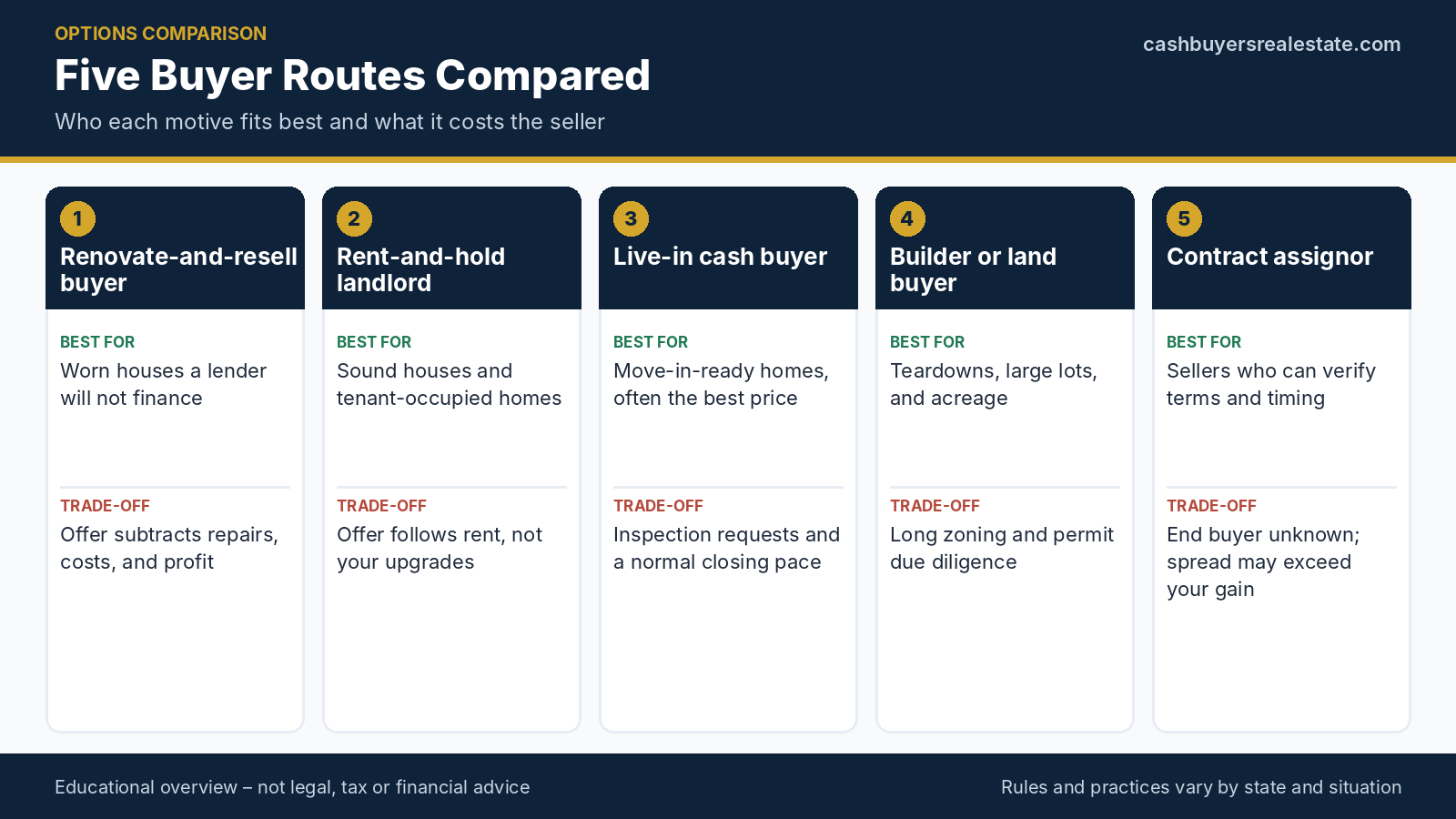
Text version of this infographic
- Renovate-and-resell buyer — Best for: Worn houses a lender will not finance. Trade-off: Offer subtracts repairs, costs, and profit.
- Rent-and-hold landlord — Best for: Sound houses and tenant-occupied homes. Trade-off: Offer follows rent, not your upgrades.
- Live-in cash buyer — Best for: Move-in-ready homes, often the best price. Trade-off: Inspection requests and a normal closing pace.
- Builder or land buyer — Best for: Teardowns, large lots, and acreage. Trade-off: Long zoning and permit due diligence.
- Contract assignor — Best for: Sellers who can verify terms and timing. Trade-off: End buyer unknown; spread may exceed your gain.
Occupancy and Shared Walls: Tenants, Vacant Houses, Condos, and Small Buildings
Who lives in the house, or whether anyone does, reshapes the buyer pool as much as condition does. A sound house with a tenant paying below-market rent is a different asset from the same house empty, and a condo is different from either because other owners’ behavior affects the value of yours. These situations narrow the field of cash buyers in some ways and widen it in others, and the sellers who handle them well tend to be the ones who gather the right paperwork before the first call.
Tenant-Occupied Properties: The Lease Is Part of What You Are Selling
When a tenant lives in the property, a buyer is purchasing a house and also a set of existing rights and obligations. How a lease carries over to a new owner, what notices are required, and what happens to the security deposit are matters of state and sometimes local law, and an attorney who handles landlord-tenant matters in your state is the right source for them. The paragraphs below describe how buyers think about occupied properties, not how your lease works.
What rental buyers are actually valuing
Landlords and rental funds pay for income, so the starting point is the rent roll: who the tenants are, what each pays, when each lease ends, whether payments arrive on time, and what deposits are held. A house leased at a rent close to the market level for another year is attractive because the buyer takes over a working business with no vacancy period. A house leased well below market rent is less attractive, because the buyer may be locked into a low return until the lease ends, and the lower income reduces the price the buyer can support using the rent-based formula described earlier. A month-to-month tenancy offers flexibility in the other direction: the buyer can raise rent or take possession sooner, subject to notice rules, but also faces the risk of turnover.
Buyers who intend to occupy the home themselves, or to renovate and resell it, view a tenant as an obstacle, and they will discount their offers for the time and cost of regaining possession. In practice, that means a tenant-occupied property tends to sell to rental buyers, with a smaller group of renovators willing to wait. Pressuring a tenant to leave to make a sale easier is risky, legally and ethically. State and local rules govern notices, entry for showings, and any payment to a tenant who agrees to move out, and a buyer who learns that you handled a tenant improperly may walk away or demand a lower price.
Sellers can improve their position by assembling a simple package: copies of leases and amendments, a payment history for the past year, the amount of every deposit and where it is held, records of repair requests and what was done, and a clear note on utilities and who pays them. Buyers also commonly ask for written confirmation from tenants of the rent and lease terms, sometimes called an estoppel statement, and being ready for that request shows you are organized. For more on occupied sales, see the guide to cash buyers for rental properties.
Local rules that can add steps, and a worked scenario
Some jurisdictions give tenants special rights when a landlord sells. The District of Columbia is a well-documented example: its Tenant Opportunity to Purchase Act gives tenants in rental buildings notice of a proposed sale and a first chance to buy, with timelines that can add weeks or months before the sale to a third party can close. Since July 3, 2018, most single-family homes in the District have been exempt, though limited rights remain for certain elderly or disabled tenants who met specific lease and occupancy dates, according to the District’s housing department and the Office of the Tenant Advocate. Most places have no such law, but the existence of any like it is one reason a seller of an occupied property should check local rules before signing a contract.
Federal law in this area is narrower than many people assume. The Protecting Tenants at Foreclosure Act, for example, deals with tenants in foreclosed properties, not ordinary sales between private parties. For routine sales, the controlling rules come from state landlord-tenant statutes, the lease itself, and any local ordinances. A buyer’s attorney and your own will usually review them, so ask early whether the contract treats the tenant’s lease as continuing and how the deposit transfers at closing.
Illustrative example (hypothetical numbers, not market data): A seller owns a duplex where one side is rented at $950 a month on a lease with fourteen months remaining, and the other side is rented month to month at $1,100. A landlord buyer estimates market rent at $1,200 per side. The first unit is $250 a month below market, or $3,000 a year, for fourteen months, which is about $3,500 of foregone rent. The buyer subtracts that amount from the offer and also asks the seller to credit the security deposits held. A buyer who plans to live in one side and rent the other would value the month-to-month unit differently, because possession could be recovered after proper notice. The same building could therefore draw two different offers depending on whether the buyer wants the income or the space, and the seller’s records are what let each buyer price the situation accurately.
Table 4 summarizes how common occupancy situations change the buyer pool, so you can see where your property falls and what to prepare.
| Occupancy situation | Cash buyers who tend to fit | How it affects value | What buyers will ask for | Seller preparation |
|---|---|---|---|---|
| Owner-occupied, moving out before closing | Households, flippers, landlords | Neutral; the buyer gets the house on a set date | Move-out date and condition at closing | Plan the move and cleanout early |
| Vacant and secured | Flippers, landlords, builders | Faster access, but carrying costs fall on the seller until closing | Keys, utilities, access for inspections | Keep it insured, heated or cooled as needed, and maintained |
| Tenant on a lease at or near market rent | Landlords, rental funds | Supports the price through existing income | Lease, payment history, deposit records | Assemble a tenant file and tell the tenant about showings as the law requires |
| Tenant on a lease well below market | Landlords willing to wait | Reduces value by the rent gap over the lease term | Same documents plus any rent increase rights | Verify what the lease and state law allow before arguing for a higher price |
| Month-to-month tenant | Landlords and live-in buyers | Flexible for the buyer, riskier for tenant turnover | Notice terms and rental history | Understand notice rules in your state |
| Tenant behind on rent or holding over | Experienced investors comfortable with eviction | Heavy discount for uncertainty and legal cost | Court filings, payment ledger, notices served | Talk with a landlord-tenant attorney before negotiating |
The table works best as a preparation checklist. If your property sits in the first row, the main task is logistics. If it sits in the last row, the buyer pool is small and the price will reflect the legal uncertainty, so the useful question may be whether to resolve the tenancy first with the help of an attorney, or to sell with the tenant in place to a buyer who accepts that. Either choice can be reasonable, and the right one depends on the state’s process, the cost in time and money, and the amount you would gain.
Vacant Houses, Condos, and Small Multifamily Buildings
The second group of properties differs from tenant-occupied homes mainly in who bears risk while the sale is pending. A vacant house exposes you to physical risk, a condo exposes you to the finances of an association, and a small multifamily building exposes you to both rent-roll and building condition. Each shifts the buyer pool in a particular direction.
Vacant houses: convenience for the buyer, carrying risk for you
An empty house is easy to show, inspect, and hand over, which appeals to renovators and landlords who plan to start work immediately. It is also exposed. Pipes freeze, roofs leak unnoticed, break-ins and vandalism happen, and neighbors and code officers notice overgrown lawns. Many insurance policies limit or exclude certain coverages when a home has been vacant for a set period, with the details depending on the insurer and the policy, so it is worth asking your insurer what applies to you before you assume the house is covered. Some cities also require owners of vacant buildings to register them or maintain them to specific standards.
For cash buyers, a vacant house with a clean title is among the most straightforward purchases, and they will often accept it as is, with a short inspection period. The main price effect comes from the reason the house is empty. A house vacant because the owner moved is a different proposition from one vacant because of fire damage, a death, or code enforcement, and buyers will ask. If you are selling a house that has sat empty, spend a little to keep it maintained and presentable, and document the condition with dated photographs. The sibling guide on cash buyers for vacant houses covers those situations in more detail.
Practical upkeep matters more than staging. Utilities should stay on long enough for the buyer’s inspection, because a buyer cannot test the furnace, the water heater, or the plumbing in a house with the power and water shut off, and an untested system is priced as a failed one. Winter brings its own task: keeping the heat at a safe minimum or having the water system properly drained by a professional prevents burst pipes. Lawn care, a visible lockbox, and a neighbor or property manager who can check on the house weekly all tell a buyer the property has been looked after, and they reduce the discount a careful buyer would otherwise apply for the unknown.
Condos, townhomes, and two-to-four-unit buildings
Condominiums and some townhomes carry a layer that single-family sellers do not face: the association. Financed buyers must often buy in a project that meets the lender’s standards, and those standards are why condo sales sometimes fall through for reasons that have nothing to do with the unit. Fannie Mae’s project standards, for example, treat a single owner holding more than 20 percent of the units in a project of 21 or more units as over its limit, and limit the share of units that are 60 or more days behind on association dues to 15 percent. A project that fails such tests can be hard to finance, which pushes a seller toward cash buyers, who do not have to satisfy a lender. That helps explain why investors and cash-rich households are a common source of buyers for condos in troubled or investor-heavy projects.
The association also affects what you must provide. Associations typically supply documents on dues, special assessments, rules, and any pending litigation, and may charge a fee for them. Some governing documents restrict rentals, which matters to investors, or give the association a role in approving buyers, which matters to everyone. Order those documents early, and treat any unpaid assessments as something to resolve before closing.
Small multifamily buildings with two to four units sit between houses and larger investments. Some buyers are owner-occupants who plan to live in one unit and rent the others, often with a loan; cash buyers are usually investors who value the property by its rent roll and building condition. The valuation questions resemble those for tenant-occupied houses, multiplied by the number of units, and the buyer’s inspection will focus on shared systems such as roofs, boilers, and separate utility meters. If the building is mixed, with some owner-occupied and some leased units, the paperwork for each unit should be organized separately so the buyer can price each one.
Land, Rural Parcels, and Manufactured Homes: Where Title and Terrain Pick the Buyer
Away from the suburbs the cash buyer pool changes character. Houses sit on larger parcels, comparable sales are sparse, and a significant share of homes are manufactured or mobile homes whose legal status can differ from a conventional house. In these settings the question of who buys is shaped by what kind of land the buyer wants, how the home is titled, and whether a lender is willing to touch the deal at all. This section covers the rural parcel first and then the manufactured home, where a single line on a title document can change the buyer pool completely.
Rural Houses, Acreage, and Land-Heavy Parcels
A house surrounded by acreage is really two assets: a dwelling and a piece of land. Different buyers value the two in different proportions, and the way you present the property can steer which buyers pay attention. Rural sales are also slower and less predictable, and cash buyers fill a gap that appraisal and lending constraints leave behind.
Why the buyer pool changes outside metropolitan areas
In a dense neighborhood, a house may sell to any of hundreds of qualified buyers within weeks. In a rural county the number of qualified buyers for a specific parcel may be a handful. The usual suspects include neighbors who want to enlarge their holdings, farmers and ranchers who need pasture or cropland, hobby farmers and people seeking a country lifestyle, recreational buyers who want hunting or fishing access, timber and land investors, and builders with plans for a homesite. Each looks at the same parcel through a different lens, and the one who values the land most is often a neighbor who already knows its soils, access, and quirks.
Cash plays a larger role in rural sales for practical reasons. Lenders and appraisers rely on comparable sales, and in sparsely populated areas those may be few, old, or dissimilar, so appraisals can come in uncertain or low. Land loans, where available, tend to be harder to obtain than mortgages on homes. A buyer paying cash sidesteps those hurdles, and a seller whose property has unusual features often finds that cash buyers are the realistic pool. Sellers sometimes also consider carrying the financing themselves, which opens the door to buyers without a bank, though that choice involves its own legal and tax complications and calls for professional advice.
The Consumer Financial Protection Bureau noted in 2014 that manufactured housing made up about 6 percent of occupied U.S. housing but roughly one in seven homes outside metropolitan areas. That figure is dated, and the share has shifted since, but it is a reminder that a rural seller is more likely than an urban one to be dealing with a manufactured home on a parcel, which adds a second layer to the buyer pool. The next subsection returns to that point in detail. For now, the practical takeaway is to price and market the land and the dwelling as a package whose parts may appeal to different bidders.
Wells, septic systems, access, and the rural due-diligence list
Rural buyers, especially experienced ones, run a due-diligence checklist that city buyers rarely consider. Drinking water often comes from a private well, and the Environmental Protection Agency states that private well owners are responsible for delivering safe drinking water to their households and that private wells are not regulated by the federal government under the Safe Drinking Water Act. Whether a state or county requires testing at sale varies, so a buyer may ask for a water test as a contingency, and a seller who has recent results in hand can shorten that discussion. Sewage is often handled by a septic system, and requirements for inspection, permits, and repair at sale differ by county and state; a failing system can be a major repair and is covered in more depth in the guide to selling a house with septic problems.
Access and legal boundaries matter too. A rural parcel may rely on a private road or an easement across a neighbor’s land, and a buyer will want to see recorded documents that guarantee access. A survey that matches the legal description protects both sides, since fences are not always on the property line. Mineral or timber rights may have been separated from the surface in a prior sale, and some states offer agricultural or open-space tax programs under which changing the land’s use can trigger back taxes. None of these items is unusual, but each is the sort of detail that costs time if it is discovered late and costs nothing if it is documented early.
Illustrative example (hypothetical numbers, not market data): A seller inherits a farmhouse on twelve acres that includes a few acres of open pasture and a wooded back portion. The house is livable but dated, with a well and an older septic system. A neighboring rancher values the pasture and tells the seller the house is worth little to him, offering a figure based mostly on acreage. A couple relocating from the city, paying cash from the sale of their home, values the house and the privacy and is willing to pay a higher overall figure but wants a well test, a septic inspection, and thirty days to close. A builder is interested in splitting off two acres for a homesite but needs a survey and county approval first. The same twelve acres draw three offers with three structures, and the seller who knows what each buyer is actually paying for can decide whether the highest number is also the surest.
Manufactured and Mobile Homes: The Title Decides the Buyer
Manufactured housing is a major source of affordable homeownership, and it is also where sellers are most often surprised by how much the paperwork matters. Whether a home is legally treated as real estate or as personal property, whether it sits on land the owner holds, and when it was built all shape who can buy it and how.
Real property or personal property: what the title says
The Consumer Financial Protection Bureau explained in 2014 that manufactured homes may be titled either as real estate or as personal property, while site-built homes are almost always titled as real estate. Real estate titling generally requires a permanent foundation on land the owner holds, and personal property titling generally goes with a personal property loan, also known as a chattel loan, which tends to have lower origination costs and faster closings but fewer consumer protections. A HUD-published study in the Cityscape journal found that only about 19 percent of new manufactured homes shipped in 2019 were titled as real property while about 76 percent were titled as personal property, and that about 64 percent of manufactured home owners also own their land while roughly 28 percent own the home but not the lot.
Why does this matter to a cash seller? Because it determines whether a retail buyer with a conventional mortgage can compete. Fannie Mae’s guidelines require that the manufactured home and the land it sits on be legally classified as real property, that the home sit on a permanent foundation, and that it carry a HUD data plate or certification label. A home that does not meet those standards generally cannot be financed through that channel, which leaves cash buyers and buyers using other loan types. Titling rules come from the states, and they differ. In Texas, for instance, the housing department explains that a manufactured home is personal property by default and becomes real property only when the owner files an application for a statement of ownership, meets requirements on land ownership or a qualifying lease, resolves liens, and records the statement in the county real property records. Other states use different mechanisms, so ask your state’s titling agency or an attorney how your home is classified.
| Situation | How it is usually titled | Cash buyers who tend to fit | Financing available to other buyers | What the seller should check |
|---|---|---|---|---|
| Newer home on owned land, permanent foundation | Often real property if the paperwork was completed | Owner-occupants, local investors, neighbors | Mortgage may be possible if lender standards are met | Recorded title status and any conversion documents |
| Newer home on owned land, titled as personal property | Personal property under state motor-vehicle or housing records | Cash buyers who can retire the title | Often limited to chattel loans or cash | Whether a conversion to real property is available in your state |
| Home in a leased park lot | Personal property in most cases | Cash buyers who will keep it in place | Chattel loans or cash; park approval often needed | Park standards, lot rent, and approval timeline in writing |
| Home built before June 15, 1976 | Varies; no HUD certification label | Cash buyers, investors, removal or salvage buyers | Lenders usually require a HUD label or data plate | Age, condition, and any park age limits |
| Home with a lien or unclear title paperwork | Depends on state records | Experienced investors who clean up title | Not financeable until resolved | Lien payoff and title record before marketing |
| Home to be moved off site | Personal property | Buyers with transport and a prepared site | Rarely financed | Moving permits, condition for transport, who pays |
To use the table, begin with your own title documents and recorded land records, not with the sign out front. If your home is on owned land and titled as personal property, the question of conversion is a worthwhile one to bring to a title company or attorney, because a home that can be treated as real property reaches a wider group of buyers. If you are in a park, the buyer pool is shaped by the park’s rules. In every case, the more precisely you can describe the title situation, the less discount buyers will build in for uncertainty.
Homes in parks, older homes, and what moves the price
Since June 15, 1976, manufacturers of manufactured homes have been required to certify that each home meets the federal construction and safety standards, known as the HUD Code, by attaching a red certification label to each transportable section, according to HUD. Homes built before that date are often called mobile homes, have no such label, and are harder to finance. That age line is one of the biggest price breaks in the segment, along with condition, size, and whether the home can legally stay where it is.
When a home sits in a leased park, a buyer who plans to keep it there usually needs the park’s approval, and park rules can affect the pool of buyers. California is a documented example: its Civil Code lets park management require prior approval of a buyer who will keep the mobilehome in the park, limits the grounds for refusal to specified reasons such as financial ability to pay rent, requires management to state its standards within 15 days of notice, and treats an application as approved if management does not respond in writing within the statutory window. Other states have different rules, and some leave more room to park owners, so check yours. Lot rent is often a major factor in a buyer’s math, because a buyer is effectively paying monthly rent forever and will discount the purchase price for it.
A seller can improve the outcome by learning the park’s requirements before listing the home anywhere, since age limits, condition standards, and approval timelines can disqualify buyers and slow a closing. Gather the title documents, lot rent history, park rules, and any past inspection or repair records. Where a home is old, worn, or ill-suited to the park’s standards, the realistic buyers may be cash investors who will renovate it, buyers who will move it, or those who want the materials, and the price will reflect that narrower field. Because the paperwork is unfamiliar to many sellers, it pays to ask for the buyer’s plan in writing and to have the title transfer reviewed before you sign.
Attracting the Right Buyer and Screening Out the Wrong One
Knowing who is likely to buy your kind of house is only half the work. The other half is reaching those buyers and then separating the ones who can perform from the ones who cannot or will not. Both tasks are within a seller’s control, and neither requires anything more than organization, a few direct questions, and the patience to compare more than one offer. This section starts with screening, because a careless choice of buyer is the costliest mistake in a cash sale, and then turns to presenting the property so that the right buyers find it.
Screening Buyers: Identity, Funds, Terms, and the Closing Table
Screening is not an accusation. Serious buyers expect it and usually answer without fuss, because they have been through it before. The goal is to learn who is on the other side of the contract, whether the money exists, and whether the paperwork says what the conversation said.
Questions and documents that separate capable buyers from talkers
Begin with identity. Ask for the full legal name of the buyer, including the name of any company that will sign the contract, and confirm the entity through the secretary of state’s business registry where it was formed. Ask who has authority to sign and who stands behind the entity. A person acting through a newly formed company is not suspicious in itself, since many investors hold each purchase in a separate company for liability reasons, but you should know whether the company has a track record, a physical address, and a person you can reach. Public records can show whether the buyer has purchased property in the county before, and a title company can often tell you whether the buyer has closed deals with them.
Next comes money. Proof of funds is usually a recent bank or brokerage statement, a letter from a financial institution, or, for buyers using a lender or private capital, a commitment letter that explains the source and terms. Statements should show the buyer’s name or the entity’s name and an available balance at least equal to the price, and you should treat a screenshot or an unsigned note as the weakest form of evidence. The sibling guide on what proof of funds should show goes through the documents in detail. A buyer who relies on hard money or a private lender should show a firm commitment before you take your house off the market.
Third, ask about the closing. Which title company, escrow office, or attorney will handle it, and where is it located? Closing practice varies by state: some states use title companies and escrow agents, others use attorneys at the closing table, and a few use a mix. In either setup you want a neutral professional who holds the money and records the deed, and you want to choose or at least approve that professional. Confirm wire instructions by calling a number you found independently, not one printed in an email, because fraudulent changes to wire instructions are a known risk in real estate closings. Ask how much earnest money will be deposited, with whom, and when.
Red flags in offers and contracts, and what a reasonable explanation looks like
Red flags are patterns that deserve a pause and a question, not proof of bad intent. Almost every pattern has an innocent explanation, which is why the best response to one is to ask for the explanation and see whether it holds up. The table below pairs common patterns with the reason they matter, a plausible innocent reason, and a sensible next step.
| Pattern | Why it matters | Possible innocent explanation | Sensible next step |
|---|---|---|---|
| Pressure to sign today or the offer disappears | Rushing prevents comparison and review | The buyer has a competing deal and a real deadline | Ask for time to review with an attorney; a serious buyer can usually wait a day or two |
| Contract with blank spaces or terms to be filled in later | Blanks can be completed in ways you did not agree to | Placeholder for a closing date or a name | Do not sign until every blank is filled or struck through |
| Very small earnest money deposit that the buyer can recover at will | You carry the risk if the buyer walks away | The buyer plans a quick close and short inspection | Ask for a meaningful deposit held by a neutral party |
| Broad right to assign the contract to anyone | The end buyer may be someone you never vetted | An investor who often uses partners or related entities | Ask whether the buyer intends to close personally; negotiate notice and approval rights |
| Buyer chooses an unfamiliar closing company in another state | The neutral party might not be neutral or licensed locally | The buyer’s attorney recommends a regular partner | Verify the closer’s license and consider proposing a local title company or attorney |
| Proof of funds is a screenshot or a vague letter | Money may not exist or may not be available | Privacy concerns about account details | Request an official statement with sensitive digits masked, or a lender commitment |
| Offer far above all others with a long, free option period | The buyer may be tying up the property while looking for an end buyer | A builder doing real zoning and permit checks | Trade the option period for money or a shorter timeline |
None of the entries should be read as a verdict. A real investor might have a small deposit and a broad assignment clause and still close on time, and a scammer could present perfect-looking proof of funds. The value of the table is that it turns vague unease into specific questions, which a seller can ask politely and in writing, and which a title professional or attorney can help interpret. If the buyer answers calmly and puts the answer in the contract, the pattern has been explained. If answers keep shifting, or the buyer reacts to ordinary questions with anger or urgency, treat that as information about how the rest of the deal is likely to go.
Put together, these screening steps reduce to six habits that apply to almost any buyer, whatever their motive: verify who the buyer is, ask for proof of funds, read the cancellation clauses, check the assignment terms, work with a reputable closer, and never sign a form with blanks. The third infographic gathers those six habits into one checklist, rated by how much risk each one guards against.
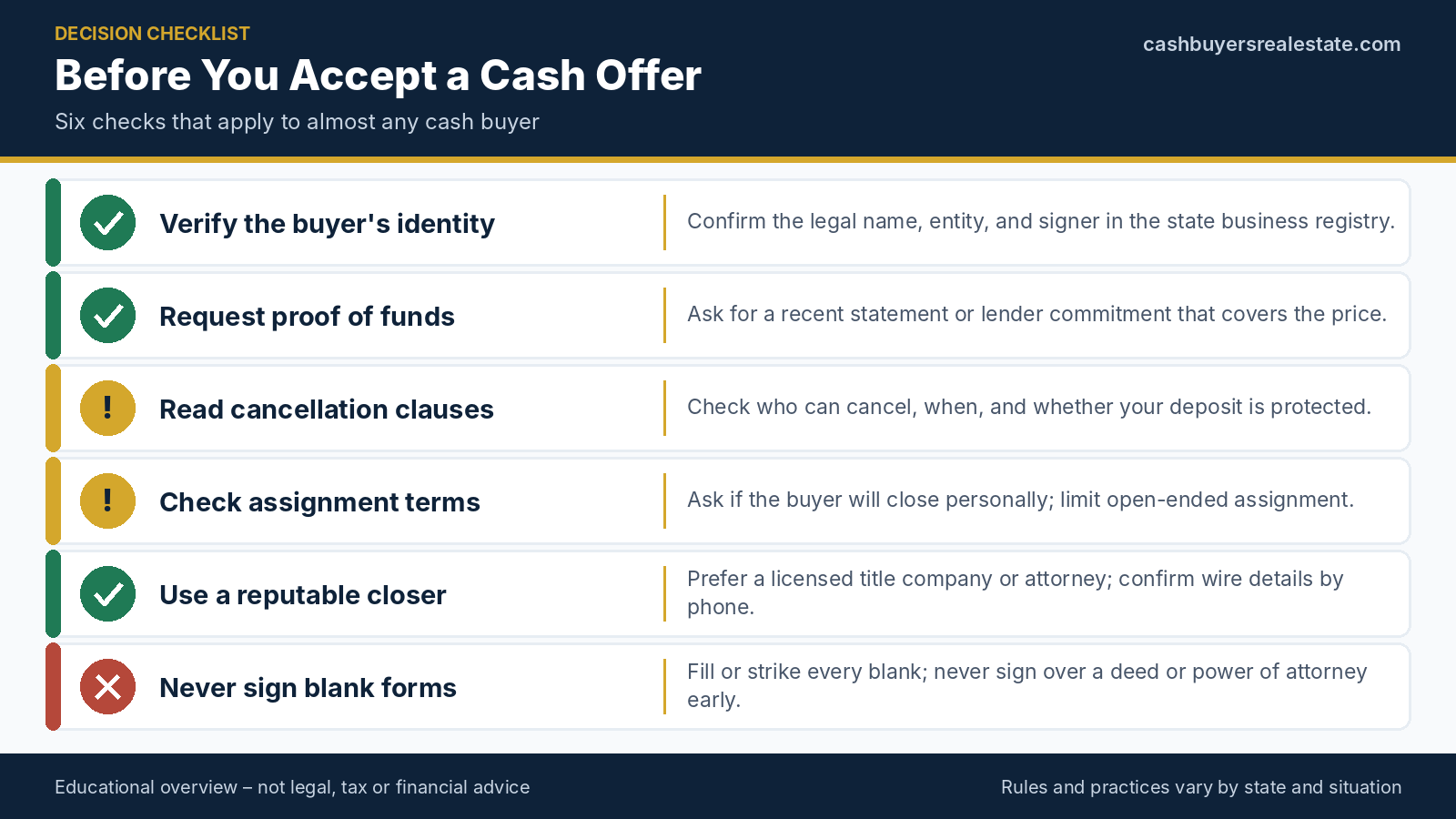
Text version of this infographic
- Verify the buyer's identity — Confirm the legal name, entity, and signer in the state business registry.
- Request proof of funds — Ask for a recent statement or lender commitment that covers the price.
- Read cancellation clauses — Check who can cancel, when, and whether your deposit is protected.
- Check assignment terms — Ask if the buyer will close personally; limit open-ended assignment.
- Use a reputable closer — Prefer a licensed title company or attorney; confirm wire details by phone.
- Never sign blank forms — Fill or strike every blank; never sign over a deed or power of attorney early.
Attracting the Right Buyer for Your Property
Once you can screen, you can invite. The goal is not to chase every buyer but to put accurate information in front of the buyers whose purposes match your property and to give two or three of them a fair chance to bid. Done well, this brings the competition that raises offers without turning the process into a marathon.
Describe and prepare the property for the buyer you want
The easiest improvement is a precise, honest description. State the property type, the year built, the size, the condition of the roof, systems, and structure as you know them, whether anyone lives there, any liens or title issues you are aware of, and the features that matter to the buyer type you are targeting. For a rural parcel, include acreage, access, well and septic information, and any easements. For a rental, include rents and lease dates. For a manufactured home, include the title status. When buyers see that you have answered their first ten questions, they spend less of their offer on uncertainty and more of it on the house.
Preparation should match the audience. Cosmetic improvements such as cleaning, decluttering, and fresh paint matter to a household buyer who will live in the house, and may add little to a renovator’s calculation, since the renovator will gut the kitchen anyway. A seller headed toward renovators can usually skip staging and invest the time in paperwork: permits, receipts, inspection reports, and a clear list of known problems. A seller headed toward landlords might concentrate on making sure the roof does not leak and the plumbing and electrical are safe, since those are the items that drive repair estimates. The guide to selling a house fast without repairs explains what repairs are usually worth doing and which are not.
Where you reach buyers also depends on the property. Houses that suit retail buyers and relocating households tend to be found through agents and listings, rural land through neighbors, farm and land networks, and local contacts, tenant-occupied buildings through landlords and local property investor groups, and fixer-uppers through investors who advertise or who respond to direct inquiries. You will likely be contacted by people who send mailers or call about your home, and the guide to local buyers who advertise that they buy houses explains how to check who is behind such a solicitation without endorsing any of them.
Creating competition without chasing every buyer
Two or three comparable written offers do more for a seller than any amount of negotiating with a single buyer. Having alternatives changes the conversation: you can say that you are reviewing other offers and mean it, and you can compare prices and terms side by side. A typical approach is to give a defined window, such as a week, for buyers to submit written offers with proof of funds, and then evaluate them on net proceeds, deposit size, contingencies, closing date, and the buyer’s track record, not the headline figure alone. A short, fair deadline also filters out buyers who are only fishing for a contract they can hold while they look for someone else to take it.
Include a benchmark. Ask a local real estate agent for a market opinion of what the house would sell for on the open market and what the costs of selling that way would be, so that you can estimate a net figure to hold the cash offers against. The sibling page on house buyers near me maps the different kinds of local buyers, including owner-occupants and builders, that may be reachable beyond the investors who advertise most loudly. Treat each buyer’s offer as information about what that buyer values, and avoid disclosing the other offers’ details or your bottom line; the buyers do not need them.
Avoid exclusivity unless you have a very good reason. A contract that locks the property up for weeks for a buyer who then renegotiates leaves you worse off than before. If a buyer asks for an exclusive period to do due diligence, tie it to a nonrefundable deposit or a clear schedule, and be prepared to move on if the schedule slips. Patience is a strength here, but it should be your patience, on your terms, and not a free option for someone else.
Questions Sellers Ask About Who Buys Houses for Cash
The questions below come up repeatedly once a seller moves from curiosity to comparing real options. The answers are general and meant to orient you; state law, local practice, and the facts of your property can change them, so use them to prepare questions for a licensed attorney, title professional, or tax adviser.
Questions About Buyers and Property Types
Questions about which buyers fit which houses
- Who buys a house for cash if it needs major repairs?
Mostly renovators, flippers, contractors, and landlords who can price repairs and carry the project themselves. Financed buyers often drop out because lenders have condition standards, and a home with serious safety or structural defects may not qualify for a conventional loan until repairs are made. These buyers build their offers backward from the finished value, which means the repair estimate comes straight out of your price. Gathering two or three contractor bids and any inspection reports before you talk to buyers gives you a basis to test their numbers.
- Will anyone pay cash for a house that has a tenant living in it?
Yes, and landlords and rental funds are the most likely buyers. They value the lease, the rent, and the tenant’s payment history, so leases, deposit records, and a rent ledger make your property easier to price. Renovators and owner-occupants usually avoid tenant-occupied homes or discount their offers for the time it takes to regain possession. Local and state rules on leases and notices vary, so confirm them with a landlord-tenant attorney before you promise the buyer anything about the tenancy.
- Who buys land or a house on acreage for cash?
Neighbors who want more land, farmers and ranchers, hobby farmers, recreational buyers, builders, and land investors are the usual group. Because comparable sales are sparse in rural areas and land loans can be harder to get, cash buyers fill a real need. Buyers will ask about access, survey, well, septic, and any easements, so having those records ready speeds things along. The best offer often comes from someone who already knows the area.
- Do cash buyers purchase mobile and manufactured homes?
Yes, and cash buyers are often the main buyers when financing is difficult. How the home is titled, whether it sits on land you own or in a leased park, and when it was built all matter. A home built after June 15, 1976 carries a HUD certification label, and older homes do not. If the home sits in a park, the park may have to approve the buyer, so ask for its standards in writing early.
Questions about price and offers
- Do cash buyers always pay less than market value?
No. Investors who renovate or rent need a margin, so their offers are usually below the finished value of a house that needs work. Household cash buyers who plan to live in a move-in-ready home may pay close to market value, because they value the house for living in it. The right comparison is net proceeds after commissions, repairs, carrying costs, and closing costs, and not the headline price alone.
- Why do offers on the same house differ so much?
Because buyers want different things. A flipper prices resale minus repairs and profit, a landlord prices rent against a target return, a builder prices the land, and a household prices a home to live in. Each also carries different risk tolerance and timelines. Wide gaps between offers are normal and give you information about what each buyer values.
- Are luxury homes harder to sell for cash?
They can be, because the pool of buyers is small and comparable sales are scarce. Flippers and rental investors are less active at the top of a market, while individuals with substantial liquidity and relocating households are more likely. A well-priced listing often competes strongly with a cash offer at this level. Ask a local agent for an independent opinion of value before you accept any private offer.
- Should I make repairs before asking for cash offers?
It depends on who you want to attract. Cosmetic work helps with household buyers and does little for renovators, who plan their own updates. Fixing safety problems or leaks that could grow, documenting past work, and sharing inspection reports usually help with every buyer type. Spend money only where it will raise your net proceeds more than it costs.
Questions About Trust, Paperwork, and Timing
Questions about verifying buyers and contracts
- How can I tell whether a cash buyer is real?
Ask for the buyer’s full legal name and the name of any company, verify the company in the state business registry, and request proof of funds. Ask which title company or attorney will close, and confirm that firm independently. Check county records for past purchases. No single check proves that a buyer is legitimate or fraudulent, but a buyer who answers these questions plainly and puts the answers in the contract is behaving the way capable buyers do.
- Is it normal for a buyer to want to assign the contract?
It is common among investors, and it is lawful in principle, though some states regulate it. The concern is that you may not know who the final buyer is or what they will pay. Ask whether the buyer intends to close personally, read the assignment clause, and consider asking for notice of any assignment and a meaningful deposit. If a state license or disclosure rule applies, the buyer should be able to explain how they comply.
- Who chooses the title company or attorney?
Practice varies by state and by contract. In many deals the buyer proposes the closer, and sellers can ask to use a firm they trust or at least to approve the buyer’s choice. In attorney-closing states, the attorney’s role differs from a title company’s, and you may want your own attorney to represent you. Whoever handles the closing should be licensed in your state and independent enough to hold funds and record the deed.
- Do I still have to disclose problems in a cash sale?
Generally yes. Paying cash does not remove a seller’s legal disclosure duties, and the duties vary by state. As-is language usually limits what a buyer can demand in repairs but does not allow you to hide known material defects. Ask a local real estate attorney which disclosure forms and rules apply in your state.
Questions about timing, taxes, and alternatives
- How long does a cash sale take?
It can be quicker than a sale involving a mortgage, because there is no loan underwriting or lender appraisal, but the timeline still depends on title work, the buyer’s inspection period, any liens or probate steps, and how quickly the closing office works. Do not assume any particular number of days. Ask the buyer for a written timeline, and ask what could delay it.
- Will I owe taxes on the sale?
Possibly. Under the Internal Revenue Service’s rules, homeowners who meet the ownership and use tests, generally two of the last five years, can exclude up to $250,000 of gain from the sale of a main home, or $500,000 for joint filers, but other sales, rentals, and inherited properties are treated differently. The IRS explains the basics in Topic No. 701. A tax adviser can apply the rules to your facts and any state tax.
- Is listing with an agent better than a cash sale?
Sometimes. A listing may produce a higher price when the house is in good condition and you can wait, while a cash sale may produce a better net when repairs, carrying costs, or timing matter. Run both calculations, using real estimates for commissions, repairs, and the months you expect to carry the property. The comparison is easier to trust when it includes at least one written cash offer and one agent’s opinion of value.
- What if I have a tenant, a lien, or a title problem too?
Those issues narrow the buyer pool to people with the experience to handle them, and they usually reduce offers. A title company can run a search and tell you what is recorded against the property. Liens are often paid from sale proceeds at closing, but the details depend on the type of lien and your state. Resolve what you can before marketing and be open about the rest.
Choosing a Route and Taking the First Steps
By now you have a sense of which buyers might want your property and why. The last step is turning that picture into a choice. There is no universally best route; a cash sale to the right buyer can be an excellent outcome, and a listing, a repair-and-list plan, or a sale to a family member can beat it. The framework below connects your priorities to a route, and the next section turns the choice into a short list of actions.
A Decision Framework for Matching a Buyer Type to Your Priorities
Choosing well means being honest about what you value. Most sellers care about some mix of price, certainty, speed, and effort, and the right route depends on how you rank them. The two subsections below walk through that ranking and then look at when something other than a cash buyer is the better answer.
Ranking price, certainty, speed, and effort
If price is your first priority, the buyers most likely to pay the most are household buyers, who value the house as a home, and a listing that exposes the property to the widest set of bidders. These routes ask more of you in preparation, showings, and patience. If certainty is first, look for a buyer with documented funds, a meaningful deposit, short contingency periods, and a closing office you trust, even if the offer is somewhat lower. Certainty has a value that does not show up in a headline price: a deal that closes on schedule beats a higher offer that collapses after six weeks, because the collapse costs you the weeks, the carrying costs, and sometimes the momentum of other interested buyers.
If speed is first, investors who buy as-is and move quickly are the likeliest match, but speed costs money, and the discount is the cost of that speed. If effort is first, because you are managing an estate from another state or recovering from a difficult year, an as-is sale with minimal showings and no repairs may be worth a lower number. Be aware that these priorities interact. The fastest buyer is not necessarily the most certain, and the most certain is not always the cheapest. Ranking your priorities in writing, before the offers arrive, protects you from choosing based on the last phone call you had.
A useful exercise is to attach a rough dollar value to each priority. If saving three months of carrying costs and avoiding repairs is worth $15,000 to you, then an offer that is $12,000 below a listing’s expected net may be a good trade, and one that is $30,000 below may not. The point is not to reach a precise figure but to give yourself a yardstick so that an offer can be judged against something other than a feeling. The guide to cash home buyers describes how these sales work from start to finish if you want the full process.
When a listing or another route beats every cash buyer
Several situations favor something other than a cash sale. A house in good condition in a strong market often nets more through a listing, because the wide buyer pool bids up the price and the repairs are minor. A seller with time and money to make targeted repairs may earn more by fixing a few items and listing. A sale to a family member, a neighbor, or a tenant, or a seller-financed sale, can fit when relationships and tax planning matter, though each needs legal and tax advice. And in some cases, waiting is the right choice, because a hurried sale locks in a loss that a slower one might avoid.
Illustrative example (hypothetical numbers, not market data): A seller can list a sound house at $240,000 or accept a cash offer of $205,000. Listing costs are assumed to be $12,000 in commissions at 5 percent, $3,600 in seller closing costs, $6,000 in repair credits after inspection, and $4,200 in carrying costs over three months, leaving about $214,200. The cash offer carries no commission, about $2,050 in seller closing costs, and one month of carrying costs at $1,400, leaving about $201,550. The listing nets roughly $12,650 more, but takes longer and carries the risk that the buyer’s financing or appraisal falls through. Whether the extra net is worth the wait depends on the seller’s circumstances. A seller who needs to relocate in four weeks may reasonably choose the cash offer, and one with no deadline may not.
The example is not a prediction. Commission structures, closing costs, and carrying costs vary widely by market and by agreement, and some houses have much bigger repair needs than this one, which would shift the result toward a cash offer. What matters is that you run the numbers with your own estimates. The sibling guide on the fastest ways to sell a house compares routes when speed is the main driver.
What to Do Next: Documents, Questions, and a Calm Comparison
With a route in mind, the practical work is to assemble the facts buyers will ask for and to compare offers in a consistent way. Doing this before you take calls makes you harder to rush and easier to deal with, which tends to help your price.
Documents and facts to gather before anyone visits
Start with ownership and title: the deed, the mortgage statement with the current payoff, any lien notices, and, if the property came through an estate, the court papers that show who has authority to sell. Then gather property records: tax bills, insurance declarations, any association documents, past inspection reports, permits, receipts for major work, warranties, and a list of known problems. For a rental, add leases, the rent ledger, and deposit records. For a rural property, add the survey, well and septic records, and easements. For a manufactured home, add the title or ownership statement and the park rules. If a mortgage or home equity loan is still outstanding, request a payoff letter instead of relying on a recent statement, since a payoff letter shows the exact amount owed on a specific closing date, including interest accrued to that day.
- Deed, payoff statement, and any lien or judgment notices
- Recent property tax bill and homeowner’s insurance declarations page
- Inspection reports, permits, and receipts for major repairs
- Leases, rent ledger, and deposit records for any tenant-occupied unit
- Survey, well, septic, and easement records for rural parcels
- Title or ownership statement and park rules for manufactured homes
- Association documents and a statement of dues for condos and townhomes
The checklist is long, but few sellers need every item. The point is to know which items apply to your property and to have them ready, since each missing document is something a buyer will price as risk. If you are unsure about the title status, ask a title company to run a preliminary search, and if you need help with any legal step, such as an estate or a tenancy, an attorney licensed in your state can advise you.
Comparing written offers and deciding without pressure
Ask each buyer for a written offer that states the price, the deposit and who holds it, the inspection or due-diligence period, the closing date, who pays which closing costs, the closing company, any right to assign the contract, and what happens if either side backs out. Put the offers in a simple table, estimate your net proceeds from each after repairs, closing costs, and carrying costs, and add a column for the risks you identified when you screened the buyer. Include a listing as one of the columns so you can see the cost of choosing speed or convenience.
Give yourself time to decide. A good offer will usually survive a day or two of review, and an attorney or a title professional can read a contract faster than most sellers expect. If an offer comes with pressure to sign immediately, treat it as a reason to slow down. You are allowed to ask questions, to counter, to wait for another offer, or to walk away, and a serious buyer will understand.
The right buyer for your house exists somewhere on the spectrum from a retiree paying cash for a home to live in, through the renovator, landlord, and builder, to the neighbor who wants the back acreage, and the right route may not involve any of them. What helps most is understanding why each would want the property, what each would pay and ask for, and what you would be giving up in exchange. If you can describe your property in the five facts, rank your priorities, verify the buyer, and compare at least two offers on net proceeds, you will be in a good position to choose, whichever way the choice falls.