
How Do Cash Home Buyers Work? Offers, Process & Red Flags
A homeowner who asks how do cash home buyers work is rarely asking about paperwork. The real question sits underneath: why did a buyer who admits the house will be worth far more once it’s fixed up send an offer that sits well below what the renovated houses down the street sold for? To a seller, the gap can feel like a verdict on the house, or on the seller. It is neither. It is the output of a small business model, and once you can read that model, the offer stops being mysterious. You can see which parts of the number are real costs, which are estimates the buyer made on thin information, and which are simply profit the buyer expects for taking a risk you’ve decided not to take.
The short version is that most cash buyers who send unsolicited offers are operating businesses, and the offer is the end of a calculation that starts with what the finished house should sell for and subtracts everything that has to happen in between: the repairs, the months of ownership, the interest on borrowed money, the real estate commissions and closing costs on the way out, the cost of finding the lead in the first place, and a margin that has to cover the deals that go badly. Some buyers keep the house and rent it, which changes the arithmetic but not the logic. Others never intend to own the house at all and sell their contract to another investor, which adds a layer of margin on top. In every version, the price you see is a residual, the amount left over after the buyer’s costs and risks have been subtracted from an estimated end value.
Cash home buyers work by estimating what a house will be worth once it is repaired, subtracting repair, holding, financing, selling and overhead costs plus a profit margin, and offering the remainder. The discount to market value is that bundle of costs and risk, and parts of it can be challenged with evidence.
This guide follows the money rather than the paperwork. It builds a labeled, hypothetical profit-and-loss statement for a single house so you can see each line, explains what private lenders charge for the short-term money many investors depend on, and separates the numbers in an offer that are effectively fixed from the ones that rest on the buyer’s assumptions and can be argued with. It also explains the sequence of a typical sale from the buyer’s side of the table, when a buyer can honestly pay more than the usual discount implies, how to think about the question of whether the profit is fair, and which contract terms and behaviors suggest that the business model in front of you doesn’t hold together. The aim is that you finish with a way of testing any offer, not a verdict on any particular buyer.
Some neighboring questions get only a short treatment here because other guides on this site take them up in depth. The mechanics of turning a resale value into an offer figure, including the common formulas, are laid out in the guide to how cash buyers calculate offers, and the question of whether a specific company deserves your trust is the subject of are cash home buyers legit. How to confirm that a buyer actually holds the money is covered in the page on proof of funds for cash buyers. The wider picture of the whole category, including what kinds of buyers exist, sits in the main cash home buyers guide. What this article adds is the unit economics underneath all of those topics: the business arithmetic that explains why offers look the way they do.
A word about tone before the first section. Nothing in the economics of a cash purchase makes the buyer a villain, and nothing makes the buyer a rescuer either. Buyers take on repair risk, financing cost, carrying cost, and resale uncertainty that many owners can’t or don’t want to carry, and they expect to be paid for it. Whether the payment they are asking is reasonable depends on your alternatives, and for plenty of houses and plenty of owners the better route is a regular listing, a light round of repairs before listing, or a sale to a family member or neighbor. Those alternatives get a real comparison later, because a cash offer is only a good offer when it beats the next best thing you could actually do, measured in money you keep and not in the number printed on the first page.
How Do Cash Home Buyers Work as a Business, Deal by Deal?
Every offer you receive rests on a few assumptions about what happens to the house after you hand over the keys. Before looking at the numbers in detail, it helps to understand the basic shape of the business, who is operating it, and how the buyer’s money gets from the bank to your closing table. This section lays that groundwork, using the best public data available as of October 2026 to describe how large and how varied the investor segment of the market is, and then it sets out the three main ways a cash buyer ends up being paid.
The Basic Business Model Behind a Cash Offer
A cash buyer who purchases houses as a business is, in effect, a small manufacturer. The raw material is a house that is hard to sell on the open market in its current condition or on the seller’s timeline, and the finished product is a house that an ordinary buyer with a mortgage will pay full retail price for. The buyer earns money by closing the distance between the two, and that distance has costs that someone has to bear.
The buyer is selling a finished house that you are not offering
When you list a house yourself, you are offering the market whatever condition the house is in today, and mortgage-financed buyers will compare it with every move-in-ready house on the market. A financed buyer typically needs the house to appraise, pass a lender’s property standards, and survive an inspection that the buyer can use to ask for repairs or walk away. A house with a failing roof, outdated systems, deferred maintenance, or a cluttered interior tends to lose that comparison, which is why such houses so often sit, and why the sellers of them are drawn toward buyers who will take the property as it stands. The buyer is not paying for the house you have. The buyer is paying for the house that exists after the work is done, minus the price of getting there.
That framing explains something sellers often find insulting: a buyer can look at a house that is perfectly livable and still offer a figure far below its as-is listing value. The buyer is not judging whether you can live there. The buyer is measuring the distance from the current state of the house to the standard of finish that a retail buyer will pay top price for, and then pricing every dollar and every month of that distance. A kitchen that has served a family for thirty years may look like an asset to you and like a gut-and-replace line item to someone preparing the house for a cost-conscious resale. Neither view is dishonest, and both feed into the same calculation. Understanding that the buyer is pricing a different product than the one you’ve been living in is the first step toward discussing the number sensibly.
Three ways the money gets made: resale, rental income, and assignment
Most cash purchases of residential houses end in one of three exits, and each exit determines how much the buyer can afford to pay today. In the resale exit, the buyer renovates and sells to an owner-occupant, which is the classic house flip, and the profit comes from the difference between the all-in cost and the sale price. In the rental exit, the buyer keeps the house, often after repairs, and earns a stream of rent while the property possibly appreciates; the buyer is measuring monthly cash flow against the total amount invested, and may be willing to accept a thinner immediate margin if the rent supports it. In the assignment exit, the buyer never closes on the house at all but sells the right to buy it, usually to another investor, in exchange for a fee; the wholesaler’s margin is smaller in dollars but must still be paid out of the spread between your price and the end buyer’s price.
These exits matter to you for a practical reason. A buyer planning to flip is sensitive to repair costs and resale timing. A buyer planning to rent is sensitive to rent levels and the condition of major systems. A buyer planning to assign is sensitive to whether another investor will take the deal at the price needed to leave a fee, and an assigning buyer’s offer therefore floats on someone else’s appetite. Each can quote you a real figure, yet the figures are built on different foundations and fail under different pressures. When you evaluate an offer, one of the most revealing early questions is which of the three exits the buyer is planning, because the answer predicts both the number and the reliability of the closing. The companion guide on the types of cash house buyers goes deeper on how each type behaves.
Who Is Actually on the Other Side of Your Offer
The people and businesses that buy houses for cash range from individuals purchasing one house with money from a previous sale to well-capitalized firms that buy hundreds of houses a year. Public data can’t cleanly separate them, but it does show that the investor segment is large enough to matter and varied enough that no single description fits.
How large the investor segment is, according to the latest public data
The National Association of REALTORS® reported in its September 2026 existing-home sales release, published on October 13, 2026, that all-cash transactions made up 27% of sales, down from 30% a year earlier, and that individual investors and second-home buyers together accounted for 20% of sales, up from 15% the month before. The median time on market for homes sold was 33 days. Those figures describe the entire resale market, including buyers who are not in the business of buying houses from distressed or unwanted situations, so they overstate the share of sales that are investor purchases from sellers like you. Still, they confirm that cash is a normal feature of the market and that investors are a meaningful buyer group.
A second public dataset looks specifically at flipping. ATTOM’s Q1 2026 home flipping report, published on June 18, 2026, counted 64,348 single-family and condo flips in the quarter, about 8% of all home sales, and found that 61.1% of flipped homes had been bought with all cash. ATTOM reported a typical gross profit of $66,000 and a 25.4% return, with typical holding time of 165 days from purchase to resale. Those numbers sometimes get quoted as if they were the investor’s take-home pay, which is a serious misreading, and the next section explains why: ATTOM’s own methodology defines gross profit as the difference between the purchase price and the resale price before renovation and other expenses.
It’s worth being careful about what these figures can and cannot support. National percentages blend very different local markets, in which investors may account for a sliver of sales in one county and a large share in another, and they blend very different houses, from turnkey condos to vacant fixer-uppers. A monthly release also describes closed sales, which lag the offers made weeks or months earlier. The sensible use of the data is modest: it tells you that cash and investor purchases are ordinary parts of the market, that plenty of competition for a marketable house may exist, and that the flipping business runs on thin enough margins and long enough holding times that its returns are not automatic.
Why “cash” says little about the scale or the resources of the buyer
Inside those percentages sit buyers whose resources and incentives differ enormously. A small local operator might fund two or three projects at a time with a mix of personal savings and short-term loans, and may need each one to finish on schedule to fund the next. A regional company might have a standing credit line, a crew of in-house contractors, and a steady stream of marketing, which lets it run many projects in parallel at a lower margin per project. A fund managing investor capital might accept a modest return per house because it is buying in volume and holds the properties as rentals for years. All of them can truthfully say they pay cash, and from your seat all of their offers look like a number and a closing date.
The differences surface later, and they surface in ways that matter to you. A buyer with deep reserves can absorb a surprise in the inspection without needing to retrade the price, while a thinly capitalized buyer may have no room for one and may ask for a reduction or an extension when anything goes wrong. A buyer with scale can often afford to offer more on an easy house because the marketing cost is already paid, while a one-off buyer may need a wider cushion. None of this can be read from the word “cash.” It has to be inferred from how the buyer prices the house, how the contract is drafted, who is named as the buyer, and what the buyer is willing to document. Later sections return to those verification steps; the point for now is that the business model, not the payment method, is what determines how an offer is built.
The Deal-Level Profit and Loss: One Hypothetical House From Purchase to Resale
The clearest way to understand a cash offer is to build the buyer’s profit-and-loss statement for one house, line by line, and then see what happens to it when real life interferes. The figures in this section are invented for illustration, chosen to be plausible and internally consistent rather than to describe any market, and they are labeled that way wherever they appear. What matters is the structure: where the buyer’s money goes, in what order, and which lines the buyer can control.
Building the Revenue Side: Resale Value and the Exit
A buyer’s top line is the price the finished house is expected to bring, less what it costs to sell it. Both halves of that sentence are estimates when the buyer sends you an offer, and the buyer has to be conservative about each, because the offer is made months before the resale happens and no one gets to adjust it afterward.
After-repair value is an estimate, and the buyer prices its uncertainty
After-repair value, usually shortened to ARV, is the buyer’s estimate of what the house will sell for once the planned work is finished. Buyers build it from comparable sales, called comps: recent sales of similar houses in the same neighborhood, adjusted for size, age, lot, and finish level. In theory two careful buyers looking at the same comps should land close together. In practice the range of reasonable values can be wide, because renovated comps differ in quality, because the best comparable sale might be six months old, and because the house itself may have a feature, such as an odd layout or a busy street, that the comps don’t share. Since a buyer who overestimates ARV loses money while a buyer who underestimates merely loses a deal, the usual habit is to pick a value toward the lower middle of the range. That habit alone can take a surprising amount out of an offer.
Illustrative example (hypothetical numbers, not market data): A buyer finds four renovated sales within half a mile of a three-bedroom ranch: $288,000, $296,000, $304,000, and $312,000. The $312,000 house had a finished basement and a new addition, and the $288,000 house backed onto a rail line. The buyer ignores both extremes, notices that the two middle sales closed within the last 90 days, and settles on $300,000 as the figure for the offer. A seller who cites the $312,000 sale is not wrong that it exists, but the buyer will say it had a feature this house lacks. Either side can move the number only by showing evidence about the comps, which is why the comps matter more than the argument.
For a seller, the useful insight is that ARV is the single largest lever in the entire calculation and also the one that rests on the buyer’s judgment. A ten-thousand-dollar change in ARV moves the offer by nearly the same amount, because every cost beneath it stays put. That is why experienced sellers ask the buyer which comps supported the figure and why a seller who has already gathered recent sales data from a real estate agent or an appraiser is in a stronger position. The seller’s goal is not to win the argument about whether the finished house will be worth $312,000 or $288,000. It is to learn whether the buyer’s number is anchored in real sales or simply chosen because it works.
Selling costs on the way out: commissions, concessions, and closing
Once the buyer has a resale price, the next subtraction is the cost of getting paid. A buyer who lists the finished house on the multiple listing service typically pays the listing agent, and may also contribute toward the buyer’s agent, the buyer’s closing costs, or both, depending on the market and the negotiation. Since the practice changes the National Association of REALTORS® announced took effect on August 17, 2024, offers of compensation between agents can no longer appear on MLS platforms, and NAR states that agent compensation remains fully negotiable. Sellers can still offer compensation outside the MLS and can still offer concessions toward a buyer’s costs. The result is a less standardized exit cost than a decade ago, and a flipper who plans for the high end of the range is being careful, not greedy.
Alongside agent compensation come title insurance, settlement fees, recording charges, and transfer taxes where the state or locality imposes them, and these vary so much by state that no national figure is safe to quote. Buyers must also plan for the possibility that a retail buyer’s inspection will produce a repair request, or that an appraisal will come in below the contract price, forcing a price reduction. There is a further structural limit on quick resales: under the federal regulation governing FHA-insured mortgages, 24 CFR 203.37a, a house generally is not eligible for FHA financing if the resale contract is signed 90 days or less after the seller acquired it, and resales between 91 and 180 days trigger added documentation when the price has doubled. Those rules affect a fast cosmetic flip far more than a full renovation, but they shape how the buyer plans the timeline and how large a pool of retail buyers the finished house can reach.
Building the Cost Side: Acquisition, Repairs, Carry, and Financing
Below the resale line sit the costs between purchase and sale. Sellers tend to focus on the purchase price and the repair budget, and those are the two biggest items. But the smaller lines, which come from time and borrowed money, are where many first-time observers underestimate what a buyer is carrying, and they are the lines that grow fastest when a project slips.
Repair budgets and the contingency that protects the buyer
The repair budget is the buyer’s estimate of what it will cost to bring the house to the level of the comps used for ARV. It is built from a walkthrough, often a quick one, then adjusted using the buyer’s experience with local contractor pricing and with what typically hides behind walls. Items visible on the walkthrough, such as flooring, paint, fixtures, and kitchen cabinets, are relatively easy to price. Items that are not visible, such as the condition of the sewer line, the age of the electrical panel, what lies under old flooring, the presence of mold behind a leaking tub surround, or whether an unpermitted addition will need to be brought into compliance, are priced through a contingency. Buyers commonly add a percentage on top of the base estimate to cover them, and the right percentage depends on the house’s age and condition.
From the seller’s side, this explains why a house that looks nearly ready can still draw a large repair deduction: the buyer isn’t pricing only what is visible but a probability-weighted amount for what isn’t. It also means that a seller who can document the age and condition of major systems, show receipts for past repairs, and provide permits for past work can sometimes persuade a buyer to lower the contingency, because the unknowns have shrunk. A seller who has no such documents leaves the buyer to assume the worst case. That asymmetry is one reason the guide to selling a house fast without repairs stresses gathering paperwork even when you don’t plan to spend a cent on the property.
Carrying and financing costs, and the full deal laid out in one table
Every month the buyer owns the house costs money whether or not anything is being done to it. Property taxes accrue, insurance has to be in force (often at higher rates for vacant or renovation-stage property), utilities run, and someone has to keep the lawn cut and the pipes from freezing. If the purchase and repairs are financed with a short-term loan, interest accrues as well, and the loan usually carries upfront charges called points, each point being one percent of the loan amount. ATTOM’s Q1 2026 report found a typical hold of 165 days from purchase to resale, which is roughly five and a half months, so a six-month hold is a fair baseline for the illustration that follows.
The table below puts all of these lines together for the hypothetical house. It assumes the buyer finances 90% of the purchase price plus the full repair budget with a short-term loan at 11% annual interest and 2.5 points, which sits inside the ranges published lenders describe and which the next section examines.
| Line item | Amount | Share of resale price | What the line represents |
|---|---|---|---|
| Estimated resale price (ARV) | $300,000 | 100.0% | Buyer’s conservative estimate from comps |
| Purchase price paid to the seller | $165,000 | 55.0% | The cash offer, before the seller’s own costs |
| Buyer’s closing costs on purchase | $2,500 | 0.8% | Title, recording, and settlement charges |
| Repair budget | $40,000 | 13.3% | Scope visible on the walkthrough |
| Repair contingency (10%) | $4,000 | 1.3% | Reserve for hidden conditions |
| Carrying costs, six months at $800 | $4,800 | 1.6% | Taxes, insurance, utilities, upkeep |
| Loan points (2.5% of $192,500) | $4,812 | 1.6% | Upfront lender charge |
| Loan interest (11% on the average balance) | $9,378 | 3.1% | Cost of borrowed money over six months |
| Lender fees and draw inspections | $1,800 | 0.6% | Processing and construction draw checks |
| Selling costs (7% of resale price) | $21,000 | 7.0% | Agent compensation, concessions, closing charges |
| Marketing and overhead allocation | $7,000 | 2.3% | Share of lead costs, staff, software, insurance |
| Total cost | $260,290 | 86.8% | Everything above, except the resale price |
| Buyer’s profit if nothing goes wrong | $39,710 | 13.2% | Before income tax and before any overrun |
Read the table from the top: the buyer pays out $260,290 to earn $300,000, and the $165,000 offered to the seller is only a little over half the total spent and a little over half the resale price. The remaining 45% of the resale price is divided among repairs, time, borrowed money, selling costs, and overhead before the buyer sees a dollar. The profit line looks comfortable at nearly $40,000, but it is a best case with exactly six months, an exact resale price, and no overruns, and the buyer’s share of that profit is also taxable income. The point of the table is not that the numbers are typical; it is that each line is something the buyer has to cover, so the offer cannot rise without something else falling.
Behind the arithmetic sits a sequence that every one of these transactions follows, and the order of the steps is part of the economics, because each one either narrows the buyer’s uncertainty or spends the buyer’s time. The seller shares the details of the property and the situation. The buyer reviews the house, usually with a walkthrough, and prices it against comps and a repair estimate. A written offer follows, and if both sides agree a purchase contract fixes the price, the earnest money, the inspection window, and the closing date. A due diligence period then tests the assumptions the offer was built on, and the sale ends at the closing table, where the closing agent delivers title to the buyer and net proceeds to the seller. Later sections walk through each stage from the buyer’s side of the table.
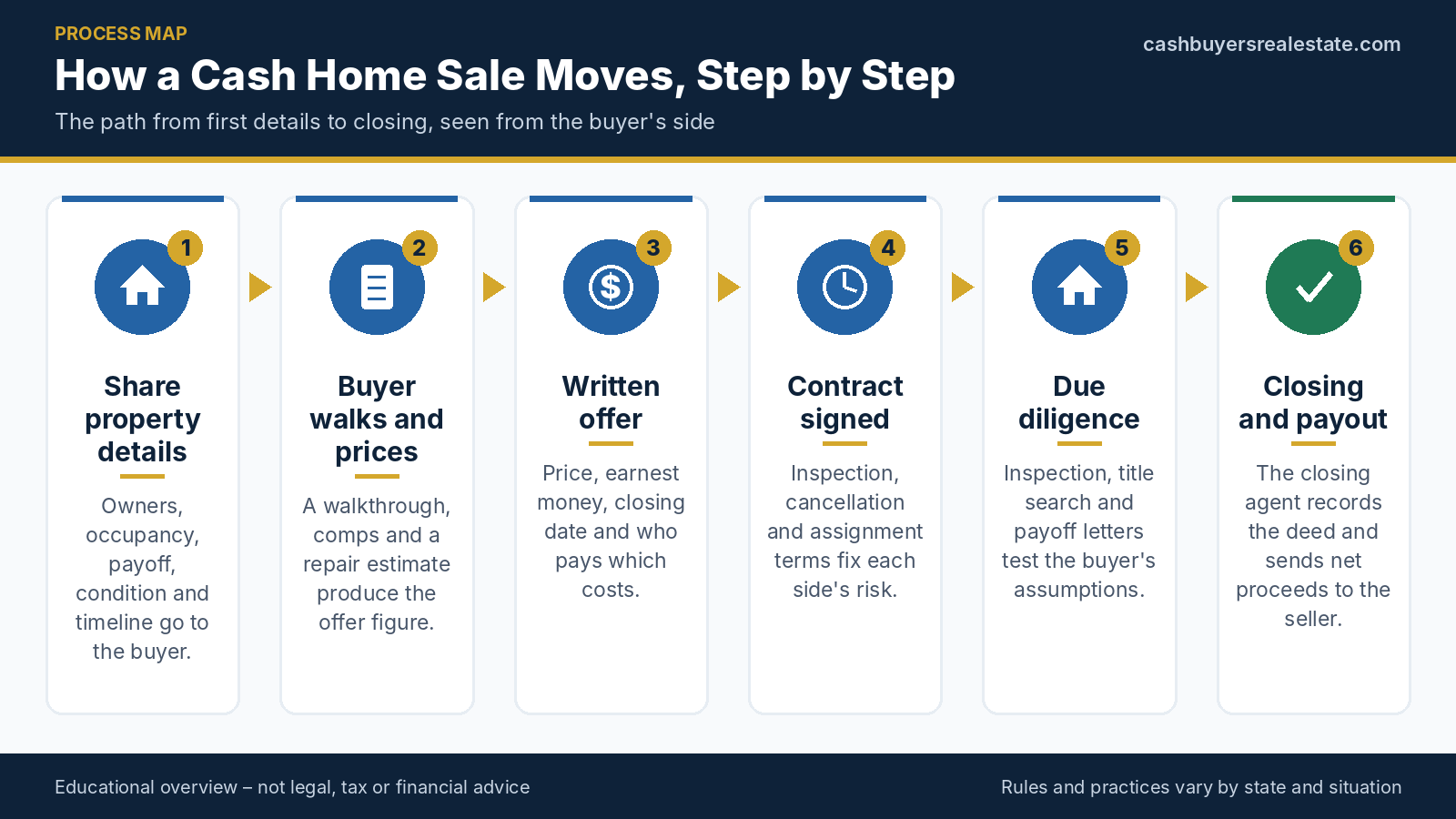
Text version of this infographic
- Share property details — Owners, occupancy, payoff, condition and timeline go to the buyer.
- Buyer walks and prices — A walkthrough, comps and a repair estimate produce the offer figure.
- Written offer — Price, earnest money, closing date and who pays which costs.
- Contract signed — Inspection, cancellation and assignment terms fix each side's risk.
- Due diligence — Inspection, title search and payoff letters test the buyer's assumptions.
- Closing and payout — The closing agent records the deed and sends net proceeds to the seller.
What the Buyer’s Money Costs: Hard Money, Private Capital, and Cash on Hand
Most of the buyers who describe themselves as cash buyers aren’t paying for each house out of a savings account. Many borrow the purchase price, and often the repair money, from specialized lenders who charge more than a bank would and lend for months rather than decades. That borrowed money is the second-largest cost line in the hypothetical deal after the repairs, and its structure explains why buyers are so sensitive to timing. This section explains how that kind of lending works, what published sources say about its pricing, and why even a buyer who owns every dollar outright still faces a price for using it.
Hard Money and Other Short-Term Loans
Short-term investor loans, usually called hard money loans, are secured by the property being bought and priced on the value of that property more than on the borrower’s income or credit history. The lender cares chiefly about whether the house, once repaired, will sell for enough to repay the loan, and so it limits how much it will lend against that expected value and watches the borrower’s schedule closely.
How a short-term investor loan is built: rate, points, draws, and loan-to-value
Published lender guides describe a fairly consistent structure, although they disagree at the edges. A bank-published explainer from Herring Bank describes interest rates of 8% to 15% a year, upfront charges of two to five points, terms of six to 24 months, and a cap of roughly 65% to 75% of after-repair value for fix-and-flip loans. A second guide, RentalRealEstate.com, last updated in September 2026, reports a rate range of 8% to 15% with 9% to 12% most common, one to five points with one and a half to three most common, terms of six to 24 months with 12 most common, and loans capped at 70% to 75% of after-repair value. Both sources contain internal inconsistencies, and neither is a statistical survey of actual loans, so the most defensible reading is that the cost of this kind of money varies widely by lender, borrower experience, and deal.
Two mechanical features matter for sellers. The first is the draw schedule: a lender typically releases the repair portion of the loan in stages as work is completed and inspected, so the buyer carries a growing balance rather than a full one from day one, and the lender charges fees for the inspections. The second is that this credit is not consumer credit in the legal sense. Under the Truth in Lending rules the Consumer Financial Protection Bureau administers as Regulation Z, section 1026.3(a) exempts credit extended primarily for a business or commercial purpose, and the official commentary treats credit used to acquire, improve, or maintain a rental property the borrower does not occupy as business credit. Because the borrower is an investor and not a household, many of the disclosures and limits that protect a homebuyer with a mortgage don’t apply, and the lender prices the loan with more freedom. For comparison, Freddie Mac’s weekly survey put the average 30-year fixed mortgage rate at 7.40% on October 15, 2026, which gives a sense of the gap between ordinary home lending and short-term investor money.
Why time is the most expensive ingredient in the buyer’s budget
Because interest accrues monthly and carrying costs run regardless, every extra month a project lasts adds a roughly fixed amount to the buyer’s cost, and the points paid at the start do not shrink if the project finishes early. That combination makes buyers care intensely about schedule: a house that can be repaired and sold in four months leaves more room for the seller’s price than the same house stuck at nine months. The table below uses the same hypothetical loan from the profit-and-loss example to show how the time-related costs change with the length of the hold.
| Holding period | Interest | Points | Carrying costs | Total time-related cost |
|---|---|---|---|---|
| 4 months | $6,252 | $4,812 | $3,200 | $14,264 |
| 6 months | $9,378 | $4,812 | $4,800 | $18,990 |
| 9 months | $14,066 | $4,812 | $7,200 | $26,078 |
| 12 months | $18,755 | $4,812 | $9,600 | $33,167 |
Reading across the rows, each additional month adds about $2,360 in this example: roughly $1,560 of interest plus $800 of carrying cost, with the points as a fixed cost whether the project takes four months or twelve. Moving from a six-month to a nine-month hold costs the buyer more than $7,000, and a twelve-month hold more than $14,000, with nothing to show for it. This is why a buyer cares about an occupied house that won’t be vacated on time, about a title cloud that delays closing, and about a repair scope that depends on permits. A seller who can offer a clean, quick, certain closing gives the buyer something with a measurable dollar value, even though the buyer rarely says so out loud.
Cash on Hand, Partners, and the Cost of Capital
Not every buyer borrows from a hard-money lender. Some use their own savings, some raise money from private individuals who lend or invest in return for a share, and some manage pooled funds. Each of these arrangements has a cost, even when no interest statement arrives in the mail.
Every dollar has a price, even when no loan is involved
A buyer using personal savings still has alternatives for that money: it could earn interest, repay other debts, or fund a different property. Economists call that foregone alternative the opportunity cost, and a rational buyer sets a minimum acceptable return on the cash tied up in a house. If a project can’t clear that hurdle, the buyer will put the money elsewhere, which sets a floor under the margin the buyer must earn. Private lenders who fund a portion of the purchase usually demand a fixed return or a share of the profit, which behaves like interest. Investment funds answer to their own investors and are held to return targets that translate into a minimum margin per house.
For a seller, the useful conclusion is that “cash” does not mean “free money.” A buyer who tells you there are no financing costs is describing the absence of a loan, not the absence of a price for capital, and the offer will still be built around a required return. Sellers sometimes assume that a buyer without a lender can afford to be more generous. That can be true if the buyer’s required return is low, as it might be for a long-term landlord, but it is not automatic, and the best evidence is the buyer’s own explanation of how the offer is built. A buyer who can’t or won’t walk you through the logic is giving you information too.
Partnership arrangements add another layer. An experienced operator may bring a project, a crew, and local knowledge, while a partner brings money, and the two split the profit according to a written agreement that often pays the money partner first up to a stated return. Even when those terms are generous to the operator, the effect on the seller is the same as with a loan: someone’s capital is committed to the house for a fixed period, the required return is built into the offer, and a project that runs late tightens the margin for everyone involved. That tightening is a quiet reason many buyers work to keep schedules short and surprises few.
What lender-funded purchases mean for a seller’s closing
When the buyer’s money comes from a short-term lender, the lender becomes a silent third party to your closing. The lender may require its own valuation of the property, a title commitment on its own timetable, proof of the buyer’s insurance, and a signed loan package before it wires funds. None of that is unusual, and well-organized investors manage it routinely. But the added steps mean that a contract signed with a lender-dependent buyer carries a different kind of timing risk than a contract signed with a buyer whose funds are already in the closing agent’s account, and the difference is invisible unless you ask. Nothing is wrong with a buyer using a lender; the issue is whether the contract’s closing date and the buyer’s obligations reflect that reality honestly.
That is why questions about the source and readiness of funds belong at the start of the conversation and not the end. A buyer funded by a lender should be able to say so and explain what has been approved and what remains, and a buyer using its own money should be able to document it. The guide to how fast cash buyers can close examines how funding sources affect closing schedules, and the page on proof of funds explains the documents that matter. For this article’s purposes, the lesson is narrower: the way a buyer pays for a house is part of the economics of the offer, because capital has a cost, delays multiply it, and a buyer who cannot fund the deal cannot honor the price.
Why a Cash Buyer Can’t Pay Retail: Margin, Risk, and the Cost of Finding You
Sellers often ask a simple question that deserves a straight answer: if the finished house is worth what it’s worth, why can’t the buyer just pay close to that? The reasons are structural, not personal. A buyer who paid close to retail would have nothing left to cover the costs in the previous table, and a buyer who guesses wrong a few times in a row would be out of business. This section works backward from the resale price to show how the ceiling on an offer arises, explains what the buyer’s margin is actually paying for, and looks squarely at the question of whether that margin is fair.
Working Backward From the Resale Price
The offer you receive is usually the end of a subtraction that starts at the top of the profit-and-loss statement and works down. Understanding the sequence shows you why each dollar you ask for has to come from somewhere, and where the flexibility, if any, resides.
The arithmetic ceiling on any offer
Think of the buyer’s process in reverse. The buyer begins with the expected resale price and subtracts selling costs, then repairs and contingency, then the time-related costs of financing and carrying, then the buyer’s own closing costs, then an allocation for marketing and overhead, and finally the profit the buyer requires. Whatever remains is the most the buyer can pay and still reach the target. In the hypothetical deal, that remainder is $165,000, or 55% of the resale price, and every line above it is a cost the buyer expects to meet. If you wanted to raise the offer by $20,000 without lowering the buyer’s profit, you would have to find $20,000 of cost to eliminate, and the lines the seller can influence are few: the repair scope, the length of time, and the certainty of closing.
This also shows why the gap between the offer and retail value can look so large yet be mostly spoken for. In the hypothetical, the $135,000 difference between the resale price and the purchase price breaks down into roughly $44,000 for repairs and contingency, about $20,800 for carrying and financing costs once the lender fees are counted, $21,000 for selling costs, $7,000 for overhead, $2,500 for the buyer’s closing costs, and about $39,700 for profit. Seen that way, only about 29% of the discount is the buyer’s profit, and the rest is cost. That doesn’t make the buyer’s margin untouchable, but it does mean that a seller who assumes the whole discount is profit will misjudge what the buyer can give up. A different guide, on what cash buyers typically pay, looks at the ranges buyers describe and the factors that move them.
The risk reserve: what the margin is paid to absorb
A profit margin in a business like this is not pure reward, because it must cover the projects that go wrong. Houses reveal problems late, contractors miss schedules, permit offices slow down, markets soften between purchase and sale, and sometimes a buyer simply misjudged the finished value. A buyer who earns a comfortable profit on every deal that goes as planned will still lose money on the ones that don’t, and the average across all the deals has to remain positive for the business to survive. The margin on any one house therefore includes a share of the cost of the buyer’s mistakes and bad luck on others, which no individual seller sees or controls.
The table below stress-tests the hypothetical deal to show how quickly a healthy-looking profit can disappear. Each row changes one condition, and the last row combines three ordinary setbacks that could happen on the same project.
| What goes wrong | Change from the plan | Approximate profit | Share of planned profit lost |
|---|---|---|---|
| Nothing (the plan) | Six months, $44,000 repairs, $300,000 resale | $39,700 | 0% |
| Repairs run over | Repair and contingency spending 25% higher | $28,100 | 29% |
| The project runs long | Nine months instead of six | $32,600 | 18% |
| The market softens | Resale price 5% lower, to $285,000 | $25,800 | 35% |
| All three together | Repairs 25% higher, nine months, price 5% lower | $6,900 | 83% |
The table shows how a modest slip in each of three variables compounds. A 5% drop in resale price, about $15,000, costs the buyer more than a third of the planned profit because every other cost stays where it was, while a quarter overrun on repairs removes nearly a third. When all three occur at once, less than a fifth of the profit is left, and a slightly worse outcome would produce a loss. Buyers who have been through a few projects know this, and their offers carry a cushion for it. The cushion is not a trick. It is why an offer that looks too low for a clean project can still be rational on the information the buyer had, and it is also why a buyer who offers far more than the arithmetic allows is a reason for questions.
Marketing, Overhead, and the Question of Fairness
Two more elements complete the picture: the cost of finding sellers in the first place, and the broader question of whether the margin that results is something a reasonable seller should accept. The first is a matter of arithmetic. The second is a matter of judgment, and sellers are entitled to make it.
The cost of finding you: lead generation, staff, and overhead
Buyers who purchase houses from owners rather than from the listing market have to find those owners, and finding them costs money. The methods are familiar: direct-mail letters and postcards sent to owners of houses that match certain profiles, roadside signs, online advertising, text and phone outreach, referral relationships with attorneys, agents, and contractors, and websites designed to capture inquiries. Most of the people who receive or see the marketing don’t respond, and most of those who respond aren’t ready to sell or have a house that doesn’t fit the buyer’s criteria. The result is that the marketing cost of one purchased house is the marketing cost of everyone who didn’t become one.
Illustrative example (hypothetical numbers, not market data): An investor spends $6,000 on a mailing of 3,000 letters. About 1% of recipients respond, so 30 owners call. Of those, 12 have houses and situations the investor can price, and the investor sends 12 offers. One accepts. The marketing cost of the one purchased house is therefore $6,000, even though the individual letter cost about $2. Add roughly $1,000 of staff time, software, and insurance spread across the deal, and the $7,000 overhead line in the profit-and-loss statement follows. A seller who never answered a letter paid none of it, but the seller who did answer is effectively paying for the eleven who didn’t.
Overhead goes beyond marketing. A buyer who operates at any scale pays for office or phone systems, a person or team to take calls and walk houses, a transaction coordinator who tracks contracts and title, insurance and licensing where required, accounting, and project management for contractors. Spread across deals, those costs make volume a competitive advantage: a company that closes many houses a year can spread fixed costs thin and may accept a smaller per-house margin, while an occasional buyer has little overhead but also little efficiency and may need a wider cushion. Neither pattern is a guarantee of a better or worse offer. It simply means the same house can attract genuinely different prices from buyers at different scales, which is one more reason to gather more than one.
Profit versus perceived fairness: how to think about the buyer’s margin
Whether a buyer’s profit is fair is a question reasonable people answer differently, and it helps to separate three versions of it. The first is whether the buyer’s profit is large in dollars: a $39,710 profit on a house the seller sold for $165,000 can feel startling. The second is whether the profit is large relative to the risk, time, and capital involved: the same profit looks different when you see the stress test above, the months of work, and the lender’s charges. The third, and the one that matters most to the seller, is whether the sale made the seller better off than the realistic alternatives. A buyer can earn a large profit and still have offered a price that beat everything else the seller could actually do, and a buyer can earn a small profit while offering a price that left the seller worse off than a modest listing would have.
Public data helps with the first question only up to a point. ATTOM’s Q1 2026 report found a typical gross flipping profit of $66,000 and a return of 25.4% on the purchase price, yet its methodology counts the gap between purchase and resale prices before rehabilitation and other expenses, so it says nothing about what investors kept after repairs, interest, and selling costs. For the seller, the practical test is comparative. Gather at least one other written offer or a realistic listing estimate, subtract the costs you’d bear in each route, and compare what you would keep. If the cash offer wins on net proceeds, on certainty, or on your own priorities, the buyer’s margin is a cost of getting what you wanted. If it loses on all of them, the margin is something you can decline to pay. The guide to cash sale versus listing for a fast sale takes that comparison step by step.
Everything above assumes the seller is already weighing an offer from an investor, which is only one of the routes open to an owner. A cash sale to an investor is one of five realistic choices, alongside listing the house as it is with an agent, spending money on repairs before listing, selling directly to an owner-occupant or a family member without an agent, and selling to a landlord who intends to keep the house as a rental. Each trades price, effort, speed, and certainty differently, and the comparison near the end of this guide puts figures on those trade-offs, and the graphic below sets the five routes side by side.
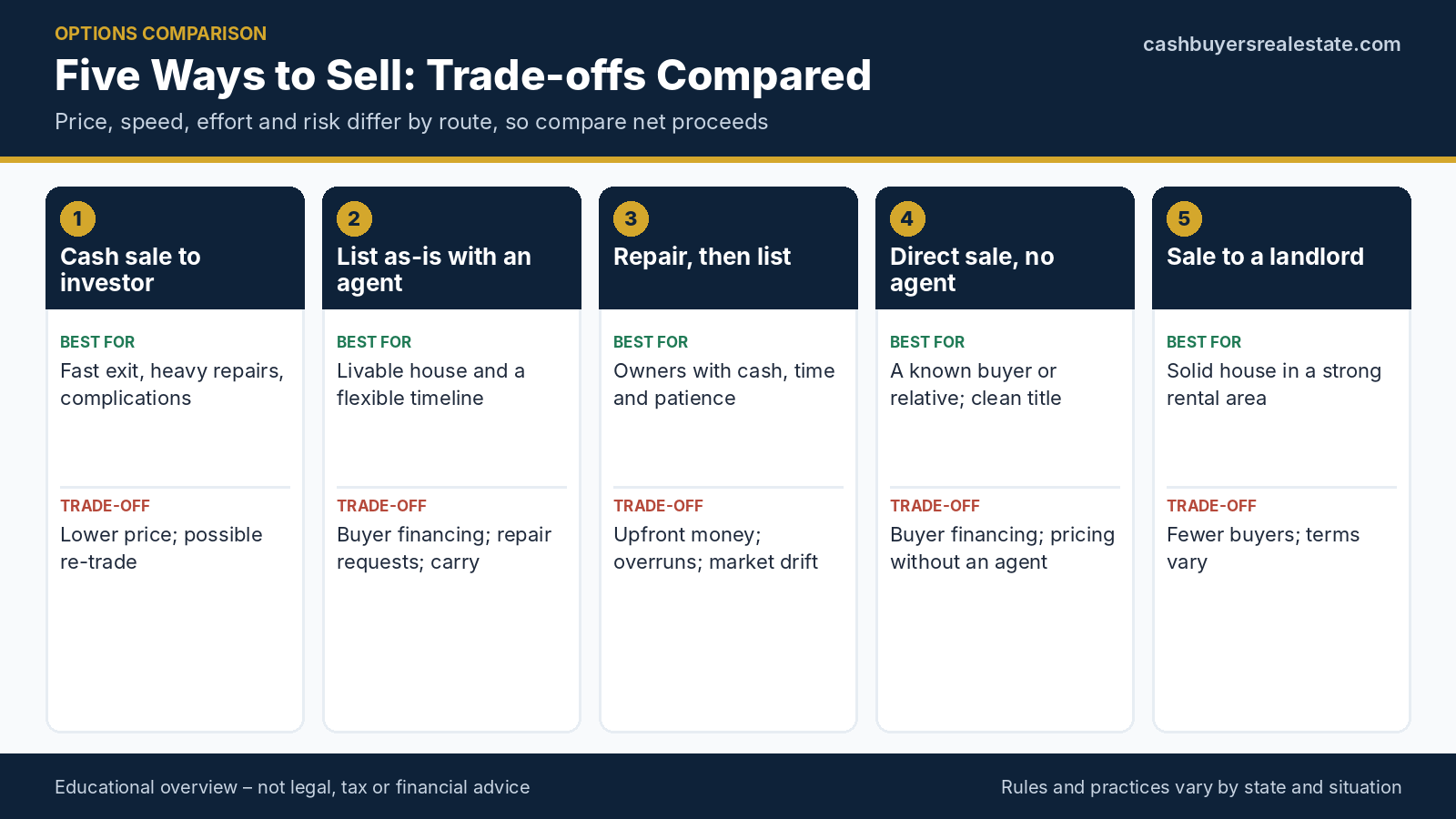
Text version of this infographic
- Cash sale to investor — Best for: Fast exit, heavy repairs, complications. Trade-off: Lower price; possible re-trade.
- List as-is with an agent — Best for: Livable house and a flexible timeline. Trade-off: Buyer financing; repair requests; carry.
- Repair, then list — Best for: Owners with cash, time and patience. Trade-off: Upfront money; overruns; market drift.
- Direct sale, no agent — Best for: A known buyer or relative; clean title. Trade-off: Buyer financing; pricing without an agent.
- Sale to a landlord — Best for: Solid house in a strong rental area. Trade-off: Fewer buyers; terms vary.
From First Call to Closing: The Sale as the Buyer Experiences It
The financial model gets tested at every step of the transaction, which is why a buyer’s behavior during a sale makes more sense once you know what the buyer is protecting. Each stage of a typical cash purchase, from the first inquiry to the wire on closing day, is either gathering information that feeds the profit-and-loss statement or reducing a risk that could damage it. Following the sale from the buyer’s side explains questions that can seem intrusive, explains why prices sometimes move after a contract is signed, and shows where a seller has leverage and where there is little.
Lead, Walkthrough, and Offer
The front end of a cash purchase is a rapid information-gathering exercise. The buyer is trying to learn four things as quickly as possible: whether the seller can actually sell, what the house is really like, what it will be worth when done, and whether the seller’s timeline matches the buyer’s capacity. Speed matters to the buyer because leads go cold and competing buyers also call.
What the buyer is learning on the first call and the walkthrough
The first conversation, whether by phone, text, or web form, is built to answer questions that feed the model. Who owns the house, and do all owners agree to sell? Is the house occupied by the owner, a tenant, or no one? Is there a mortgage, a home equity loan, back taxes, or a lien that must be paid from the proceeds? Why is the seller selling, and by when? Each answer changes a line of the calculation. A tenant in place with a lease affects possession and the length of the hold. A payoff larger than the likely price means the sale can’t close without the seller bringing money or the lender agreeing to a short sale. A seller who needs to close in two weeks is giving the buyer leverage, and a seller with no deadline is not.
The walkthrough, which can be done in person or sometimes through photos and video, collects the repair information. A practiced buyer checks the same things in roughly the same order: the roof and gutters, the foundation and any signs of settling, the HVAC and water heater, the plumbing and electrical, evidence of past or active water intrusion, windows, flooring, kitchen and bathrooms, and the exterior and drainage. The walkthrough is also when the buyer forms the first impression of the seller’s own records: whether permits exist for additions, how old the major systems are, and whether the seller seems candid about problems. Sellers who treat the walkthrough as a negotiation lose the chance to use it as a conversation; sellers who point out the issues they know about, with documents, tend to receive more calibrated offers because the buyer has fewer unknowns to price.
How an offer becomes a contract
After the walkthrough, a buyer usually presents a price, either verbally or in writing, and then a purchase agreement. The price is only one term. A complete agreement also fixes the amount and handling of earnest money, the length of the inspection or due diligence period, the closing date, who selects the closing agent and pays which closing costs, when the seller must vacate and in what condition the house must be left, and what happens if either side backs out. The detailed anatomy of these contracts is the subject of the guide to the cash home buyer contract, but the economic logic is simple: every term shifts risk or cost between the two parties, and the price is only meaningful in combination with those terms.
Two terms deserve special attention in light of the buyer’s model. One is the due diligence period, which is the window in which the buyer can inspect, review title, line up financing, and sometimes walk away. A short period usually favors the seller’s certainty, while a long one gives the buyer a free option on the deal. The other is any provision that lets the buyer assign the contract to someone else, which is the clause that makes wholesaling possible. An assignment clause isn’t automatically a problem, since many legitimate buyers use affiliated entities, but it changes who may end up at the closing table, and a seller should understand that before signing. A buyer who is straightforward about both terms, and willing to explain them without hurry, is usually describing a deal that works the way the model suggests.
Due Diligence, Re-trades, and Closing
After the contract is signed, the transaction moves from persuasion to verification. The buyer confirms the house is what was assumed, the title company confirms the seller can convey clean title, and the lender, if there is one, confirms its own conditions. This is also the period when sellers are most likely to be surprised.
Inspection periods and why a price sometimes changes after the contract is signed
An inspection or due diligence period is a contractual right to look closer and, depending on the wording, to renegotiate or terminate. A buyer who priced the house from a quick walkthrough often hires a home inspector, a sewer-scope specialist, a roofer, or a contractor during this window. If something turns up that exceeds the contingency built into the offer, the buyer faces a choice between absorbing the loss, asking for a reduction, or leaving. Asking for a reduction is common enough that sellers should expect it as a possibility, and the pattern, called a re-trade, is one of the most frequent sources of disappointment in cash sales. It isn’t necessarily bad faith: a real defect really does change the buyer’s cost. It becomes a concern when the requested reduction is out of proportion to the finding, or when the pattern of re-trading looks designed to wear the seller down.
Illustrative example (hypothetical numbers, not market data): A buyer’s offer assumed a $4,000 repair contingency. During the inspection period, a sewer camera shows a collapsed section of clay pipe under the front yard, and a plumber quotes $9,000 to replace it. The buyer asks the seller to reduce the price by $9,000. The seller points out that the contingency already holds $4,000 for unknowns and offers to split the remaining $5,000, so the price falls by $2,500 rather than $9,000. Both sides have a reasonable argument, and the outcome depends on what else the buyer can find, on how badly the seller needs to close, and on whether the seller has a second offer to fall back on.
The seller’s best protection is information. A seller who has had the sewer line scanned, the roof inspected, or the foundation evaluated before signing converts unknowns into known quantities, and the buyer’s contingency shrinks accordingly. A seller who hasn’t can still review the contract before signing to see how termination and price-adjustment rights are written, how much earnest money is at stake, and whether the buyer’s right to cancel is truly limited to the inspection period. The page on cash offer contract red flags explains the clauses that turn a routine inspection right into an open-ended option. Even then, the cleaner approach is usually to compare more than one offer before signing, because the seller’s strongest position in the whole process is the moment before there is a contract.
Title, payoff, and the closing table
While the buyer inspects, the closing agent runs a title search to confirm who owns the property and whether anything attaches to it, such as mortgages, judgment liens, unpaid property taxes, tax liens, mechanics’ liens, easements, or unreleased claims from earlier owners. In many states a title company or escrow officer handles the closing; in others, attorneys handle it and the title work, so the roles and the paperwork differ from state to state. In every state, though, the same financial core applies: the closing agent assembles a settlement statement showing the price, the payoff of liens and loans, the seller’s closing costs, prorated property taxes and utilities, and the net amount due to the seller. A seller who has not yet received a payoff letter from the mortgage lender should request one early, because it is the number that determines what the seller actually receives.
The closing itself can happen with the parties in one room or signing separately, in person or by mail or remote notary where state law allows. Once the documents are signed and funds are confirmed, the deed is recorded and the proceeds are sent to the seller by wire or check. Because the seller’s funds come through the closing agent and not from the buyer directly, the choice and reputation of the closing agent matter as much as the buyer’s, a point the guide to cash home buyer scams develops further. Sellers are generally free to ask for a closing agent they trust, although contract terms sometimes allocate the choice to the buyer. Either way, the settlement statement should be reviewed before closing day, and any line you don’t understand should be explained before you sign.
What Is Fixed and What Is Negotiable in a Cash Offer
Once you know how the offer was built, the next practical question is where it can bend. Sellers sometimes assume everything in an offer is negotiable, and sometimes assume nothing is, and both assumptions cost money. Some numbers reflect hard facts the buyer can’t change, such as what a roof replacement costs or what the lender charges. Others reflect judgment calls, and judgment calls respond to evidence. A third group is not a number at all but a term, such as timing or possession, which has a price to one party and a different price to the other.
The Parts of an Offer That Rarely Move
Pushing against the immovable parts of an offer wastes goodwill. The buyer has to meet certain costs whatever the seller thinks of them, and a buyer who gives them up loses money on the house. Knowing which parts these are lets you spend your negotiating effort where it can change the result.
Hard costs, financing terms, and the buyer’s required return
The first group of costs is the set of prices the outside world sets. Contractors charge what the local labor and materials market bears, and a buyer who has completed many projects knows those prices closely. Property taxes and insurance are what they are. A lender’s rate, points, and fees are fixed by the loan agreement. Selling costs at the back end depend on the local market and on agent compensation, which is negotiable between the buyer and an agent but not with you. When a buyer says a roof will cost a certain amount and has priced roofs in your county for years, arguing that the figure is too high without a competing quote doesn’t change the buyer’s actual cost, and it signals that you haven’t done the homework.
The second fixed element is the buyer’s required return. Every buyer has a minimum profit below which the project is not worth the risk, whether expressed as a dollar floor, a percentage of resale price, or a return on cash invested. That floor may be lower for a buyer with large volume or low-cost capital and higher for a small buyer, but for any given buyer on any given day it isn’t a negotiating position so much as a threshold. A seller who asks a buyer to accept a margin far below that threshold will usually hear “no” or will see the buyer find a cost to trim somewhere else, such as a lower contingency or a lower repair scope. A more productive conversation asks which assumptions might be conservative and what evidence would change them.
Soft numbers: the estimates that evidence can change
The numbers that can move are those that rest on the buyer’s judgment from limited information. The first is after-repair value, where comparable sales are the evidence. If the buyer used a conservative comp set and you have recent sales the buyer overlooked, particularly renovated houses that sold quickly and at higher prices, you can legitimately ask for a reconsideration. The second is the repair scope. A buyer who budgeted a full kitchen replacement may be persuaded by photos and receipts that the kitchen was updated seven years ago, or a buyer who assumed the roof is near the end of its life may reconsider after seeing a recent roofer’s inspection letter.
The third soft number is the contingency, which is an estimate of the unknown. As noted earlier, the more documentation you provide about permits, system ages, past repairs, and known problems, the smaller the unknown becomes. The fourth is the allocation of closing costs, which can sometimes shift between buyer and seller as part of the overall bargain, and the fifth is the timeline, because both closing date and possession date change the buyer’s carrying costs. A guide on how investors who buy houses evaluate deals covers the investor’s side of those judgments. The principle for sellers is that you move soft numbers with evidence and hard numbers only by changing the facts underneath them, and it is far easier to succeed with the first than the second.
When a Buyer Can Pay More
The standard discount described in the profit-and-loss example isn’t a law of nature. It reflects one type of buyer with one kind of plan for one kind of house. Change the plan or the house and the ceiling moves. Sellers who understand which circumstances raise the ceiling can look for buyers whose plans fit their property instead of settling for the first number.
Rental holds, low-repair houses, and quick cosmetic flips
The biggest source of variation in what buyers can pay is the exit. A buyer who plans to rent the house skips the retail-grade renovation, avoids the commissions and closing costs of a resale, and measures the deal by rent against total investment. For a house in decent shape in a rental market with strong demand, that arithmetic can support a higher purchase price than a flip would. A house needing little work shrinks the repair and contingency lines and shortens the hold, so a flip becomes cheaper to execute and can support a stronger offer. A quick cosmetic flip, with paint, floors, and fixtures, works the same way, subject to the resale timing limits described earlier for buyers who finance with FHA-insured loans.
These examples have an unfortunate corollary: a house that needs heavy work, has structural or title problems, or sits in a weak rental market has fewer buyers whose plans fit, and those buyers have less room to pay. The table below summarizes how several common buyer plans shape the price they can afford, and why. It is a comparison of logic, not of figures, because the real numbers depend entirely on the house and the market.
| Buyer’s plan | What the buyer is most sensitive to | When the price can be higher | When the price tends to be lower |
|---|---|---|---|
| Renovate and resell | Repair cost, hold length, resale price | Light or cosmetic scope; strong resale market; known system ages | Heavy repairs, hidden conditions, slow resale market |
| Rent and hold | Rent level, vacancy, system condition | Good condition; high local rents; flexible closing date | Major systems near failure; weak rental demand; code issues |
| Quick cosmetic resale | Speed, finish quality, buyer pool | Clean title; vacant house; neighborhood with fast-selling comps | Occupied house; permit questions; resale limited by financing rules |
| Assign the contract to another investor | The end buyer’s appetite and price | Strong investor demand; simple, appealing house | Weak demand; contract must leave a fee below the end buyer’s ceiling |
| Owner-occupant paying cash | Personal needs, repair tolerance, own timeline | Wants the house for itself; fewer profit requirements | Limited cash; unwilling to take on major repairs |
To read the table, find the row that most resembles the buyer in front of you and then ask whether your house sits in the “higher” or “lower” column. A landlord can often outbid a flipper for a solid house in a strong rental area, and a flipper can often outbid a landlord for a cosmetic project in a strong resale neighborhood. A buyer who plans to assign the contract is the one whose offer is least reliable as a measure of what the house is worth, since the price is set by the gap the assigning buyer hopes to capture. Most sellers receive offers from several categories without being told which one is which, and a direct question about the buyer’s plan is usually the quickest way to find out.
Terms that cost the buyer less: timing, possession, and flexibility
Price is not the only thing the seller controls. Because time is expensive for a buyer, concessions on timing can substitute for dollars. A flexible closing date lets a lender-funded buyer line up its financing without a rush charge. A willingness to vacate quickly, or to leave the house empty and broom-clean, shortens the hold. Conversely, a seller who needs to stay for sixty days after closing gives the buyer a rent-free occupant and a delay, and might accept a lower price in return for the time; some buyers will agree to a short post-closing occupancy in exchange for a rent payment or a credit. Which direction the trade runs depends on what the seller values most.
Illustrative example (hypothetical numbers, not market data): One house, with the same $300,000 estimated resale value as before, draws three offers. A renovate-and-resell buyer offers $165,000 after pricing a full renovation. A small landlord, who would do $12,000 of rental-grade repairs and avoids resale costs, offers $190,000 because the expected rent is strong. A contract buyer who intends to assign the deal to a flipper offers $150,000, hoping to resell the contract for a fee. The seller accepts none immediately but asks the landlord whether a closing in 45 days is acceptable and the flipper whether a 14-day closing could earn a higher price. The landlord agrees to the later date at the same price, and the flipper moves to $172,000 for the speed. The offers moved for reasons that had nothing to do with the house itself.
The example illustrates a pattern that applies broadly: the same house is worth different amounts to buyers with different plans and different constraints, and the cheapest way to raise an offer is often to find the buyer whose constraints you already satisfy. The practical consequence is that comparing offers requires comparing terms along with price, since a lower figure with a short, certain closing may beat a higher one with a long contingency period. The detailed tools for doing that, including how to put offers side by side on net proceeds, are covered in other guides, but the underlying idea starts here, in the economics of the buyer’s plan.
Red Flags and Safeguards: Telling a Workable Business Model From a Warning Sign
Understanding how the economics work is also the best defense against offers that don’t. A legitimate buyer’s price has to add up, the contract has to match what the buyer says, and the buyer’s behavior has to be consistent with a business that expects to complete the purchase. When one of those three elements fails, it doesn’t prove wrongdoing, but it does tell you where to look harder. This section uses the earlier arithmetic to identify warning signs and then describes verification steps proportionate to the risk, without suggesting that any single sign establishes fraud.
Reading the Economics for Warning Signs
An experienced reader can test an offer in two ways. The first is to ask whether the price makes sense given what the buyer says about the house and the buyer’s plan. The second is to ask whether the contract’s terms put the buyer’s business risks on the buyer or quietly move them onto the seller.
Offers that don’t match any workable business model
Start with the price. A figure far below the profit-and-loss ceiling needs a reason, usually a major defect or title problem, and a buyer who can’t state the reason may simply be anchoring low in the hope that the seller is uninformed. A figure far above the ceiling needs one too. If a buyer offers well above what the arithmetic supports, with no explanation of how, there are only a few possibilities: the buyer has information or a plan you haven’t been told about, the buyer is a contract buyer who hasn’t yet found an end buyer and is tying up the house in the hope of selling the contract, or the buyer intends to reduce the price later through the inspection period. The last pattern, an attractive headline followed by a series of deductions, is the one sellers most often describe afterward as bait.
The buyer’s explanation matters more than the number. A buyer who can walk you through the comps used, the repair scope assumed, and the assumed timeline is describing a model you can check. A buyer who responds to questions about the price with pressure instead of explanation, such as insisting that the offer expires today, discouraging you from getting other quotes, or implying that nobody else will want the house, is behaving in a way that has nothing to do with the economics and everything to do with preventing comparison. A good business doesn’t need you to avoid comparison, since its price survives it. Offers made before anyone has seen the property, with no condition questions at all, deserve the same scrutiny, because a price that doesn’t depend on the house can’t have been calculated from it.
Contract terms that move the buyer’s risk onto you
The contract is where a buyer’s real position becomes visible. In a straightforward purchase, the buyer takes on the risks the business model already assumes: the cost of repairs, the time of resale, and the cost of financing. A warning sign appears when the contract shifts those risks to the seller in ways the price doesn’t compensate. A long or unlimited inspection period that lets the buyer cancel for any reason, with the earnest money refundable, effectively gives the buyer a free option on the house while the seller’s property is off the market. A large nonrefundable fee that the seller must pay if the seller cancels, with no reciprocal remedy, does the reverse. Blank spaces, terms deferred to later documents, and contracts that cannot be read in full before signing deserve a pause.
| Term or behavior | What it may indicate | A reasonable response |
|---|---|---|
| Broad assignment clause with the buyer named only as “and/or assigns” | The buyer may not intend to close personally and may be a contract buyer | Ask who is expected to close and whether the buyer will confirm the end buyer’s funds |
| Open-ended or very long inspection period | A free option for the buyer while the house is off the market | Ask for a fixed, short period and a defined list of grounds for cancellation |
| Earnest money that is tiny, unspecified, or released to the buyer | Little commitment behind the contract | Ask that earnest money be held by a neutral title company or attorney |
| A price that drops sharply after the inspection | An offer built to be re-traded | Compare to the original contingency; ask for the inspection findings in writing |
| Pressure to sign today or to avoid other quotes | The offer may not survive comparison | Set a reasonable decision date and gather a second offer or listing estimate |
| Blank lines, missing dates, or documents referred to but not provided | The contract may be completed or changed later | Do not sign until every term is filled in and every referenced document is attached |
| A recorded memorandum or listing agreement tucked into the packet | A claim on the property or a right to sell it that you did not discuss | Ask what it does and have an attorney review it before signing |
Use the table as a prompt for questions, not as a scorecard. Several of these terms appear in legitimate contracts for good reasons, and a buyer using a standard form drafted by an attorney may include clauses that look alarming out of context. What matters is whether the buyer can explain each one plainly and whether the explanation is consistent with the price and the plan. If a reasonable response is met with irritation or delay, that reaction is itself information. Ask a local attorney to read any clause you cannot explain back in your own words.
Verification Steps That Match the Risk
Verification doesn’t need to be adversarial. A legitimate buyer expects to be asked who they are and where their money comes from, since sellers with experience ask routinely. The goal is to match the effort to the size of the risk: a quick check on a small transaction, and a more thorough one when the sale price is large or the contract contains unusual terms.
Checking the buyer, the entity, and the funds
Begin with who the buyer is. The contract should name a real person or a business entity, and that entity should appear in the state’s business registry as active. The name on the contract should match the name on any proof of funds, and a buyer who contracts through one entity while showing funds in the name of another should explain the connection. Public county records show prior deeds, so you can often see whether the named buyer or its principals have actually closed other purchases in the area, which tells you more than a website’s claims. None of that proves reliability, but a buyer with a verifiable history is easier to evaluate than one whose paper trail begins with your house. The overview of real estate investors that buy houses describes how investors usually operate and what they typically disclose.
Proof of funds is the next layer. A bank or brokerage statement, or a letter from a lender stating the amount of a committed loan, shows that the money exists or is available; it does not show that it is reserved for your deal, and a statement can be old or edited. The sturdier test is to ask the title company or closing attorney to confirm that earnest money has actually been deposited and to explain when the balance will arrive. Before you sign, it helps to run through a short, practical checklist:
- Confirm the buyer’s identity and entity status, and make sure the contract names the party who will actually close.
- Ask for proof of funds and for confirmation of the earnest money deposit from the closing agent directly.
- Read every cancellation clause, including who can cancel, when, and for what reasons.
- Check what the contract says about assignment, and ask who the end buyer is likely to be.
- Choose, or at least verify, the title company or attorney who will handle the closing.
- Refuse to sign anything with blank lines, and keep a complete copy of every document.
Those six checks are the same ones summarized in the decision checklist graphic below, and they take far less time than the problems they prevent.
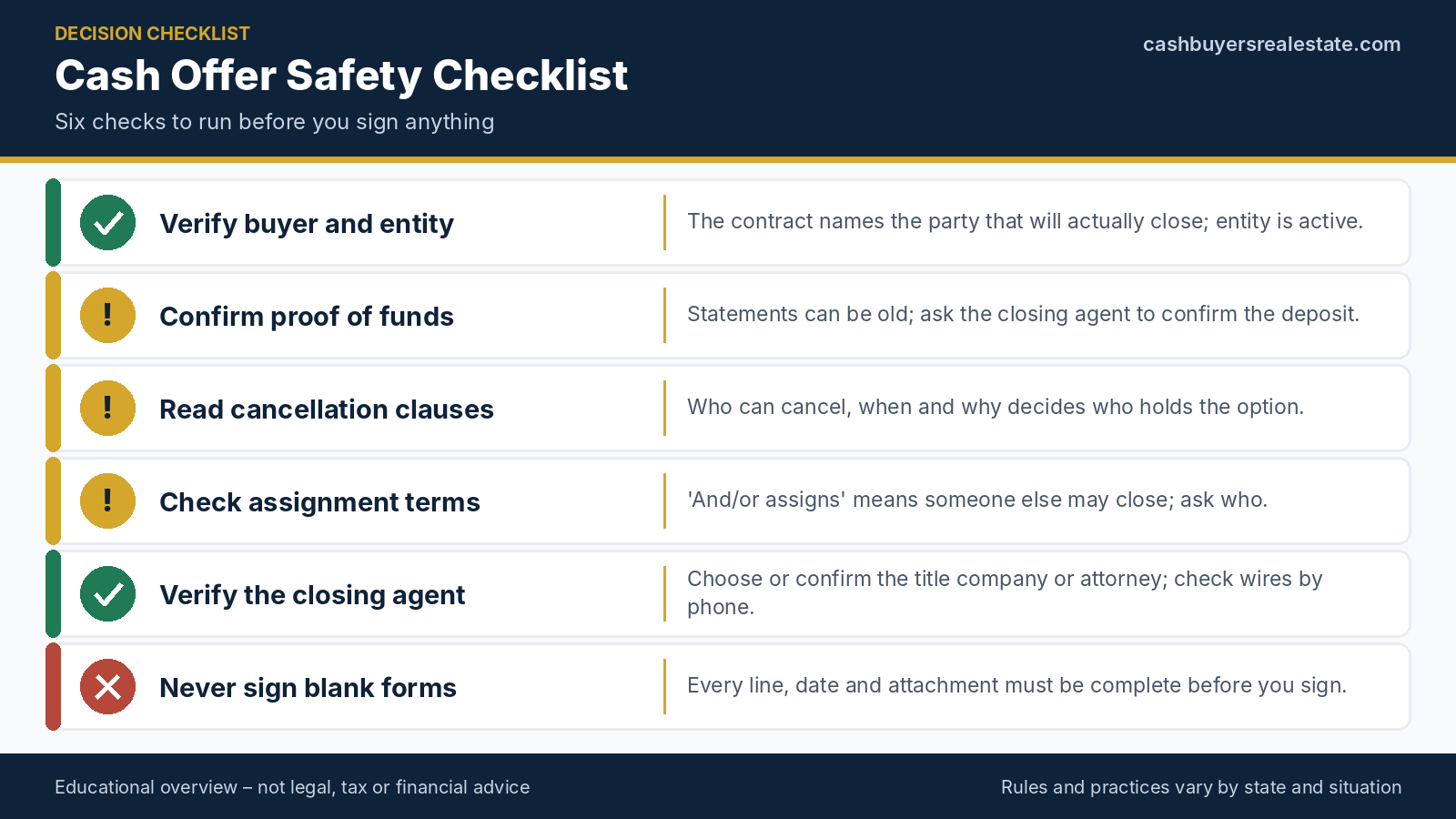
Text version of this infographic
- Verify buyer and entity — The contract names the party that will actually close; entity is active.
- Confirm proof of funds — Statements can be old; ask the closing agent to confirm the deposit.
- Read cancellation clauses — Who can cancel, when and why decides who holds the option.
- Check assignment terms — 'And/or assigns' means someone else may close; ask who.
- Verify the closing agent — Choose or confirm the title company or attorney; check wires by phone.
- Never sign blank forms — Every line, date and attachment must be complete before you sign.
Closing-day safeguards and federal reporting rules
Safeguards on closing day center on the money. Verify wire instructions by phone, review the settlement statement a day or two beforehand, and compare each line to the contract. If the closing agent reports a charge you didn’t expect, ask for an explanation and a supporting document before you sign. Make sure payoff amounts match the lenders’ payoff letters, that property tax proration follows the local custom, and that your net proceeds equal the price minus the items you expected. After closing, keep the full set of documents. If the sale produced a gain, the IRS describes in Topic No. 701 how the home sale exclusion of up to $250,000 of gain, or $500,000 for joint filers, works when you owned and lived in the home for at least two of the last five years, and says that if you received a Form 1099-S you must report the sale even if the gain is fully excludable.
Federal anti-money-laundering rules are also entering the picture for certain all-cash purchases. The Financial Crimes Enforcement Network adopted a residential real estate reporting rule that requires settlement professionals, not sellers, to report certain non-financed transfers of residential property to legal entities and trusts. The National Association of REALTORS® noted in October 2025 that reporting had been postponed until March 1, 2026; because compliance dates for rules like this can change, ask your closing agent whether the rule applies to your transaction and what, if anything, they will need from you. In practice you may be asked for identifying information about the buyer’s owners, which is a reasonable thing to expect from a buyer that is itself willing to be identified.
Frequently Asked Questions About How Cash Home Buyers Operate
The questions below come up repeatedly once sellers understand the basic model and start applying it to a real offer. They are grouped by theme, and the answers add detail and caveats instead of repeating the sections above. As with the rest of this guide, they describe how the business generally works, not how any particular buyer behaves, and any rule of law mentioned varies by state.
Questions About Price, Profit, and Offers
Most sellers start with price, and with good reason: the number on the first page is usually the first sign that the buyer’s view of the house differs from the owner’s. These questions deal with why offers land where they do and what can be done about it.
Questions about the discount and the buyer’s margin
- Why is a cash offer so much lower than what my house could list for?
A listing price is a gross figure that the seller then pays commissions, closing costs, repairs requested by the buyer, and months of ownership against. A cash offer is already a net figure from the buyer’s point of view, with those costs subtracted before the price is stated. The fair comparison is therefore not the offer against the list price but the offer against what you would actually keep from a listing after every cost and delay.
- How much profit do house flippers actually make?
ATTOM’s Q1 2026 report put typical gross profit at $66,000 and the return at 25.4%, but those figures are measured before renovation and other expenses, so they overstate what investors keep. No public dataset reliably reports net profit per project. Results vary widely with the market, the scope of work, and how long the project runs, and some projects lose money.
- Do cash buyers always renovate the houses they buy?
No. Some keep the house and rent it, some do light cosmetic work and resell, and some sell the contract to another investor without ever taking title. The plan matters because it affects what the buyer can pay and how reliable the closing is. Asking directly what the buyer intends to do with the house is a normal question and usually gets a straightforward answer.
- Does a buyer paying cash offer a better price than a buyer with a mortgage?
Not automatically. Cash removes lender-related risk, such as an appraisal shortfall or loan denial, which can make a lower price worth accepting for some sellers. But a financed owner-occupant buying a move-in-ready house may pay more than an investor who must repair and resell it. Price depends on what each buyer will do with the property, not on how it is paid for.
Questions about negotiating and comparing offers
- Can I negotiate a cash offer, or is it take it or leave it?
Most offers can be negotiated, but the most effective negotiation addresses the buyer’s assumptions with evidence, such as recent comparable sales, repair receipts, permits, and inspection reports. Asking a buyer to accept a lower profit without changing any assumption rarely works. Terms like closing date and possession are also negotiable and sometimes more valuable to the buyer than a small price change.
- How many offers should I collect before deciding?
Enough to understand the range, which is usually at least two or three written offers plus a realistic estimate from a listing agent. Ask each buyer to put price, earnest money, closing date, inspection period, and who pays which closing costs in writing so the offers can be compared on the same terms. A single offer, no matter how convenient, cannot tell you whether the price is reasonable.
- Is it appropriate to ask a buyer how the offer was calculated?
Yes, and the buyer’s response is useful information. A buyer who can name the comparable sales used, the repair scope assumed, and the timeline expected gives you something you can check. A buyer who becomes defensive, says the formula is proprietary, or changes the subject to deadlines is giving you a different kind of information. Neither reaction proves anything alone, but both are worth noting.
Questions About Process, Money, and Safety
The second group of questions concerns how a sale actually proceeds, who pays what, and how to keep yourself safe. These are also the places where state differences matter most, so the answers point you toward local professionals more often than toward fixed rules.
Questions about financing and closing
- Does “cash” mean the buyer has no lender at all?
Not necessarily. Some buyers use their own funds, while others use short-term investor loans or private money and still describe the purchase as a cash deal because there is no mortgage contingency in the contract. What matters to you is whether the funds are committed and available at closing, which is why asking for documentation and for the closing agent’s confirmation is reasonable.
- Who pays the closing costs in a cash sale?
It depends on the contract and on local custom, and neither side should assume. Some buyers offer to cover certain costs as part of the deal, and some contracts leave them with the seller as usual. Look at the settlement statement before closing day and compare each line to the agreement, so that your net proceeds are no surprise.
- Why might a closing take longer than the buyer first said?
Delays commonly come from title problems, payoff letters that arrive late, an occupant who hasn’t moved out, a permit or code issue, or a buyer still arranging a short-term loan. A well-run buyer identifies these early and tells you about them. A closing date that is only a target, with no contract term tied to it, deserves a question about what happens if it slips.
- Will I owe taxes on the sale?
It depends on your gain, how long you owned and lived in the house, and your filing status. The IRS describes an exclusion of up to $250,000 of gain, or $500,000 for joint filers, when ownership and use tests are met, and requires reporting if you receive a Form 1099-S. A tax professional can apply those rules to your situation, including any inherited or rental property details.
Questions about trust and warning signs
- How can I tell whether the buyer plans to assign my contract?
Read the assignment clause and look at how the buyer is named. Language such as “and/or assigns” signals that someone else may close, and a direct question about the intended end buyer is reasonable. Many legitimate buyers assign to their own entities. The issue is whether the buyer is willing to be transparent about who will perform and how that party’s funds can be confirmed.
- What should I do if I’m asked to sign before I’ve read the whole contract?
Don’t sign. A legitimate buyer will allow time for a complete read and for review by an attorney or other advisor, and any offer that cannot survive a reasonable pause has told you something about its quality. Ask for the full document, including every attachment referred to, and set a decision date that gives you time to compare it with other options.
- Is an investor buying at a discount taking advantage of me?
Buying below retail is the basis of the business, so the discount alone doesn’t indicate unfair dealing. The better questions are whether you understood the alternatives, whether the buyer was open about the terms, and whether the price beat what you could realistically have kept another way. A transaction can be fully legal and still be a poor fit for your priorities, which is why comparing net proceeds matters.
Choosing Your Route and Taking the Next Step Without Pressure
Knowing how the business works doesn’t tell you whether to use it. That depends on what you own, what you owe, how much time you have, and what you can afford to spend or risk. A cash sale to an investor is a good answer to some problems and a poor answer to others, and the aim of this last section is to help you tell which kind you have. It offers a framework for matching the route to your priorities, a comparison of five routes using invented but consistent numbers, and a practical sequence for the first steps.
A Decision Framework: Matching the Route to Your Priorities
A sensible decision starts with naming what matters most, because the five routes rank differently depending on the answer. Price, speed, certainty, and effort all pull in different directions, and no route wins on all four. Before you compare offers, it helps to decide which of those four you would trade away first.
Which priority is driving the decision: net proceeds, speed, certainty, or effort
If maximizing the amount you keep is the priority and you have time, money, and patience, repairing and listing the house is usually where the highest net proceeds sit, because you capture the value the buyer would otherwise earn by doing the work. The cost is the cash or credit you need up front, months of ownership, and exposure to the same overruns and market drift illustrated by the stress test earlier. If speed and effort matter most, and the house needs work or has complications such as a tenant, a lien, or an unresolved estate, a sale to an investor trades some price for a shorter path and for freedom from managing repairs. If certainty matters most, the buyer’s proven ability to close and the absence of a financing contingency count for a great deal, but only if the buyer is verifiably able and willing to perform.
Some situations tilt strongly. A seller with a house in decent condition, a flexible calendar, and no complications often finds that a conventional listing, perhaps after modest repairs, produces a better net outcome. A seller facing an imminent deadline with a damaged house may find that none of the slower routes is available. Many sellers fall in between, which is why the useful step is to write down your realistic alternatives and rank your priorities before looking at any offer. A guide to selling a house fast discusses the full range of fast-sale options for sellers whose timeline is the main constraint.
How the five routes compare once costs are counted
The table below compares the five routes for the hypothetical house used throughout this guide. The prices, costs, and timelines are invented and the net figures are before any mortgage payoff and before income tax, so the table illustrates the shape of the trade-offs and not what any real house would produce.
| Route | Sale price | Costs, credits, and repairs | Net to seller | Illustrative timeline | Main risk |
|---|---|---|---|---|---|
| Sell to an investor for cash | $165,000 | $2,000 | $163,000 | 3 to 5 weeks | Price discount; re-trade after inspection |
| List as-is with an agent | $205,000 | $24,350 | $180,650 | 2 to 4 months | Buyer financing; repair requests; carrying costs |
| Repair, then list | $295,000 | $76,650 | $218,350 | 6 to 9 months | Cost overruns; upfront cash; market drift |
| Sell directly to an owner-occupant or relative | $200,000 | $3,000 | $197,000 | 1 to 3 months | Buyer’s financing; pricing without an agent |
| Sell to a landlord who will hold the house | $190,000 | $2,500 | $187,500 | 3 to 6 weeks | Fewer qualified buyers; terms vary |
The cash sale to an investor yields the lowest net in this illustration, and the repair-and-list route yields the highest, by a margin of more than $55,000. But the highest-net route requires about $50,000 in repair money and months of patience, and the stress test showed how fragile that outcome can be if repairs run over or the market slips. A seller who doesn’t have the money, time, or tolerance for that risk can’t choose it in practice. The investor route wins on speed, effort, and the absence of up-front spending, and a direct sale or landlord sale may fall between the two. The table doesn’t pick a winner. It shows that the right choice depends on which column you care about, which is also why a single headline price should never decide the question. Readers who want to explore the listing alternative in more depth will find that comparison in the guide linked in the earlier section on margin and fairness.
What to Do Next
Once you know your priorities, the next steps are practical and don’t require committing to anything. The goal of the first two weeks is to replace guesses with documents and written offers, so that when you do choose, you choose with evidence.
Documents to gather and the questions that reveal the buyer’s model
Start by collecting the paperwork that answers the questions every buyer will ask. A current mortgage statement, or better, a payoff letter, tells you what must be paid at closing. Property tax bills and any notices of liens or code violations show other claims on the proceeds. Records of permits, warranties, receipts for major repairs, and ages of the roof, furnace, water heater, and electrical panel reduce the unknowns that buyers price into their contingency. A copy of any lease, if the house is rented, and the names of everyone on the deed complete the file. Having this material ready helps with any route, since agents, direct buyers, and investors all need it.
Some documents depend on your situation and your state. If the house is part of an estate, the court papers that show who has authority to sell are essential, and a title company will ask for them before it agrees to insure the sale. If the house sits in a community with a homeowners association, the association’s dues statement and any unpaid assessments or violation notices will be requested. Many states require sellers to complete a property disclosure form, and some require specific disclosures about lead paint, flood exposure, or known defects regardless of how the house is sold. Ask a local attorney or title professional which of these apply, and never skip a disclosure the law requires on the theory that the buyer is purchasing the house as it stands.
Then prepare the questions that reveal how a buyer’s model works. Ask what the buyer plans to do with the house, who will actually close, where the funds come from and when they will be available, how the offer was calculated, which comparable sales it relied on, what the inspection period allows, what happens to the earnest money if the buyer cancels, and who will handle the closing. Ask for the answers in writing when you can. The guide to questions to ask a cash home buyer expands on this list. The pattern to watch for is not any single answer but whether the buyer’s answers are consistent with each other, with the contract, and with the economics described in this guide.
A sensible sequence for the first two weeks
A workable order is to gather the documents first, then request a realistic listing estimate from a local real estate agent so you know what the market route would likely produce, then collect two or three written offers from investors, and finally compare all of them on net proceeds, timeline, and risk. Put each route through the same arithmetic: price minus payoff, minus costs, minus repairs or credits, adjusted for how long you would carry the house. Have an attorney or title professional in your state review the contract you prefer before you sign it, since closing practices and seller protections differ by state. If you feel pushed to sign by a deadline the buyer has set, treat the pressure as information and slow down.
Nothing here argues for or against selling to an investor. For some owners, a quick, certain sale to a buyer who will take the house as it is solves a real problem at a price they can accept, and for others a listing or a repair project keeps thousands of dollars that a discount would have given away. The most useful thing you can do is understand the buyer’s arithmetic well enough to test any offer against it, compare it honestly with the other routes open to you, and decide at your own pace. If the numbers make sense for your priorities, proceed with care. If they don’t, there is nothing wrong with waiting, gathering more offers, or choosing a different route.