
Real Estate Investors That Buy Houses: Offers, Process & Red Flags
The offer arrived, the number looked workable, and you signed. Then the emails started: a request for access on Thursday, a title company asking for a copy of your deed, a contractor who wants to photograph the crawl space, and a polite question about whether the roof has ever leaked. If you’re dealing with one of the real estate investors that buy houses, this stretch between a signed agreement and the closing table is where the transaction is really decided. The price on the first page of the contract is a starting point that the buyer’s verification either confirms or adjusts, and sellers who understand that sequence usually protect more of their net proceeds than sellers who treat it as background paperwork.
Short answer: After you accept an investor’s offer, the buyer uses an inspection or due-diligence period to confirm title, inspect the property, price repairs, refresh comparable sales, secure funds, and check who is actually buying. Most price changes trace back to findings in those steps, so preparing documents and facts early is how you protect your net.
Diligence is simply the buyer’s period of verification, and with a cash investor it carries more weight than it does in a financed sale. There’s no mortgage lender whose appraiser and underwriter will catch problems on the buyer’s behalf, so the investor performs those jobs personally. That means ordering a title search, walking the property with a contractor, comparing recent sales again, confirming that the money exists, and reading the contract for exits. None of this is unusual or sinister. A buyer who skipped it would be gambling with their own money, and a buyer who gambles tends to be a buyer who fails to close. What matters for you as the seller is understanding which findings legitimately change the economics, which are routine and should not change anything, and which are pressure dressed up as discovery.
Most writing about investors explains who they are and what they plan to do with a house. This guide takes the other side of the signature: what an investor actually does between “yes” and closing, what each step is looking for, and how you can prepare so that diligence ends in a closing instead of a renegotiation. The most common source of conflict in these deals is the post-contract price reduction, often called a re-trade. Some re-trades are fair responses to real discoveries, such as a lien nobody mentioned or a failed sewer line. Others are tactics. Telling them apart is mostly a matter of evidence, and you’ll see how to ask for it without escalating the situation.
The sections ahead follow the order in which things tend to happen. First comes the diligence window itself and the documents investors ask for, then title and lien findings, then the physical property and the valuation refresh, then how re-trades arise and how to respond with a worked example. After that the guide covers funds, contract assignment and closing mechanics, access and occupancy logistics, and finally a seller preparation list alongside warning signs in a buyer’s conduct. The FAQ and a closing decision framework come last. Investor strategies such as flipping, renting, or assigning contracts are covered in the guide to investors who buy houses, the inspection question is treated in depth in a separate piece on whether cash buyers require inspections, and negotiating tactics get their own treatment in the article on cash offer negotiation. Here those topics appear only where they shape diligence.
It also helps to remember that “investor” is not one kind of buyer. Some are individuals who renovate and resell a few houses a year, some are landlords adding rentals, some are small funds with set underwriting rules, and some are intermediaries who sign a contract and then assign it to someone else. Each type verifies different things and behaves differently under pressure. A landlord who plans to keep the house cares about the tenant situation and long-term repair needs; a renovator cares intensely about the resale value after repairs; an intermediary cares about whether a final buyer can be found before the window closes. If you want the broader picture of how these buyers operate, the overview of how cash home buyers work is a good companion.
Finally, a note on balance. A thorough buyer is usually a safer buyer, because verification done early is cheaper for everyone than surprises discovered at the closing table. The goal isn’t to resist diligence; it’s to arrive at closing with a contract that closes at a price you understand, funded by money that is really there, through a closer who is handling the paperwork properly. A cash investor isn’t automatically the right path either. Listing with an agent, selling to a financed buyer, or repairing first can produce a higher net for some properties, and the final section of this guide compares those routes honestly so you can decide with the numbers in front of you.
How Real Estate Investors That Buy Houses Use the Time Between Yes and Closing
Between a signed agreement and a completed sale, an investor’s work runs on several tracks at once: records, the building, the market, the money, and the contract itself. Seeing those tracks side by side makes the process far less mysterious, because most of the messages you receive after signing fall into one of them. This section lays out how the window is defined, how the work typically sequences, which documents investors ask sellers to supply, and what changes when the person signing the sale isn’t a single living owner.
The Diligence Window: What the Clock Is For and How It Runs
The diligence window is a contractual period during which the buyer can investigate and, depending on the wording, walk away or renegotiate. Everything about it, including its length, is a matter of contract language rather than law, so reading your own agreement closely is the single most useful thing you can do on day one.
What the inspection or due-diligence clause actually gives the buyer
In most investor contracts the window appears under a heading such as inspection period, due-diligence period, or feasibility period. The clause typically says the buyer may inspect the property, review title and any seller-supplied documents, and terminate the agreement for any reason, or sometimes only for specified reasons, within a stated number of days. The length is negotiated and varies widely, and the contract may or may not allow extensions. What the clause grants in practice is an option: for the length of the window, the buyer holds a right to leave, and the seller is bound. That asymmetry is worth feeling clearly, because it explains why investors can ask questions and request repairs during this period with relatively little risk to themselves.
The details inside the clause decide how much leverage the option really gives. Does the buyer need a reason to terminate, or can they cancel for any reason at all? Is the earnest money, the deposit the buyer puts down to show commitment, refundable throughout the window, or does part of it become non-refundable on signing? Does the window start on the date of signing, on the date the buyer receives certain documents, or on the date the buyer gets access? Does silence at the end of the window mean the buyer has accepted the property, or does the buyer have to deliver written notice to proceed? Contracts answer these questions differently, and an investor-drafted form often answers them in the investor’s favor. The overview of cash buyer contingencies explains how those protections are usually worded, and it’s worth reading before you sign rather than after.
One practical consequence is that the window is a negotiating asset for the seller too. A shorter window, a requirement that the buyer deliver notice of any objection in writing with the supporting report attached, and a clause that the earnest money becomes non-refundable once the window ends all reduce the period during which the buyer holds a free option. Sellers often negotiate the price and forget to negotiate these terms, even though they can matter more to the final result than a few thousand dollars on the offer line. If you’ve already signed, the useful move is to calendar the end date and the notice requirements, because the end of the window is when the buyer’s bargaining power drops and your own certainty rises.
A typical sequence, track by track
Although every deal has its own rhythm, investor diligence tends to run on parallel tracks that start within days of signing. The title track begins first because it costs little and can reveal deal-ending problems cheaply: the investor or a closer opens a file with a title company or attorney, who searches the public records and issues a preliminary report or a commitment. The property track follows, with a walkthrough by the buyer and often a contractor, an inspector, or both. The valuation track runs quietly in the background, with the buyer re-checking comparable sales and the resale assumptions behind the offer. The funding track confirms that cash, or a short-term source of funds, will be available at closing. And the contract track checks the paper itself, including any plan to assign the agreement to another buyer. The table below sets out one plausible sequence so you can see where your own messages fit.
| Stage | What the investor does | What you will notice | Where friction appears |
|---|---|---|---|
| Contract signed | Opens a file with a title company or attorney; sends earnest money to the holder named in the contract | A welcome email, a request for your payoff lender and contact details | Earnest money not delivered on time; unclear who the closer is |
| Early window | Orders the title search; schedules the walkthrough; asks for documents and disclosures | Calls about access, requests for the deed, mortgage statement, and tax bill | Missing documents; a co-owner who hasn’t been told |
| Mid window | Walks the house with a contractor or inspector; gets repair bids; refreshes comps | One or more visits, photos of the roof, panel, crawl space, and sewer line | Findings that differ from the assumptions in the offer |
| Late window | Reads the title commitment; confirms funds; decides to proceed, ask for a change, or cancel | A call or an amendment proposal, sometimes a request for an extension | Re-trade request; a lien or title defect that needs curing |
| After the window | Orders final payoff figures; coordinates signing with the closer; arranges funds delivery | A draft settlement statement; signing instructions | Payoff figures that differ from your estimate; wire instruction changes |
| Final days | Does a final walkthrough; confirms the property is in the agreed condition and vacant or occupied as agreed | A walkthrough visit; confirmation of possession details | Items left behind; damage since the first visit; utilities shut off early |
| Closing | Signs, funds the transaction, records the deed | Signing, receiving net proceeds, handing over keys | Last-minute wire problems; clerical errors on the statement |
Read the table as a map of where questions come from rather than a promise about speed, since the length of each stage depends on the contract, the title company’s workload, the county’s recording practices, and the property’s condition. Notice that friction clusters in the middle and at the end of the window, which is precisely where preparation helps most. The how-to guide on cash offer timelines goes deeper into how long each stage can take in practice, and the point to carry from this table is that the window is full of ordinary activity with a handful of decision points hidden inside it.
Illustrative example (hypothetical numbers, not market data): A homeowner signs an investor’s agreement on a Monday that sets a window ending on the following Friday week, ten days later. By Wednesday the title company has opened a file and sent the seller a request for a payoff authorization. The buyer’s contractor visits on Thursday and sends bids on Saturday. The title commitment arrives the following Tuesday and lists one unreleased old mortgage and a recorded easement. On Wednesday the buyer calls to say the easement is fine but wants help clearing the old mortgage, and on Thursday the seller supplies a recorded release the title company had not found. The buyer gives written notice to proceed on Friday morning, hours before the window ends. The seller’s calendar note about the deadline, and the quick answer on the old mortgage, were what kept a routine finding from turning into an extension request.
What an Investor Asks You to Provide
The requests that land in your inbox during the first days of the window aren’t random, and most of them serve a specific check. Understanding the purpose of each request helps you respond faster and lets you notice when a request goes beyond what a transaction of this kind needs.
The documents that come up in almost every file
Nearly every investor and closer will ask for some version of the same short list. A copy of your deed shows how title is vested and who must sign. A recent mortgage statement or payoff authorization lets the closer request an official payoff figure from the lender, and the payoff is what the lender will accept to release its lien at closing, which differs from the principal balance shown on a monthly statement because it adds interest through the payoff date and may include fees. The latest property tax bill shows whether taxes are current and what the closer should prorate. Homeowners association information, if any, shows dues, any unpaid assessments, and rules about sales. Utility information helps schedule the final walkthrough and the transfer of service. And the seller’s disclosure form, where your state requires one, tells the buyer what you know about the property’s condition. The table below sets these side by side with their purpose and the usual source.
| Document | Why it is requested | Usual source | Common snag |
|---|---|---|---|
| Deed or vesting information | Confirms who owns the property and who must sign | Your records or the county recorder | Name on the deed differs from the name on your ID |
| Mortgage statement and payoff authorization | Lets the closer request a written payoff from each lender | Your servicer | A second lien or home equity line nobody mentioned |
| Property tax bill and proof of payment | Shows whether taxes are current and how to prorate them | County or municipal tax office | Delinquent taxes or a pending special assessment |
| HOA or condominium information | Shows dues, unpaid assessments, transfer fees, and sale restrictions | Association or management company | Slow association responses; fees for the certificate |
| Seller disclosure form | Records what you know about the property’s condition, where required | Your state’s form or a contract addendum | Answers that conflict with what inspectors later find |
| Repair, permit, and warranty records | Supports the buyer’s view of the roof, systems, and unpermitted work | Your files, contractors, the permit office | Work done without a permit, or paperwork you can’t find |
| Lease and rent records, if occupied | Shows who lives there, on what terms, and what deposits are held | Your landlord files | Verbal arrangements with no written lease |
| Government ID and, where relevant, entity or estate papers | Confirms identity and authority to sell | You, your attorney, or the court | Authority documents not yet issued |
The practical reading of this table is that almost every row has a quick-fix version and a slow-fix version. A mortgage payoff request takes minutes if you sign the authorization the day it arrives and days if it sits in a spam folder. A tax bill is a download for some counties and a phone call for others. Because the window is a clock, the pace of your replies is one of the few levers you control. It’s worth building a folder, paper or digital, the day you accept the offer, and the guide to preparing for a fast home sale includes a fuller preparation approach you can adapt.
Not every request deserves the same response. Items on the list above serve identifiable verification purposes. Requests that don’t, such as banking passwords, a copy of your Social Security card, a signature on a blank page, or a payment from you before the buyer’s work is done, deserve a pause and a question about why they are needed. A closer legitimately needs your identity documents and the information required to pay you, but a legitimate request names its purpose and goes through the closer’s official channel. When in doubt, call the title company or attorney at a number you found independently, not one printed in an email asking for the material.
Authority documents when the seller isn’t a single living owner
Investors who buy inherited, shared, or trust-held houses ask for a second layer of paper, because the key diligence question there isn’t only whether title is clean but whether the person signing has the legal power to sign. For a house held by an estate, that usually means court-issued documents naming a personal representative, which go by different names across states, such as letters testamentary or letters of administration. For a house held in a living trust, the closer typically asks for a certification of trust or the relevant trust pages and the trustee’s identification. For a seller acting under a power of attorney, the closer reviews the instrument itself, its scope, and whether it is still valid, because many powers of attorney end at the principal’s death and some do not authorize real estate sales without specific language. The rules are state law, and title companies often have their own underwriting requirements on top of them.
Co-ownership raises its own diligence question: does everyone with an ownership interest agree to sell, and has everyone been identified? Siblings who inherited together, a divorcing couple whose names both remain on the deed, and relatives who hold a share from an earlier generation all have to sign unless a court or a document says otherwise. An investor who learns about a co-owner late will either demand a signature, lengthen the timeline, or lower the price to reflect the risk. For that reason, telling the buyer early about every owner and every pending legal process, such as a probate case or a divorce, tends to produce a better outcome than letting the title search reveal it in week two. The guides on selling a house quickly in probate and on selling during a divorce explain how those situations affect timing and who must approve the sale.
There’s also a protective side to authority paperwork, one that favors you. A buyer who is comfortable accepting vague authority is a buyer whose purchase might later be challenged, which is a risk to your finality as well as theirs. Title insurers generally will not insure a purchase from someone whose authority is unclear, and a closing that lacks proper authority documents can unravel months later when an overlooked heir or ex-spouse appears. Seen that way, providing clean authority documents isn’t only a hurdle; it’s what makes the sale durable. Where those documents are still being issued by a court, say so openly at the outset so the contract’s dates can reflect reality rather than hope.
Title Work, Liens and Ownership Surprises Before the Closing Table
Of all the things an investor checks, title is the one most likely to stop a closing outright and the one most likely to shift your net proceeds without anything being wrong with the house. A cash buyer can tolerate a worn roof because a roof has a price. A defect in ownership has no easy price, since it can mean the buyer pays for a house they cannot fully own. For that reason title work gets started first, and its findings tend to drive the schedule for everything else.
Reading the Title Search and the Commitment
Two documents carry most of the weight in this stage: the search of the public records and the title commitment that the title company or attorney builds from it. Knowing what each one is, and what each one leaves out, keeps you from either panicking over routine items or ignoring the ones that matter.
What a title search and a title commitment are, and what they are not
A title search is a review of the public records connected to a property, such as deeds, mortgages, judgments, tax records, and court filings, to learn who owns it and what claims are recorded against it. The results feed a title commitment, which is the title insurer’s written offer to issue a title insurance policy once stated conditions are met. Industry guidance describes the standard form as an offer to insure and not an abstract or an opinion of title, which is a subtle but important point: the commitment tells the buyer what the insurer will and will not cover if the conditions are satisfied, and it doesn’t certify that nothing else could ever surface. It also expires if its requirements aren’t met within the period the commitment states, and the insurer may amend it if new problems appear.
The commitment is organized in sections you can learn to read in a few minutes. The first schedule identifies the property, the proposed insured, the amount, and the person currently vested with ownership. The second schedule has two parts that matter a great deal to a seller. Part one lists requirements that must be satisfied before the policy issues, which in practice is the closer’s to-do list: pay off these mortgages, release this judgment, obtain this signature, record this document. Part two lists exceptions, meaning matters the policy will not cover, such as easements or recorded neighborhood restrictions. The First American guide to title commitments walks through the same structure in consumer language, and it’s a useful five-minute read before your own commitment arrives.
Why does a cash investor bother with all this when no lender is demanding it? Because title insurance exists to protect against claims arising from before the purchase, such as unpaid property taxes from a prior owner or unpaid work by a contractor, as the Consumer Financial Protection Bureau explains. In a financed sale the lender requires a lender’s policy; in a cash sale nobody requires a policy, so the buyer decides whether to buy an owner’s policy, and who pays for it is usually spelled out in the contract and follows local custom that varies by state. Some investors buy one anyway, because a later buyer or lender may want it. Whether your buyer plans to insure matters to you for a simple reason: a buyer who insures the purchase has a closer who will insist on resolving every requirement before closing.
Liens, payoffs and the numbers that move your net
A lien is a recorded claim against the property that must be paid or released for the buyer to receive clear title. The usual suspects are your mortgage or mortgages, a home equity line of credit, unpaid property taxes, homeowners association assessments, judgment liens from lawsuits, and contractors’ liens for unpaid work. Each one has a payoff that the closer collects directly from your proceeds, which is why the first number most sellers imagine, the sale price minus the mortgage balance on the latest statement, often turns out to be higher than the number that arrives in the end. The payoff for a mortgage includes interest accrued through the payoff date and sometimes fees, and a line of credit that you haven’t touched in years may still be open and recorded.
The easiest way to avoid a surprise is to look for your own liens before the buyer does. Pull the last tax bill and confirm it shows paid. Think back on any contractor who left a dispute unresolved, and search your own records for any court judgment or notice with your name on it. A real estate attorney or title company can run a search for a modest fee if you’d rather have an independent view, and the guide to selling a house quickly with liens explains how payoffs and negotiations with lienholders typically work. The table below summarizes the most common findings and how they usually resolve.
| Finding | How it usually surfaces | Typical path to resolution | Effect on timing or net |
|---|---|---|---|
| Open mortgage or home equity line | Title search; your own statement | Written payoff from each lender, paid at closing; for a line of credit, a request to close the account | Reduces net by the full payoff; closing the line can add a step |
| Old mortgage that was paid but never released | Title search shows it as still recorded | Obtain a recorded release from the old lender or its successor | Can take days to weeks; occasionally needs an attorney |
| Unpaid property taxes or assessments | Tax records; tax bill | Paid from proceeds at closing, or brought current before | Reduces net; rarely delays if the amount is known |
| Judgment lien | Title search of court records | Pay it, negotiate it, or obtain a release; identity must be confirmed if the name is common | Reduces net; mistaken-identity cases take longer |
| Contractor’s or mechanic’s lien | Title search; notices from the contractor | Resolve the dispute and obtain a release; some states set strict filing and enforcement rules | Can stall closing until released |
| Homeowners association balance | Association certificate requested by the closer | Paid at closing from proceeds | Reduces net; certificate fees and delays are common |
| Municipal or code enforcement lien | Title search; city records | Pay the fine, cure the violation, or negotiate with the city | Varies widely by locality |
| Easement or boundary issue | Commitment exceptions; survey | Often accepted as an exception; encroachments may need a survey or agreement | Usually no cost, but may change the buyer’s view of value |
The way to use this table is to sort your own situation into the first column before the investor does. Items whose resolution is simply payment at closing are mainly arithmetic: they lower your proceeds, but they rarely endanger the sale. Items requiring a release from someone else, such as a prior lender or a contractor, depend on other people’s speed and are the ones most likely to eat the window. The example below shows how the arithmetic can differ from what a seller expects.
Illustrative example (hypothetical numbers, not market data): A seller agrees to a $196,000 cash price. Her latest mortgage statement shows a principal balance of $118,900, so she expects roughly $77,100 before other costs. The written payoff comes back at $121,350 because it includes interest through the closing date. The title search also shows a home equity line with a $14,200 balance, $2,780 in unpaid property taxes, and a $5,600 judgment from a medical billing dispute. Deducting all four from the price leaves $52,070 before other closing costs, which is $25,030 less than her first estimate. Nothing was wrong with the house, and the buyer did nothing unusual. The gap came entirely from claims against the property that she hadn’t added up. Had she asked a title company for a preliminary search before accepting the offer, she could have compared the net against alternatives with the real numbers.
The process map below condenses the full journey, from signed agreement to recorded deed, into the six stages that the rest of this guide explains in order. Title work appears as the second stage because it usually begins right after signing, but it stays active until the final payoff figures are in. Use the map as a way to place any given email, request, or problem into its stage.
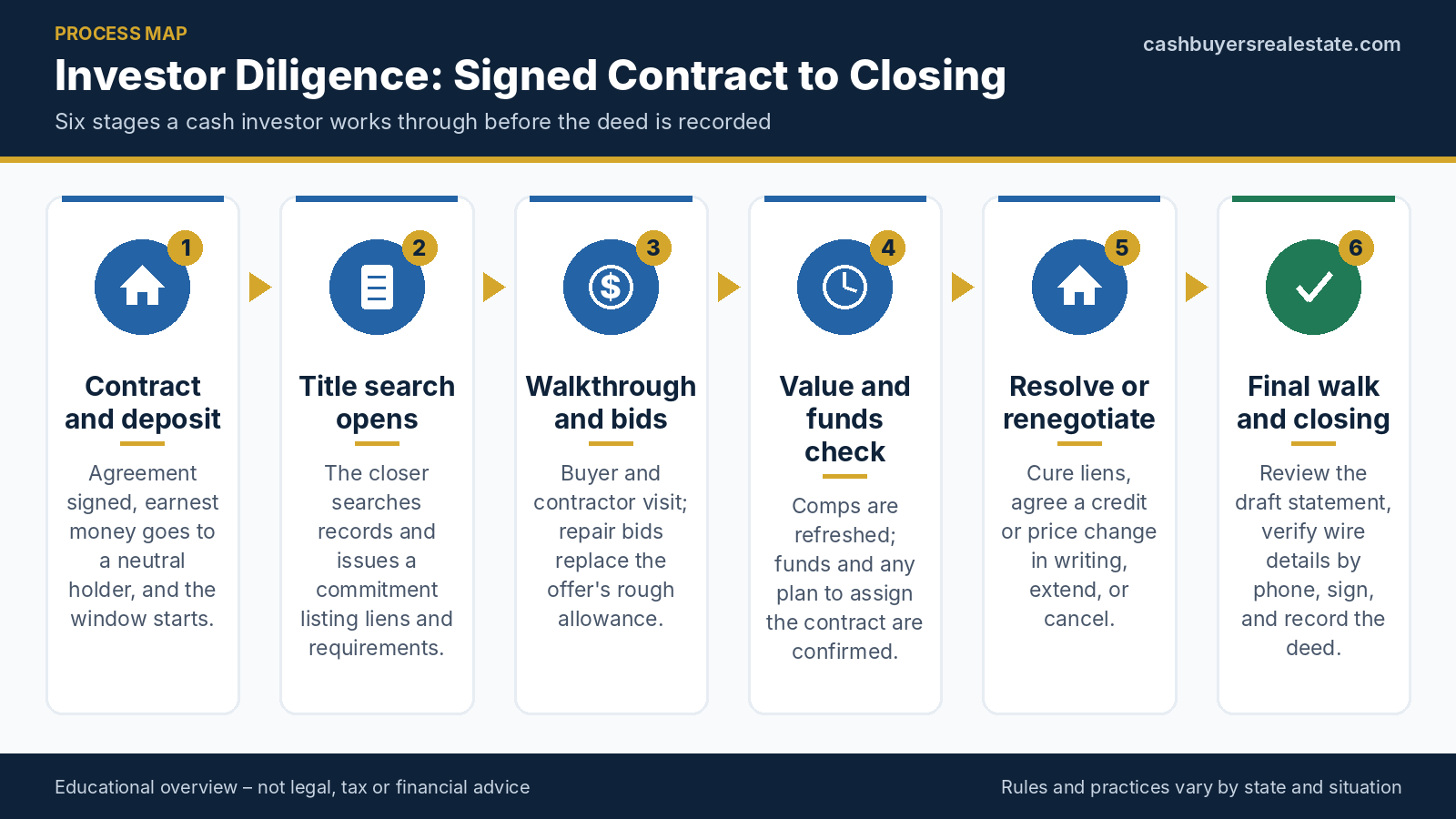
Text version of this infographic
- Contract and deposit — Agreement signed, earnest money goes to a neutral holder, and the window starts.
- Title search opens — The closer searches records and issues a commitment listing liens and requirements.
- Walkthrough and bids — Buyer and contractor visit; repair bids replace the offer's rough allowance.
- Value and funds check — Comps are refreshed; funds and any plan to assign the contract are confirmed.
- Resolve or renegotiate — Cure liens, agree a credit or price change in writing, extend, or cancel.
- Final walk and closing — Review the draft statement, verify wire details by phone, sign, and record the deed.
When the Search Finds Something
A finding on title doesn’t mean the deal is dead. Most are processed through ordinary steps, and the investor’s reaction to them often reveals how experienced the buyer is. What follows explains which problems can be fixed with money and paperwork, and which ones change the structure of the sale.
Problems that can be cured, and the ones that reshape the deal
Curable problems are the ones where a known party can fix the record with a payment or a document: paying off a lien, obtaining a release, correcting a misspelled name with a corrective deed, or recording a missing satisfaction of mortgage. These are routine for title professionals, and a competent closer will list them as requirements in the commitment and then work them one by one. The seller’s job is mostly to respond promptly, sign what is needed, and keep the investor informed. Time is the main cost: a release from a lender that has been bought and sold several times can take longer than a payoff from the current servicer.
Problems that reshape the deal are those where no one party can fix the record quickly. An unknown heir, a missing co-owner, a probate estate that isn’t open yet, a forged or defective prior deed, and a boundary dispute with a neighbor all fall into that group. In those cases the investor has three realistic choices: wait while the issue is resolved, ask the seller to resolve it under a stated deadline, or change the terms. Changing terms can mean a lower price, a longer closing date, a larger holdback at closing, or termination. A reputable investor will explain which choice they are making and why, and will put the new terms in writing as an amendment. If the explanation is vague or the new price arrives alongside a short deadline, treat that as a prompt to slow down and get a second opinion from an independent attorney.
A related cost to keep in mind is that title problems tend to cut off the simplest alternative as well. A retail buyer using a mortgage faces the same commitment and the same lender-required clean-up, so selling through an agent doesn’t make a lien disappear. What it changes is who is racing the clock and who has time. A seller with a title defect may be better off using the first weeks of the contract to cure it than renegotiating the price, since a cured defect restores the original deal. For more on selling with unresolved ownership or lien questions, the guide to selling a house with title problems covers the legal specifics in more depth, and the rules differ by state.
Owners, heirs and recorded documents that surface late
The most disruptive findings tend to come from people and papers the seller hadn’t thought about. A former spouse whose name never came off the deed after a divorce, a parent who died without the house being retitled, a relative who inherited a fractional share from an earlier generation, or a prior owner whose estate never closed can each appear in the chain of title. Each has a legal claim that must be released, signed away, or cleared by court order before a title insurer will stand behind the sale, and the right path depends on state law and the specific records. That is why the preliminary search matters so much: it turns an unknown risk into a known task with a list of people to contact.
Recorded documents can also surprise sellers. A utility easement you’ve forgotten about, a restrictive covenant limiting what can be built, an old option to purchase, or a lis pendens, which is a notice that a lawsuit affecting the property is pending, all show up in the public record whether or not they mattered to you. Easements and covenants usually remain with the land and appear in the commitment as exceptions; a pending lawsuit or an unrecorded option is more serious because it can bar a clean transfer until it is resolved. The investor’s closer will flag the difference, and what you can do is ask for plain-language explanations of each item that affects either the price or the schedule.
If a late-surfacing issue involves family members, tact matters as much as speed. A relative who suddenly learns that a house is under contract may feel surprised or excluded, and a signature that could have been easy to get on day two can become hard to get in week three. When sellers tell co-owners and heirs about the sale before the title company starts calling them, the signature process goes smoothly more often than not. If a disagreement has already developed, a mediator or an attorney who handles real estate matters may be more effective than pressing the buyer for more time, and the investor will usually respect a seller who shows a credible path to resolution.
Inspections, Repair Bids and the Comparable-Sales Refresh
The physical house is where an investor’s offer meets reality. The offer was built from photos, a phone conversation, and a quick look at neighborhood sales, so it rests on assumptions about condition and resale value. The walkthrough and the valuation refresh test those assumptions. This section explains what the buyer looks for, how a contractor’s bid becomes a repair budget, and how the value of the finished house gets checked again, because those three steps account for most of the honest reasons a price changes after signing.
Walking the House: What Inspectors and Contractors Look For
Investors rarely commission the same kind of inspection a retail buyer would. Often it is a walkthrough by the buyer and a contractor, sometimes with a licensed home inspector, specialty inspector, or sewer camera added. The aim isn’t a perfect report; it’s an estimate of what the house will cost to bring to the condition the buyer plans to sell or rent it in.
The areas that draw the most attention and why
The roof comes first, since its remaining life and any past leaks affect both cost and the risk of hidden water damage. Next is the foundation and structure, where cracks, sloping floors, or sticking doors prompt questions about settlement and drainage. Plumbing follows, particularly the main sewer line and any supply lines made of materials with a history of failure, because a failed line under a slab can cost far more than a failed fixture. The electrical panel and wiring matter for safety and insurability, and heating and cooling equipment gets a look for age and function. Moisture is the thread through all of these: investors look for stains, musty smells, and mold, because water problems tend to be larger than they appear on the surface and hard to price without opening walls.
Federal and state rules also shape what you must tell the buyer, whatever the investor finds. For housing built before 1978, the federal lead-based paint disclosure rule requires sellers to give buyers an EPA pamphlet, disclose known lead-based paint and hazards, hand over available records, and provide a lead warning statement. The same rule gives the buyer a 10-day period to inspect for lead-based paint, which the parties can change in writing and the buyer can waive, according to the EPA’s real estate disclosure page. Many states add their own seller disclosure forms covering known defects, and an as-is sale does not erase those duties. If you aren’t sure what your state requires, an attorney or the state real estate regulator is the authority, not the buyer.
For the seller, the useful takeaway is that nothing on the inspector’s list should be a surprise if you’ve looked at your own house the way a stranger would. Walk the property with a notepad and photograph the places where you know water has entered, where a repair was made, or where something doesn’t work. Honest disclosure at this stage protects you in two ways: it lowers the odds of a re-trade based on a “discovery” you already knew about, and it keeps you within your legal obligations. Concealing a known problem, or trying to hide evidence of one for the walkthrough, tends to backfire both legally and commercially, since an investor who finds one hidden item will start to doubt everything else you’ve said.
From bids to a repair budget
After the walkthrough, the buyer’s contractor produces a bid, which might be a line-item estimate or a single lump sum. That number isn’t the same thing as the repair allowance built into the original offer. The allowance was a ballpark made before anyone saw the inside of the walls; the bid reflects scope that has now been seen. The buyer then converts the bid into a budget by adding things a contractor’s bid usually leaves out: permits and inspections that the work will trigger, a contingency for unknowns uncovered once demolition begins, the cost of holding the house during the work, and sometimes a project management margin. A fair-minded investor shows these layers when asked, and a seller who understands them can have a much more productive conversation than one who sees only a larger total.
There are legitimate reasons the two numbers differ. Contractor pricing changes with materials and labor availability, and a scope that looked cosmetic from the street can turn out to include rot behind the siding or a panel that needs replacement for safety reasons. There are also less benign reasons, such as a bid padded to create room for a price cut, or a scope expanded to include upgrades the buyer wants for resale but the house doesn’t strictly need. The cleanest way to test a bid is to ask for it in writing, itemized, with photos tied to each line, then compare it with an independent estimate. The guide to repair deductions in cash offers explains how these deductions are normally calculated and where sellers often push back.
Sellers sometimes assume they can undercut the investor’s bid by hiring a handyman and fixing everything first. Occasionally that works; often it doesn’t, for three reasons. The investor may want the work done their way, to their standard, with their crew. Repairs done mid-contract can raise permit and insurance questions. And the time spent on repairs eats into a window that was priced for an as-is sale. Where a specific item is clearly cheaper for you to fix than to discount, such as clearing debris or replacing a missing smoke detector, offering to do it in writing before closing can resolve the point. For larger items, a credit at closing or a price adjustment usually works better than repairs mid-contract, and the guide to selling a house fast without repairs explains the trade-offs more fully.
Refreshing the Value and Re-Running the Offer
The second half of the property track happens at a desk. The investor’s offer was derived from an estimate of what the finished house will sell for, and that estimate gets rechecked as the walkthrough produces new information and as time passes.
How the after-repair value is checked again
Investors anchor their offers on the after-repair value, usually abbreviated ARV, meaning the estimated sale price of the house once repairs are complete. The ARV comes from comparable sales, or comps: recent sales of similar homes nearby, adjusted for differences in size, condition, age, and features. During diligence, the buyer typically refreshes the comps for several reasons. Time has passed, and sales in the neighborhood may have closed that were not available at the first look. The walkthrough may have changed the buyer’s view of the house, say, a smaller livable area than assumed or a layout that appraisers treat differently. And the choice of comparable sales is a judgment call, so a more cautious look can produce a lower number than an optimistic one. Nothing about this is secret; it’s the same work an appraiser does for a lender.
Where sellers sometimes feel misled is when the ARV used in the offer was higher than the one that appears in the re-trade. That can reflect honest reconsideration or a deliberately generous first look intended to win the contract. The way to find out is to ask which sales the buyer used at each stage and why they changed. A buyer making a good-faith adjustment can walk you through the sales; a buyer who cannot or will not explain it is signaling that the change is about bargaining pressure. Your own agent’s comparative market analysis or a licensed appraiser’s opinion can serve as an independent check, and the article on after-repair value in cash offers explains how the figure is built and why two professionals can reach different numbers in good faith.
One more subtlety is that the ARV is a forecast, and forecasts have uncertainty. A buyer planning to resell in several months is exposed to market movement during renovation, so a conservative ARV partly prices that risk. A seller who understands this can see why two investors, shown the same house, might make offers thousands of dollars apart without either being dishonest. It also explains why a second written offer is a better test of a first offer’s fairness than any single formula, a point the guide to comparing cash offers develops in detail.
Where the margin goes: holding costs, resale costs and risk allowance
An investor’s offer is built backward from the resale price. Start with the ARV, subtract the repair budget, subtract the costs of buying and selling, subtract the costs of carrying the property while the work is done, and what remains is the amount that can be paid for the house while still leaving the buyer a profit. In the illustrative formula many practitioners describe, that profit and risk cushion is the portion of the equation most open to negotiation, and it is also the portion most affected by uncertainty. When diligence reduces uncertainty, because the roof turns out fine, the margin cushion can shrink and the offer can hold or improve. When diligence adds uncertainty, because the foundation needs an engineer’s opinion, the cushion often grows and the offer falls. Seen that way, a re-trade is frequently just the buyer re-pricing uncertainty.
The costs of carrying a property are easy to overlook until you see them itemized. They include property taxes, insurance, utilities, any loan or short-term financing costs, and the opportunity cost of money tied up for months. Resale costs include a listing agent’s commission if the buyer lists, closing costs on the resale, and any concessions offered to the next buyer. None of those numbers is secret, and a buyer who shows their work gives you a way to test the offer. The how-to article on how cash buyers calculate offers shows the formula in more detail, with the assumptions made visible so you can plug in your own.
For a seller, the most useful way to use this knowledge is as a lens on the net. A cash investor’s price is below what a repaired, listed house might sell for, but the price is not the right comparison. The right comparison subtracts what you would pay in commissions, repairs, concessions, and months of carrying costs on the open-market path. The reverse also holds: if the open-market path requires work you can’t afford or can’t manage, an investor’s price may be higher in practice than its label suggests. Running both sets of numbers before you sign, using the same assumptions, is the discipline that keeps you from being surprised later, and the guide to cash versus traditional sale net proceeds offers a side-by-side way of doing it.
How Re-Trades Happen and How Sellers Can Respond
A re-trade is a request to change the price or terms after a contract has been signed. The word carries a sour reputation, yet the underlying event is neutral: a buyer learns something during the window and asks for an adjustment. Whether that is fair depends on what was learned, what was already known, and how the request is handled. This section separates justified adjustments from pressure tactics, describes the five ways a diligence period commonly ends, and walks through a numeric example of an offer adjusted after diligence, so you have a method for responding rather than only an opinion about it.
Why Prices Change After the Contract Is Signed
A seller’s best protection against a bad re-trade is a clear picture of how a good one looks. The distinction rests on three tests: did the buyer discover something that was not visible or disclosed, does the proposed number follow from that discovery, and is the buyer willing to show the evidence. When all three answers are yes, an adjustment is often defensible even when it is unwelcome.
Findings that justify an adjustment, and findings that don’t
The strongest justifications involve facts that neither side knew when the contract was signed and that carry a real cost. A cracked main sewer line revealed by a camera, a roof that has more than one layer of shingles and a leak into the attic framing, a recorded lien that wasn’t disclosed, or storm damage that occurred after the offer all fit. In each case the buyer can show a document or photo, a contractor or title company can put a number on it, and the number can be traced into the original formula. A seller who refuses all adjustment in those circumstances risks losing a buyer who will walk during the window at no cost, so engaging with a documented finding is usually the practical course.
The weakest justifications involve things the buyer could already see, general unease, or a change in the buyer’s own circumstances. Photos of a worn kitchen were in the listing materials; a buyer who priced the house from those photos and then cites the kitchen has not discovered anything. A claim that the market has softened, with no sales cited, is a feeling and not a finding. A partner or lender backing out on the buyer’s side is the buyer’s problem unless the contract says otherwise. Those requests deserve a polite question about what has changed since the offer. The table below organizes the common triggers by how often they justify a change, what evidence to ask for, and typical responses.
| Trigger cited by the buyer | Often justified? | Evidence worth requesting | Typical seller responses |
|---|---|---|---|
| Repair scope larger than the offer assumed | Yes, if the scope is documented | Itemized bid with photos; sewer camera video; inspector note | Get an independent bid; negotiate a credit or split |
| Lower comparable sales than first used | Sometimes | List of the comps used at each stage and the adjustments | Offer your own comps; ask for an appraiser’s opinion |
| Lien, tax or title cost not disclosed | Yes, to the extent it reduces what the buyer receives | Title commitment line items; payoff letters | Cure it, pay it from proceeds, or adjust the price by the amount |
| Condition changed after the offer (storm, break-in, pipe burst) | Yes | Dated photos; insurer’s claim information | Clarify who bears the risk of loss under the contract; consider a claim |
| Item visible in listing photos or the original walkthrough | Rarely | What was new, compared with what was shown before | Decline politely and point to the original basis |
| “The market softened” with no specifics | Rarely | Dated sales supporting the claim | Ask for the data; consider whether to keep the deal alive |
| Buyer’s partner, funds or resale plan changed | No | Written explanation and proof of funds | Hold to the contract; review cancellation and earnest money terms |
| Request for a longer window or extension paired with a price cut | Depends | Reason for delay; what exactly is open | Trade time for money only if the reason is documented |
To read the table, find the row that matches the buyer’s stated reason and look across for what to ask. The columns work as a script: first establish whether the trigger is new, then request proof, then decide how to respond. If a buyer cites several reasons at once, deal with them separately, since mixing a valid sewer finding with an unsupported market claim lets the weaker point ride along with the stronger. For more on how contract terms interact with these requests, the article on cash offer contract red flags covers clauses that make re-trades easier or harder.
When a request looks like pressure rather than diligence
Certain patterns make a request look more like pressure than verification. One is timing: a significant reduction proposed in the last hours of the window, when the seller’s alternatives have narrowed and the buyer’s cost of walking is low. Another is drift, where several small reductions arrive one after another, each too modest to refuse on its own but adding up to a large change. A third is the unitemized figure, such as “we can do $148,000” with no supporting breakdown. A fourth pairs a reduction with an implied threat to cancel, which carries little cost to the buyer when the deposit stays refundable during the window, as many investor contracts provide. None of these patterns proves bad faith, since an inexperienced buyer might behave this way without calculation. They are signals to slow the conversation down and ask for specifics.
The seller’s most effective counter is calm, written, and specific. Reply by email, restate the contract price and date, acknowledge the finding, and ask for the itemized basis for the number. Ask which line in the original calculation the finding changes and by how much. If the answer is a clear bid or a recorded document, take it seriously. If the answer is a restatement of the general reduction, say you’d like to see the supporting detail before discussing a revised number. Sellers sometimes feel that asking for proof is confrontational, but a buyer with real evidence is usually happy to share it, because sharing it is what gets the amendment signed.
Know your alternatives before the conversation starts. A seller whose only option is this buyer negotiates differently from one who has a second written offer, a listing agreement ready to sign, or enough financial cushion to wait. That doesn’t mean bluffing; it means being able to say honestly that you’re weighing the revised terms against other routes. The earnest money rules also matter, and the guide to earnest money from cash buyers explains how deposits are held and when they can change hands. If the buyer’s cancellation right is still open, the buyer can leave at any time, so the question is whether a revised deal is still better for you than starting over.
Responding Without Losing the Deal or Your Net
Responding well is partly a matter of tone and partly a matter of structure. A response that keeps the conversation factual, and that gives the buyer a way to say yes without losing face, often produces a better outcome than a flat refusal or an immediate concession.
Five ways diligence can end and what each means for you
Most diligence periods end in one of five ways. The cleanest is a close as written, where the buyer’s findings match their assumptions and the price stays the same. Second is a credit at closing, where the buyer agrees to the same price but receives a specific amount at the settlement table to cover a particular item, such as a lien payoff or a repair. Third is a price reduction, which changes the contract number and is usually documented in an amendment. Fourth is a cure-and-extend outcome, where the seller fixes a problem, such as obtaining a lien release, and the buyer extends the deadline to allow it. Fifth is a cancellation, where either the buyer exercises their right to terminate or the seller decides the revised terms are not acceptable and the parties part ways.
The choice between a credit and a price reduction matters more than it looks. A credit leaves the contract price intact, which can matter for comparisons, for taxes on the sale, and for how the transaction is reported, while a price reduction changes the headline number. Which is better depends on what the money is for and who benefits, and on your tax situation, which is a question for a tax professional. A cure-and-extend outcome favors sellers whose problem is time-limited, since it keeps the original price. A cancellation isn’t always a failure: if the buyer’s revised number would leave you worse off than a listing, then walking away early costs less than closing a bad deal. The graphic at the end of this section summarizes the five endings side by side.
When you’re evaluating any revised offer, return to net proceeds. Take the new price, subtract the payoffs and costs that now apply, add any credits, and compare that to what each alternative would likely net after commissions, repairs, concessions, and carrying costs. A lower price with a faster, surer closing can still beat a higher listing price that depends on a buyer’s financing and an appraisal. A lower price accompanied by uncertainty may not. The five-outcome view helps because it keeps the question practical: not whether the buyer is being fair, but which of these endings leaves you in the best position.
A worked example of an offer adjusted after diligence
Seeing the arithmetic of a re-trade removes much of its mystery. The table below reruns an investor’s offer formula three times for a hypothetical house: the original offer, the buyer’s own recalculation after diligence, and a negotiated result after the seller supplies evidence. The formula is a simplified illustration and not a standard that every buyer uses, but the pattern, in which each line item moves for an identifiable reason, is how most legitimate adjustments look on paper.
| Line item | Original offer | Buyer’s recalculation | After seller’s evidence |
|---|---|---|---|
| Estimated after-repair value | $245,000 | $241,000 | $243,000 |
| Repair budget | $38,000 | $47,500 | $44,000 |
| Resale costs | $17,500 | $17,200 | $17,350 |
| Holding costs | $8,000 | $8,600 | $8,300 |
| Buyer’s profit and risk cushion | $13,500 | $13,500 | $13,500 |
| Resulting price | $168,000 | $154,200 | $159,850 |
Read across a row to see what changed and down a column to see how the price is built. The buyer’s recalculation moves four lines for specific reasons: two comparable sales closed lower, a roof bid came in above the allowance, a sewer line needs work, and the longer repair schedule raises holding costs. Notice that the buyer’s profit cushion stays constant. That is often the test of a good-faith adjustment, since a cushion that rises along with every finding suggests the findings are being used to widen the margin. The third column also shows something sellers rarely expect: the seller’s evidence did not erase the findings, it only narrowed them. The roof allowance still rose, but by the amount an independent bid supported, and the lower comparable sale that turned out to be a poor match was given less weight. A negotiated result of this kind usually leaves both sides a little unhappy and the contract intact, which is a reasonable definition of a workable settlement.
Illustrative example (hypothetical numbers, not market data): An investor agrees to pay $168,000. In the last two days of the window the buyer texts that the best he can do now is $148,000, with no explanation. The seller replies in writing, asking for the roof bid, the sewer camera findings, and the sales used to update the value. The buyer sends a $14,500 roof bid against an $8,000 allowance, a $3,000 sewer repair, and two lower comps, which supports the $154,200 recalculation in the table. The seller obtains a second roofing bid of $11,000 and shows that one of the two lower comps was a smaller house on a busier street. The parties settle at $159,850. The seller’s net is $8,150 below the original contract and $11,850 above the unexplained $148,000 request. The difference came from asking for evidence, accepting the findings that were real, and challenging the ones that were not.
Several lessons from the example generalize. The first number the buyer offered after diligence was lower than the number the buyer’s own arithmetic supported, which is a common pattern whenever a request arrives without itemization. The seller didn’t win everything, because the roof really did cost more than assumed and the sewer line really did need work. And the final result was reached with documents rather than argument. The graphic below summarizes the five ways a diligence period can end so you can see how this example fits among them.
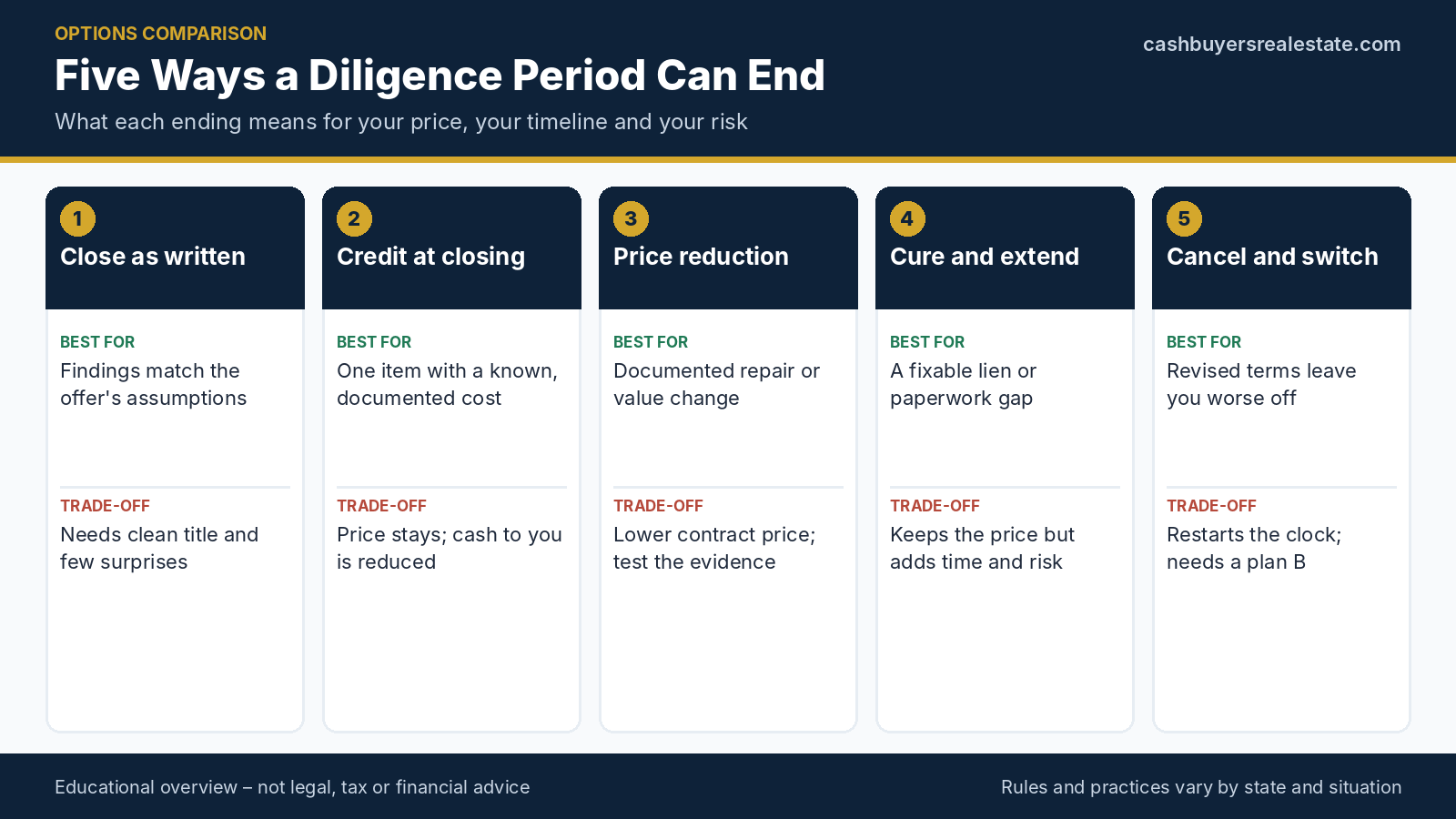
Text version of this infographic
- Close as written — Best for: Findings match the offer's assumptions. Trade-off: Needs clean title and few surprises.
- Credit at closing — Best for: One item with a known, documented cost. Trade-off: Price stays; cash to you is reduced.
- Price reduction — Best for: Documented repair or value change. Trade-off: Lower contract price; test the evidence.
- Cure and extend — Best for: A fixable lien or paperwork gap. Trade-off: Keeps the price but adds time and risk.
- Cancel and switch — Best for: Revised terms leave you worse off. Trade-off: Restarts the clock; needs a plan B.
Proof of Funds, Contract Assignment and the Closing Mechanics
The last strand of diligence points back at the buyer. While the investor is verifying your property and your title, you have every reason to verify the investor: that the money exists, that the person who signed is the person who will close, and that the closing will be handled by someone who treats your proceeds with care. This section explains what funding evidence does and does not show, how assignment language can change who your buyer turns out to be, and what to check about the closing itself, including how proceeds reach you.
Confirming the Buyer Is Real: Funds, Identity and Assignment
Sellers sometimes feel awkward questioning a buyer’s capacity once an agreement is signed, but verification is a normal part of any transaction and a legitimate investor expects it. The aim is to replace assumption with confirmation, calmly and in writing.
Proof of funds, earnest money and what each really shows
Proof of funds is a document, usually a recent bank or brokerage statement or a letter from a financial institution, that shows the buyer has money available. It is a useful first screen and a weak final one. A statement shows a balance on a particular date; it doesn’t show that the money is free of other commitments, that it will still be there on closing day, or that it is earmarked for your purchase and not three others. A letter from a lender confirming a line of credit shows borrowing capacity, which is a different thing from cash. Documents can also be edited, so the most reliable form of verification runs through a neutral third party, such as the title company or attorney confirming that it has received the deposit and, close to closing, that the buyer’s funds are in place. The guide to proof of funds from cash buyers covers the formats and their limits in more detail.
The earnest money deposit is the better early test, because it moves real money. Under most contracts the buyer delivers it to a named holder, such as a title company, an escrow officer, or an attorney’s trust account, within a short period after signing. Ask the holder for written confirmation that the deposit has arrived. A buyer who is late, offers an excuse, or proposes to deliver the deposit directly to the seller or to an unfamiliar entity is giving you information, and so is a buyer who delivers it promptly. Keep in mind that a deposit’s size is not a measure of the buyer’s total capacity; it is a measure of the buyer’s commitment during the window, and under many investor contracts it stays refundable until the window ends.
Identity verification is the other half. The buyer’s name on the contract should match the entity that proves funds and the entity the closer plans to put on the deed or the assignment. If the buyer is a company, ask for the company’s full legal name and confirm that it exists through the state’s business registry, which most states make searchable online. You aren’t doing anything hostile by asking; closers need this information anyway to complete their own checks. If a buyer resists basic identification questions while pressing you for a fast signature on every document, treat it as a reason to pause, and consider whether the questions that help you judge whether a cash buyer is legitimate have been answered to your satisfaction.
Assignment clauses and who is actually buying
Many investor contracts include language allowing the buyer to assign the agreement to someone else, often written as “buyer and/or assigns.” That clause is common and not wrong in itself. Some investors buy houses to renovate or hold and use assignment only to move the contract to a related entity, such as a newly formed company for liability reasons. Others, often called wholesalers, sign a contract with the aim of finding a different buyer and collecting a fee for transferring the contract, and may never intend to close personally. Both can be legitimate, but they carry different risks for you. The wholesaler’s ability to close depends on finding an end buyer within the window, which is why those transactions are more likely to end in an extension request or a sudden price cut.
Some states regulate the practice. Iowa’s statute, section 543B.6A of the Iowa Code, requires a wholesaler to give written disclosures to the parties before signing, including that the wholesaler holds an equitable interest and not legal title; if the disclosures aren’t made, the seller or buyer may cancel before closing without penalty, and the statute sets civil penalties for violations, according to the Iowa Legislature’s published text. Oklahoma’s Senate Bill 1075, effective November 1, 2025, requires written disclosures before contracts are signed and gives homeowners a two-business-day right to cancel, per the Oklahoma Real Estate Commission’s announcement. Those are examples, not a national rule; most states handle wholesaling differently, and some leave it largely unregulated. Your state’s real estate commission or attorney general can tell you what applies where you live.
Practical protections are straightforward. Ask early whether the buyer intends to close in their own name. If the contract allows assignment, you can often negotiate a requirement that you receive written notice of any assignee, a limit on assignment to affiliates, or a right to cancel if the assignee cannot show funds within a stated time. Check that your agreement is with an entity you can identify, and that the price in the contract is the price you’ll actually receive. If a third party appears late in the process and asks you to sign new documents, treat that as a new transaction and apply the same checks, including confirming funds with the closer. The article on selling a house directly to an investor goes further on how direct sales differ from assigned ones.
The Closing Mechanics You Should Verify
Closing is a handoff of money and title through a person or firm whose job is to hold both until the conditions are met. Most seller losses at this stage come from avoidable errors in the paperwork or in how money moves, not from the buyer’s intent.
Who closes the sale and what the settlement statement shows
Closing practice differs from state to state. In many states, a title company or escrow company handles the closing and holds funds; in others, an attorney conducts it and the money moves through the attorney’s trust account. Either way, the closer collects the buyer’s funds, pays off your liens, records the deed, and pays you. You should know in advance who the closer is, who selected them, and how to reach them independently. If a buyer insists on using a closer you cannot verify, or one located far from the property with no clear role in your state, consider asking for a closer of your choosing or having your own attorney review the documents.
The settlement statement is the itemized accounting of the sale: the price, the payoffs, the prorated taxes, the fees, the credits, and the cash to you. In mortgage-financed sales, the federal Closing Disclosure and its three-business-day delivery rule apply to the buyer’s loan; the Consumer Financial Protection Bureau describes that form and timing. Industry guidance from the American Land Title Association has long noted that this form isn’t required for all-cash transactions and that the HUD-1, a Closing Disclosure, or another settlement statement can be used, with some states requiring their own forms, as the ALTA discussion of cash transactions explains (that post dates to 2013, so ask your closer what applies today). What this means for you is simple: do not count on a three-day review rule in a cash sale. Ask for a draft settlement statement as soon as the closer can produce one, and compare each line against the contract.
Several lines deserve special attention. Check the price against the contract, the payoffs against the written payoff letters, and the property tax proration against the tax bill. Look at title and escrow fees and who is charged for each, since the contract should say who pays and the statement should match. Confirm that no unexpected charges have appeared, such as an “administrative” or “assignment” fee in your column. If the buyer is collecting a fee from the transaction, understand how it’s described and whether it comes out of the price. Finally, expect an information return: the person responsible for closing generally files IRS Form 1099-S reporting gross proceeds, which are generally the sales price and are not reduced by your expenses, with exceptions for certain principal residence sales when the seller provides the required certification, according to the IRS instructions for Form 1099-S. How the sale is taxed is a separate question for a tax professional.
Wire safety, reporting rules and the final signing
Wire fraud is the single most damaging closing-day risk, and it targets sellers as well as buyers. Criminals compromise email accounts, watch a transaction, then send realistic messages with altered wiring instructions. For sellers, the risk typically appears when you send instructions for where your proceeds should go, or when someone impersonating the closer asks you to change them. The American Land Title Association’s consumer guidance recommends obtaining wiring instructions in person or by phone, confirming them through a number you already know, being suspicious of last-minute changes, enabling multi-factor authentication on email and banking accounts, and treating urgency as a warning; if you think funds were misdirected, it advises calling your bank at once for a recall, calling the title company, and filing a report with the FBI’s Internet Crime Complaint Center. Both organizations’ pages are worth reading before closing week: the ALTA stop-fraud guidance and the FBI’s IC3 complaint portal.
A different kind of paperwork has been in flux. The Financial Crimes Enforcement Network had adopted a rule requiring closers to file reports on certain non-financed transfers of residential property to entities and trusts, a category that includes many cash purchases by investor companies, with an effective date postponed to March 1, 2026. On March 19, 2026, a federal district court in the Eastern District of Texas vacated the rule in its entirety, and FinCEN’s website stated afterward that reporting persons were not currently required to file, as summarized in a Gibson Dunn client alert. The ruling could be appealed, so the rule’s status may change; ask your closer whether any such reporting applies and what information they’ll need from you.
At the signing itself, bring government photo identification, read each document before you sign it, and never sign a page with blank lines or a placeholder for the price or the buyer’s name. If the closer sends documents in advance, use the time to read them and write down questions. If something does not match the contract, stop and ask; sorting out a difference at the table is easier before you’ve signed than after the deed is recorded. After closing, keep your copy of the final settlement statement and the 1099-S, if you receive one, with your tax records.
Access, Occupancy and Logistics While the Contract Is Open
A purchase agreement doesn’t only transfer a deed; it also reorganizes how people use the house for the next several weeks. Strangers need to come inside, belongings may need to leave, a tenant or relative may still live there, and somebody has to keep the lights on and the policy in force. Disputes in this area are rarely dramatic, yet they cause a surprising share of delays and last-minute credits, because they sit in the gaps between what the contract says and what people assume. This section covers the practical side of the window: who comes and goes, who lives in the house, what stays, and who is responsible for the property until the deed is recorded.
Giving Access Without Losing Control of the Property
Access requests are the most visible part of diligence and the part sellers have the most control over. A predictable, polite structure keeps the buyer informed and keeps you comfortable.
Scheduling walkthroughs, contractors and the final inspection
Most contracts grant the buyer reasonable access to inspect the property during the window, but “reasonable” is not defined, and good manners fill the gap. A workable approach is to ask for visits to be scheduled through one point of contact, with a day’s notice where possible, and to batch the people who need to attend: the buyer, the contractor, an inspector, and any specialist such as a sewer scope technician. Clustering the visits shortens the number of days your house is open to strangers and usually shortens the window too, since the buyer’s contractor can produce a bid sooner when the work is seen once rather than in pieces. If the house is vacant and you live far away, a lockbox or a local friend can handle entry, but record who has the code and change it afterward.
Whether you should attend visits depends on the situation. Being present lets you answer questions and correct misunderstandings on the spot, such as explaining that a stain is from a leak repaired years ago. It can also lead to casual comments that a buyer later cites in a negotiation, so keep remarks factual and avoid speculation about problems you do not actually know about. Remove items of value, medications, financial paperwork, and firearms before visitors arrive, and take photographs of the condition of each room before the first visit. Those photos matter later, because the final walkthrough is the moment at which the buyer confirms that the house is in substantially the same condition as at the time of the contract, and disagreements about damage are easier to settle with dated pictures.
Ask what the buyer intends to do during a visit, particularly if the plan includes invasive steps like opening walls, running a camera through a sewer line, or taking samples. Most contracts do not authorize damage to the property beyond what is normal for an inspection, and a buyer who needs destructive testing should ask for your consent and agree in writing to restore anything they open. Check your own homeowners policy as well, since visitors on the property can raise liability questions that your insurer or agent can answer. A short call to the insurer during the window is a sensible precaution and costs nothing.
Occupied homes: tenants, relatives and holdover occupants
When someone other than the owner lives in the house, access and timing get more complicated, and so does the investor’s valuation. A tenant with a lease generally has rights that depend on state and local law and on the lease itself, and in many places a sale doesn’t automatically end a lease. A buyer may want to keep the tenant, which makes the house a rental with an income stream, or may want vacant possession, which means the tenant must leave before closing or the buyer must wait. These two situations produce different prices and different timelines, and a contract should say clearly which applies, who handles notices, and what happens to the security deposit. State and local landlord-tenant law governs notice periods, entry rules, and whether certain payments to a tenant who agrees to leave early are lawful, so involve an attorney before offering or accepting any arrangement. The article on selling a house quickly with tenants goes through those questions in greater depth.
Illustrative example (hypothetical numbers, not market data): A landlord has a tenant on a month-to-month arrangement at $1,350 a month and receives two written offers from investors. One buyer offers $142,000 on the condition that the house is vacant at closing; the other offers $136,000 and agrees to take the property subject to the tenant. The landlord’s first thought is that the higher price is better. But delivering the house vacant means giving legally compliant notice, which takes time under local rules, perhaps losing rent during the notice period, handling the deposit, and paying for any cleanup after the tenant leaves. After estimating about two months of lost rent and $2,000 in cleanup and deposit handling, the gap between the offers narrows from $6,000 to something closer to $1,300, with more risk attached to the vacant-delivery path. The landlord decides to ask the first buyer whether it would close subject to the tenancy at a price in between, which is a conversation the numbers made possible.
Family members and informal occupants raise a related issue. An adult child who lives in the house, a relative who has stayed rent-free for years, or a roommate without a written lease can each have legal protections that make an eviction slow, even if everyone agrees the sale is a good idea. If an occupant might resist leaving, say so to the buyer at the outset, put the move-out date in the contract, and consider a short written agreement with the occupant that sets out the date, the condition in which the house will be left, and any payment you have agreed to make. A closer or attorney can advise on the right form. The worst outcomes in these situations come from discovering the issue at the final walkthrough, when the buyer arrives to find the house still occupied and a closing date at risk.
Belongings, Utilities, Insurance and Possession at Closing
The remaining logistical questions are mostly about the days between signing and closing, when the house is in an in-between state: yours in law and increasingly the buyer’s in practice.
Personal property, cleanout and what stays
An as-is sale doesn’t mean the buyer wants whatever you leave behind. The contract should say what conveys with the house, and the usual dividing line is between fixtures, which are attached and normally stay, and personal property, which normally leaves unless the contract says otherwise. Disputes arise over items in the gray zone: a mounted television, a window air conditioner, a freestanding workshop, a ceiling fan you replaced with a chandelier you planned to take. The simplest cure is to list in the contract anything you intend to remove or leave, and to photograph those items before the walkthrough. If you plan to leave furniture or contents, say so in writing and confirm the buyer accepts them; some investors price cleanouts into their offers and some expect the house empty.
Cleanouts can be a significant task in estates and in homes that have collected decades of belongings. Giving yourself time to sort, sell, donate, and dispose of items is part of the cost-benefit question of a fast sale, and some buyers will accept a house with contents in exchange for a lower price and a clear statement of who handles disposal. Whatever the arrangement, document it. An offer that treats contents as the buyer’s responsibility should say so, an arrangement that gives you a few extra days after closing to remove items should be written as a short post-closing occupancy agreement, and any items of sentimental or legal importance, such as family papers, firearms, or medications, should be removed before the buyer has access. The guides on selling a hoarder house and on cash buyers for inherited houses discuss cleanout options where the volume is large.
Utilities, insurance and the risk of loss before closing
Keep utilities on through the final walkthrough. Inspectors need power and water to test systems, contractors need light to estimate repairs, and a buyer who finds the house dark may reasonably doubt that systems work. Plan the transfer of service for the closing date and take final meter readings so that charges stop with you. In winter, a vacant house needs heat or proper winterization, since a burst pipe during the contract creates exactly the kind of damage dispute that derails closings.
Insurance deserves a separate look. Your homeowners policy is generally your responsibility until the deed is recorded, and some policies limit coverage when a house has been unoccupied for a period, so read yours or ask your agent whether a vacancy provision applies. Who bears the loss if the house is damaged between signing and closing depends on the contract and on state law, which differ; many contracts say the seller keeps the risk until closing and allow the buyer to cancel or take the insurance proceeds if the damage is substantial. Ask your attorney or the closer which rule applies, and if damage occurs, notify your insurer and the buyer promptly in writing. Concealing damage rarely helps and can create disclosure problems.
Possession at closing is the last logistical point. Typically the buyer takes possession at the time of recording and funding, with keys, garage openers, and codes handed over at or immediately after signing. If you need to remain for a few days, an informal promise is not enough; ask for a written occupancy agreement stating the date, any per-day charge, a deposit for damage, and who is responsible for insurance during that time. Some investors will agree to a rent-back; others won’t, and knowing which kind you are dealing with before you sign saves a difficult conversation later. The checklist below, presented as a graphic, pulls the verification and conduct points from the preceding sections into six items to run through before and during the window.
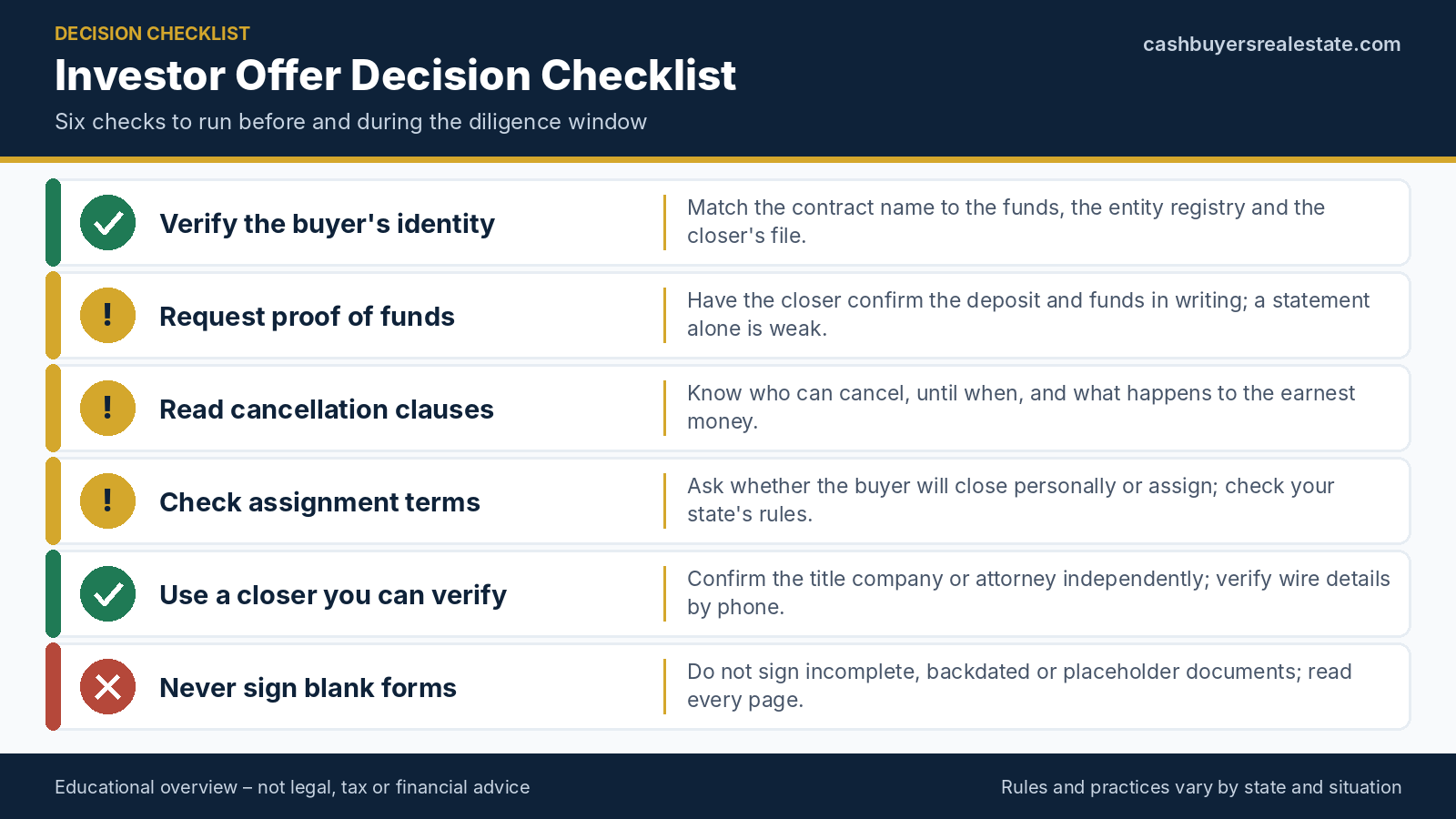
Text version of this infographic
- Verify the buyer's identity — Match the contract name to the funds, the entity registry and the closer's file.
- Request proof of funds — Have the closer confirm the deposit and funds in writing; a statement alone is weak.
- Read cancellation clauses — Know who can cancel, until when, and what happens to the earnest money.
- Check assignment terms — Ask whether the buyer will close personally or assign; check your state's rules.
- Use a closer you can verify — Confirm the title company or attorney independently; verify wire details by phone.
- Never sign blank forms — Do not sign incomplete, backdated or placeholder documents; read every page.
A Seller Preparation List and Warning Signs in a Buyer’s Conduct
Everything covered so far points toward a short list of habits. Prepare the facts the buyer will look for, communicate in a way that leaves a paper trail, and stay alert to behavior that suggests the buyer is using the process as a bargaining tool or isn’t able to close. Preparation helps because most re-trades feed on surprises, and conduct awareness helps because the occasional bad actor relies on sellers being reluctant to ask questions. Neither requires adversarial posture; both are ordinary precautions in a transaction that may be the largest of your year.
Preparing Before and During the Window
The best time to prepare is before you sign anything, but preparation is useful at every stage. What follows separates the work that pays off most before acceptance from the habits that matter once the clock is running.
Before you accept: the preparation that prevents most re-trades
Preparation before acceptance serves two purposes. It lets you judge the offer against realistic numbers, and it removes the surprises that buyers often cite when they ask for a lower price. Think of it as running the buyer’s diligence on yourself and fixing or disclosing what you find. You won’t catch everything, since a buyer’s contractor sees things you don’t, but you can close the gap considerably in a weekend of organized work. The list below is a sequence you can follow. It works in roughly this order because the earliest items change the largest numbers, and because some of them, like a payoff request or a title search, involve third parties who take days to respond. Starting them before you sign means the answers are in hand when the buyer’s questions arrive, and it gives you time to decide what to cure, what to disclose, and what to leave for the buyer to price.
- Request a written payoff from each lender, including any home equity line, and note the per diem interest so you can estimate the figure at closing.
- Check the property tax account online or with the tax office, and confirm whether any special assessments or unpaid balances exist.
- Search your own records for contractor disputes, court judgments, code notices, and unpermitted work, and ask an attorney or title company for a preliminary search if you are unsure.
- Identify every owner and every person with an interest, and tell them about the sale before the title company does.
- Photograph each room, the roof where it is safe to do so, the mechanical systems, and every area you know has leaked or been repaired, with dates.
- Gather permits, warranties, receipts for major work, and your state’s seller disclosure form, filled out accurately.
- Obtain one independent repair estimate for the largest item you know about, so you have a reference point when the buyer’s bid arrives.
The reasoning behind the last item deserves a word. A seller who walks into a negotiation with only the buyer’s number has to either accept it or reject it; a seller with an independent estimate can respond with a counterpoint grounded in a document. The estimate does not have to be perfect, and it does not commit you to doing the work. The guide on selling your house fast places this kind of preparation among the broader trade-offs of speed, and the article on preparing for a fast home sale adds the documents and logistics not covered here.
A related decision is whether to fix anything before accepting an offer. Small, inexpensive items that make the buyer’s walkthrough go smoothly, like replacing missing outlet covers or clearing debris, can reduce friction. Larger repairs usually belong in the buyer’s budget, because investors price them in. Remember that what you know about the house must be disclosed where the law requires it, and that an as-is label shifts repair responsibility without erasing disclosure duties. If you aren’t sure which known problems you must disclose in your state, ask an attorney before the buyer’s inspection and not after.
During the window: communication habits that keep the deal on track
Once the contract is signed, the habits that help most are dull and effective. Designate one point of contact on each side, and keep requests in writing even when a phone call comes first: after a call, send a short email summarizing what was agreed. Calendar the window’s end date and any notice deadlines the day you sign, and set reminders before them. Respond to document requests within a day when you can, because delay on your side hands the buyer a legitimate reason to ask for more time. Keep copies of everything, including who was granted access and when, the bids and reports you receive, and any amendments.
Be careful with the form of agreements. A change to price, dates, or terms should be an amendment signed by both parties, not a text message or a verbal understanding. Read the amendment as you would the original contract: it may restate or reset deadlines, change the earnest money terms, or include a release of claims that you didn’t intend to give. When an amendment arrives with urgent deadlines, ask for time to review it, and consider having an attorney read it. Sellers sometimes believe that paying for a short legal review slows the deal; in practice, it usually costs a small share of what is at stake, and it can prevent an expensive misunderstanding.
Finally, keep your own tone steady. The process produces moments that feel like accusations, such as a request to lower the price or a hint that the buyer might walk. Responding with questions, not reactions, keeps you in control: what changed, what is the evidence, what do you propose, and by when. When the other side answers in specifics, you’ve got a conversation worth continuing. When it answers with pressure, you’ve learned something about the buyer, and the next section explains how to weigh it. The overview of negotiating a cash offer offers more phrasing for this stage.
Red Flags in Diligence Conduct, and When to Walk Away
Most investors act in good faith, and most delays are ordinary. A small number of buyers use the window to pressure sellers or sign contracts they have no ability to complete. Spotting the difference calls for attention to behavior over time, because a single odd request may be a clerical mistake.
Behaviors that deserve a pause
The behaviors that deserve attention fall into a few families: reluctance to verify, pressure to hurry, and changes that appear without explanation. None proves wrongdoing alone, and many have innocent explanations, but each is a reason to ask a question or to check the facts independently. The table below sets the common behaviors beside why they matter and a reasonable response, so that your reaction is proportionate. The related guide to cash home buyer scams and trust checks goes deeper on scam patterns, and the overview of cash offer contract red flags covers the contract language itself.
| Behavior | Why it matters | Reasonable check or response |
|---|---|---|
| Deposit is late, unexplained, or routed outside a neutral holder | The deposit is the first evidence of real commitment | Ask the title company or attorney to confirm receipt in writing |
| Proof of funds is vague, edited-looking, or in a different name | A document is not the same as available cash | Ask the closer to confirm funds as closing nears; match names |
| Buyer will not say whether they will close personally or assign | The end buyer may not yet exist | Ask in writing; review assignment terms and any state disclosure rules |
| Insistence on a closer you cannot verify | The closer holds your proceeds and title | Verify license, registration, and phone number independently; consider your own attorney |
| Pressure to sign blank, backdated, or “just to hold the deal” documents | Incomplete forms can be filled in later | Do not sign incomplete documents; ask for the final version |
| Request for money or fees from you before closing | Sellers are normally paid at closing, not before | Decline until an attorney or closer explains the charge and its basis |
| Repeated extensions paired with price reductions | May indicate the buyer is searching for funds or an end buyer | Require a documented reason; set a firm outside date |
| Changed wire instructions or urgent payment requests | A classic pattern in wire fraud | Confirm by phone using an independently found number |
As with the other tables, read it as a prompt and not a verdict. A late deposit might come from a bank holiday. A request for an extension might reflect a slow county recorder. The point is to match each behavior with a modest, specific step, so that your response gives the buyer a chance to clear it up while still protecting you. Several rows concern the same underlying principle: money and signatures should move through verified, neutral channels, on complete documents, with nothing hurried that cannot be explained. A buyer who follows that principle without complaint is probably a buyer who can close.
Clauses deserve the same scrutiny as conduct. Read the cancellation language to see whether the buyer can terminate for any reason and for how long, and whether a unilateral right to cancel without penalty sits alongside your obligation to keep the house off the market. Look for provisions that let the buyer record a memorandum of contract against your property, which can cloud title if the deal fails, and for terms allowing the buyer to list the property while still under contract. Any clause that restricts you more heavily than it restricts the buyer is worth raising before you sign and, if you’ve already signed, worth showing to an attorney.
Walking away, extending, or switching routes
Sometimes the right response to a troubled diligence period is to leave. Whether you can depends on the contract: if the buyer has a right to cancel and you do not, the buyer holds the choice during the window, and your bargaining position comes from the buyer’s wish to close. After the window, the buyer’s deposit may be at risk if they back out without cause, and you may have the right to cancel if the buyer defaults, but the details depend on the contract and state law and should be reviewed with an attorney before you act. Do not announce a cancellation in a heated text; if you’re considering one, ask a lawyer to confirm your rights and the right form of notice.
Extending is the middle path. A short, documented extension tied to a specific open item, such as a lien release expected on a stated date, can be sensible, and the amendment should name the item, the new date, and what happens if the date passes. Open-ended extensions are riskier, because they let the buyer keep an option on your house while you carry costs and forgo other buyers. Where an extension is requested for a reason that is the buyer’s problem, such as funding or finding an assignee, you could insist on a larger or non-refundable deposit as the price of more time.
Switching routes is the third path, and the best preparation for it happens before you need it. List the alternatives: a second investor’s offer, a listing with an agent, a sale to a financed buyer, or repairs first followed by a conventional sale. The comparison of a cash sale versus listing for a fast sale sets out how timelines and net proceeds differ, and the final section of this guide returns to the choice. Whichever route you choose, a clean title and complete documents help; the work you did in preparation is not wasted when a first buyer falls through.
Common Questions About Investor Diligence After You Accept an Offer
The questions below come up repeatedly once a seller has signed with an investor and the verification stage begins. The answers are general and meant to help you ask better questions of your contract, your closer, and your attorney; where something depends on state law or your specific agreement, the answer says so rather than guessing.
Questions About the Clock, the Contract and Price Changes
Questions about the clock and the contract
- How long does an investor’s due-diligence period last?
The length is whatever your contract says, so there is no universal figure. Investor agreements often use periods measured in days, but the number is negotiated, can start from signing or from a later trigger such as receipt of documents, and may be extendable. Find the clause, write the end date on your calendar, and note whether the buyer must give written notice to proceed or to cancel.
- Can the buyer still cancel after the window ends?
It depends on the contract. Many agreements make the earnest money non-refundable after the window, so a buyer who leaves later risks the deposit, but other contracts keep separate financing, title, or default rights alive. The seller’s remedies after a buyer’s default are also set by contract and state law. If a buyer threatens to walk after the window, have an attorney read the agreement before you respond.
- What if I need more time than the window allows to clear a problem?
Ask for a written amendment that names the open item, the new date, and the consequence if the date passes. A short, specific extension tied to something like a lien release is easier to grant than an open-ended one, and buyers are usually more willing when you show progress in writing. Avoid verbal extensions, since they leave the original deadline in force.
- Do I have to allow repeated visits?
Most contracts grant reasonable access during the window, which usually includes a walkthrough, contractor visits, and a final inspection before closing. You can ask to batch visits, require notice, and be present. Refusing access that the contract allows could put you in breach, so if you think requests have become unreasonable, put your concern in writing and ask the buyer to propose a schedule.
Questions about price changes and re-trades
- Is it normal for an investor to ask for a lower price after inspecting the house?
It happens often enough that you should plan for it, but frequency is not the same as fairness. The reasonable version is tied to a documented finding that the original offer did not account for. If the request arrives without itemization, or relies on things visible from the start, ask for the supporting detail before discussing a number.
- Should I accept a credit at closing instead of a price reduction?
Either can work, and which is better depends on your situation. A credit leaves the contract price unchanged, while a reduction changes the headline number, and the two can be treated differently in settlement paperwork and for tax purposes. Ask your closer how each would appear on the statement and ask a tax professional about any effect on your reporting.
- Can I ask the investor to show how the new number was calculated?
You can ask, and a buyer with a genuine basis usually has one ready: a repair bid, a list of comparable sales, a title commitment. The law does not generally require a buyer to share their formula, so the real test is whether the buyer is willing. If you receive nothing but a figure and a deadline, treat that as information about the buyer.
Questions About Title, Occupancy and Safe Closing
Questions about title and liens
- Who pays for the title search and the owner’s title policy in a cash sale?
The contract should say, and local custom varies by state and sometimes by county. In some areas the seller customarily pays for the owner’s policy and in others the buyer does, and investors sometimes negotiate it as part of the price. Do not assume; read the allocation of closing costs in your agreement and compare it to the draft settlement statement.
- What if my payoffs add up to more than the offer?
A closing generally cannot deliver clear title unless liens are paid or released, so a shortfall has to be covered from somewhere. Options may include bringing money to closing, asking the lender whether it would accept less in a sale that requires its approval, or choosing a different route. Each has consequences for credit and taxes, so speak with an attorney or a HUD-approved housing counselor before agreeing to anything.
- Does a title problem mean the investor will cancel?
Not necessarily. Many findings, such as paid-off mortgages that were never released, are routine and get cured by the closer in the ordinary course. Serious defects, like an unknown heir or a pending lawsuit, are more likely to change the price or timing, and a good-faith buyer will explain which category your issue falls in.
- Can I see the title commitment?
You can ask the closer for a copy, and it is reasonable to do so. The commitment lists the requirements that must be met before the policy issues and the exceptions it will not cover, and reading it helps you understand what you are expected to do. If a term confuses you, ask the title officer or your attorney to explain it.
Questions about access, occupancy and safe closing
- Can an investor assign my contract to someone else without telling me?
It depends on the assignment clause and on your state’s rules. Many contracts permit assignment, and a few states, including Iowa and Oklahoma, have adopted disclosure and cancellation requirements for certain wholesaling practices. Ask in writing whether the buyer will close personally, and negotiate notice or consent rights if the clause worries you.
- What happens if a tenant is still in the house at closing?
It depends on the lease, the contract, and state and local law. The buyer may take the property subject to the tenancy, or the contract may require vacant possession by a certain date. Put the arrangement in writing, handle notices as the law requires, and get legal advice before offering a payment for the tenant to leave.
- How do I protect myself from wire fraud as a seller?
Give your wiring details to the closer through a channel you have verified, and confirm any request to change them by phone using a number you found yourself. Be cautious with urgency, enable multi-factor authentication on your email, and report suspected fraud immediately to your bank, the title company, and the FBI’s Internet Crime Complaint Center. Speed matters when trying to recall a wire.
Choosing a Route and Taking the Next Steps
Two kinds of decisions remain. The first is whether an investor’s offer is the right route at all, given your priorities and the property. The second is what to do in the coming days, whichever route you pick. Both come down to comparing net outcomes honestly, with attention to risk and not only price.
A Decision Framework: Matching the Route to Your Priorities
No single route is best for every seller, and the diligence process is one of the places where the routes differ most. A framework that starts from your priorities, not from the offers on the table, tends to produce better choices.
Weighing certainty, price, speed and effort
Start by ranking what matters most among four things: the amount you net, how quickly you need to close, how certain the closing is, and how much work and disruption you can take on. A seller who prioritizes speed and low effort, with a house needing significant repairs, often finds that an investor’s as-is offer fits, and the diligence process described here is the price of that convenience. A seller who prioritizes the highest possible net, has time, and owns a house in decent condition may do better listing with an agent, accepting the commissions, showings, and repairs that come with it. A seller who needs certainty above all will weigh the buyer’s proof of funds and closing record more heavily than a few thousand dollars of price.
Then translate each option into a net figure using the same assumptions. For an investor sale, begin with the contract price and subtract payoffs, any credits for repairs or title items, your share of closing costs, and any cleanout expense. For a listing, start with a realistic sale price from an agent’s analysis, and subtract commissions, concessions, repairs the buyer will likely request, carrying costs for the expected months on market, and closing costs. Include the chance that a financed buyer’s deal falls through, because failed contracts reset the clock. The result will rarely be dramatic in either direction; more often it shows that the options sit within a range, and the nonfinancial factors decide.
Keep honest about risk on both sides. A cash investor can fail to close or re-trade, and a financed buyer can fail on appraisal, underwriting, or inspection. Cash doesn’t guarantee a closing, and a listing doesn’t guarantee a higher price. What cash does remove is financing and appraisal risk, while what listing adds is exposure to the widest pool of buyers. If you want to see how others frame this comparison, the guide to who buys houses for cash covers the buyer types and the overview of cash home buyers covers the model in general.
Where a listing or a financed buyer changes the diligence picture
Alternatives bring their own diligence, just with different people doing it. A buyer using a mortgage typically has an inspection contingency, an appraisal that must support the price, and a lender’s underwriting that checks the buyer’s income, assets, and credit, and the lender requires title insurance. Each of those can produce its own renegotiation: inspection repair requests, appraisal gaps, and delays from underwriting conditions. The appraisal serves as a built-in valuation check, and a low one can force a price reduction, a larger down payment, or a cancellation. Those steps usually run on longer timelines than a cash investor’s, and they depend on a third party’s decisions.
What an agent adds is exposure and process: marketing to many buyers, help with negotiating repair requests, and management of the contract deadlines. What it costs is commission, preparation, and time, and these must be weighed against the savings you may see from a higher price. An as-is listing, where you decline repairs and let buyers price them in, sits between the two routes. Some sellers also choose to make selective repairs before listing to widen the buyer pool. The article on selling as-is versus renovating compares those choices, and the one on cash buyers versus financed buyers sets out how the two kinds of buyers differ in risk and timing.
What to Do Next: First Steps, Questions and Documents
Whether you’re weighing an offer or already under contract, the next steps are practical and low-pressure. Nothing here requires you to commit to any buyer, and each step improves your position regardless of the route you choose.
The first week: steps in order
If you have not yet accepted an offer, spend the first days building your own picture of the numbers. Request payoff letters, check your tax and lien status, and ask an agent for a realistic estimate of what the house might sell for after typical repairs and what that route would net. Obtain at least one more written offer if you can, so the first has a comparison. Read the draft contract carefully, with special attention to the window, the deposit, assignment, and cancellation terms, and ask an attorney to review it if anything is unclear. Decide in advance what you would accept in a re-trade and what you would not.
It also helps to set a personal bottom line before the first conversation about numbers. Work out the lowest net you would accept after payoffs and costs, and what you would do if the buyer’s final figure fell below it, whether that is listing with an agent, accepting a different investor’s offer, or waiting. Writing the figure down before emotions run high keeps a late-window negotiation from drifting. It doesn’t need to be shared with anyone, and it can change if new facts appear, but having it makes it much easier to tell a workable revision from one that only feels urgent.
If you are already under contract, the sequence changes. Mark the window’s end and any notice deadlines. Confirm that the earnest money has reached a neutral holder. Open a folder for the documents in the preparation list and send what the closer asks for. Schedule access in batches, and keep your messages written. Ask the buyer whether they intend to close personally or assign, and when you can expect the title commitment. If a re-trade request arrives, use the evidence-based response described earlier: ask for itemization, test the findings, and compare any revised terms against your alternatives.
Questions to ask and documents to gather
A short set of questions, asked early and in writing, replaces a great deal of guesswork. They also tell you something about the buyer, since specific answers delivered promptly usually come from people who plan to close. Ask them of the buyer, the closer, or both, as noted.
- Who is the closer, and how can I reach them independently of the buyer?
- Who is the buyer legally, and will that entity close or assign the contract?
- Where is the earnest money held, and can you confirm its receipt in writing?
- What are the dates for the end of the window, the final walkthrough, and closing?
- May I have a copy of the title commitment and a draft settlement statement as soon as they exist?
- Who pays for the title search, the owner’s policy, and the closer’s fees?
- What happens to my price if repairs or comparable sales differ from your assumptions, and what evidence would you share?
- What is the plan for possession, belongings, and utilities at closing?
For documents, gather the deed, the loan statements and payoff authorizations, the most recent property tax bill, association information, disclosure forms, permits and repair records, any lease and rent records, and the identity and authority papers relevant to your situation. Keep digital copies you can send quickly and paper copies for the signing. None of this commits you to anything, and it will serve you whether you stay with the current buyer, choose another, or list the house.
The last point is a balancing one. Investor purchases can be a sensible fit for houses that need work, for sellers on a tight timeline, and for situations where the alternatives are costly or uncertain, and good investors expect to be asked careful questions. They aren’t the right fit for every house or every seller, and an offer is only as good as the buyer’s ability and willingness to close at the stated price. Take the time you need, compare net outcomes and not headline numbers, and rely on a licensed attorney, a title professional, and a tax advisor for the parts of the decision that turn on your state and your finances. A decision made with the documents in hand and the alternatives understood is likely to feel better a year from now than one made quickly under pressure.