Sell House Fast after Relocation: Timeline, Costs & Seller Options
The offer letter is signed, the start date is on the calendar, and your house is still sitting in the city you’re leaving. Maybe you’re already in a new place, paying rent or a second mortgage while the old home waits for a buyer. Every month the house stays unsold, two housing bills run at once, and a house you can’t check on in person gets harder to show, maintain and negotiate. If you’re trying to sell a house fast after relocation, the job isn’t only finding a buyer. It’s running a sale from a distance, on a clock set by your employer or your orders, without paying for the delay twice.
You can sell a house from another state, usually without returning for closing, by using a local agent or attorney, a power of attorney or remote signing where your state allows it, and a closing company that handles the paperwork. Speed depends on price, condition, buyer financing, and how much you want to trade price for certainty.
This guide is built around the situations a relocating seller actually faces. You’ll see how employer relocation packages such as guaranteed buyouts, lump sums and reimbursements generally work and what to ask about them, what the IRS says, as of October 2026, about moving expenses and the home-sale exclusion, how remote notarization and powers of attorney affect closing from another state, and how to count the cost of owning two homes. We’ll compare selling now, renting the house out and bridging with temporary financing, then look at timing a sale against your new home’s closing, the paperwork that trips up out-of-state sellers, and the fraud patterns that target owners who are far away.
It helps to separate three questions that tend to blur together when you’re moving. The first is the money question: what will you net, and how much does each additional month of owning the house cost you? The second is the logistics question: who will show the house, handle repairs, sign documents and receive the funds when you’re hundreds of miles away? The third is the benefits question: does your employer offer anything that changes the answer, such as buying the home from you or reimbursing selling costs? Answers to the third question shape the first two, so we start there before diving into the mechanics.
Throughout this guide, dollar figures are hypothetical and labeled that way, because your numbers depend on your price, loan, local costs and employer policy. Tax statements come from IRS publications we cite so you can read them yourself, and we note the date they were checked. Where practice differs from state to state, such as remote notarization or what a power of attorney must look like, we use state examples from official sources and tell you to check your own state. For the broader menu of ways to sell on a deadline, the sell house fast overview compares them all, and this article concentrates on what changes when you’ve moved or are about to.
One more framing point. Relocation puts pressure on timing, but pressure is not a reason to accept the first number you see. A buyer who learns that you have a start date and two sets of bills may offer less, and a service that calls after you list may promise speed it can’t prove. The better approach is to decide your deadline and your lowest acceptable net in advance, and to compare routes against those two facts. If you’re pressed for time more generally, the guide for people who need to sell their house fast covers deadline triage in more detail.
What Makes a Long-Distance Sale Different From a Local One
Selling is the same transaction wherever you are. What changes is how much of it you can personally do, how quickly you can react, and how much a delay costs. Naming those differences early makes it easier to build a plan around them.
The Pressure Points When You’re Not There
Distance changes the cost of every small problem. A leaking faucet that you’d fix on a Saturday becomes a plumber visit you have to arrange, pay for and verify from afar.
Time, distance and the cost of two homes
The most direct pressure is financial. While the old house is unsold, you typically keep paying its mortgage or other debt, property taxes, insurance, utilities, lawn or snow service and any association dues, and you pay for your new housing too. Those monthly costs are the price of waiting, and they belong on every comparison you make. A seller who holds out for an extra $5,000 on price but carries $3,000 a month in overlapping costs has quietly lost money after a couple of months. We’ll build a worksheet for that later in the guide.
Distance also cuts reaction time. When a buyer’s agent asks for access tomorrow, or an inspection report needs a response in 48 hours, you need someone local who can act, or a quick decision you can make from a phone. Sellers who plan for that, with a trusted local contact and a clear authority to approve small items, tend to keep their contract deadlines. Sellers who don’t plan for it often discover that a late response to a repair request or a missed notary appointment is what moves their closing date.
Illustrative example (hypothetical numbers, not market data): A homeowner starts a job in another state in four weeks and lists the house the same week. Showings begin in week two, an offer arrives in week five, and the buyer’s financing and inspection push closing to week ten. Because the homeowner is out of town for the whole period, they depend on the agent for access, a local handyman for two small repairs approved by text, and a mobile notary near the new job for signing. If the old house costs about $2,300 a month to hold, the ten-week wait costs roughly $5,300 in carrying costs alone, a figure worth comparing with any offer that closes sooner.
What you can and can’t do remotely
A good deal of the sale can be done from a laptop: researching comparable sales, interviewing agents or attorneys by video, reviewing and e-signing a listing agreement, approving photos, reading offers, negotiating by message or phone, and tracking deadlines. Many title and escrow companies also exchange documents electronically and can coordinate with you by phone.
Other parts need a person on the ground or a legally valid substitute. Someone has to let in photographers, appraisers, inspectors and buyers, collect keys, handle a final walk-through, and confirm that the house has been cleared of belongings. Signing the deed and other closing documents usually requires a notary, and which notarization methods are allowed depends on the state. We cover those options in the remote-closing section. A useful way to think about it: write down every task from listing to closing, mark each one “I can do this remotely,” “someone local must do this,” or “a legal substitute is needed,” and assign owners to the second and third groups before you list.
| Task | Can you do it remotely? | Who usually fills the gap |
|---|---|---|
| Pricing research and choosing an agent | Yes | You, with video interviews and comparable sales |
| Photos and listing text | Approve remotely | Agent’s photographer |
| Showings and access | No | Agent, lockbox and showing app, or a trusted local person |
| Repairs and vendor visits | Authorize remotely | Local contractor or property manager, with photos before payment |
| Inspection and appraisal access | No | Agent or local contact with keys and codes |
| Negotiation | Yes | You or your agent, by phone and e-signature |
| Signing the deed | Depends on state | Remote notary, mobile notary, mail-away, or a power of attorney |
| Final walk-through and keys | No | Agent or trusted contact |
Look at the rows marked “No” first. Those are the tasks where one missed handoff can delay a showing, an inspection or a closing, so name a person, a backup and a phone number for each before you list.
Building a Local Team Before You List
A relocating seller’s most valuable asset is a small group of reliable people near the house. Who they are depends on how much you want to hand off.
Agent, attorney, property manager or trusted person
Most long-distance sellers use a local listing agent, who handles pricing, marketing, showings and negotiation, and who can arrange vendors. In states where attorneys run closings, a local real estate attorney is part of the team either way; Georgia’s Supreme Court, for example, held in In re UPL Advisory Opinion 2003-2 that preparing and executing a deed for others is the practice of law, so an attorney’s involvement in a Georgia closing isn’t optional. In states where title or escrow companies close sales, the closing officer coordinates documents and funds, but doesn’t give you legal advice.
If you’re thinking of selling without a listing agent to save the commission, distance makes that harder, because showings, access and negotiation all fall to you. The guide on selling fast without a realtor covers the tradeoffs. Some relocating owners hire a property manager or a trusted friend or relative for access, lockbox and vendor coordination, and keep a professional for pricing and contracts. Whoever you choose, put their authority in writing, set a spending limit for repairs, and ask for photos or short videos of any work before you pay.
Keeping the house sale-ready while you’re gone
A house that looks lived-in sells faster than one that looks abandoned. Keep utilities on so the house can be shown, inspected and appraised, with working lights, running water and climate control. Arrange regular lawn or snow service and a periodic check for leaks, pests, break-ins and mail build-up. If the house will be empty, consider whether staging or at least a thorough cleaning is worth it, since vacant rooms photograph poorly and can seem smaller.
A short monthly routine keeps small problems from turning into closing-week emergencies:
- Walk the exterior and interior for leaks, pests, broken locks and mail piled at the door.
- Run the faucets and flush toilets so traps don’t dry out, and check under sinks and near the water heater.
- Confirm the thermostat, smoke alarms and lockbox are working, and that the lights come on.
- Photograph each room with a date stamp so you have a condition record for the buyer’s walk-through.
- Check city or county notices left on the door and the status of lawn or snow service.
Also call your insurer. Many homeowners policies treat a long-vacant home differently from an occupied one, and the terms vary by company and policy, so confirm what coverage applies and for how long before you leave. The guide to selling a vacant house fast goes into vacancy risks in more detail, and the checklist for preparing for a fast home sale covers the document pile you’ll want ready before the first showing.
Employer Relocation Benefits: Buyouts, Lump Sums and Reimbursements
Before you list the house or talk to any buyer, read your employer’s relocation policy. Some employers offer nothing for home sales; others offer a detailed program with its own rules and deadlines. If a benefit exists, it may change which route makes sense, and some programs require you to use their process before you market the house yourself. Plans vary widely, so treat the descriptions below as general patterns, not promises about any particular employer.
The Package Types You May Be Offered
Relocation benefits for homeowners usually fall into two buckets: help with selling the house itself, and cash or reimbursements for the move. Many packages mix both.
Guaranteed buyout and appraisal-based programs
In a guaranteed buyout, sometimes called a buyout offer or BVO, the employer or its relocation management company agrees to buy your home, or to guarantee a price, if it doesn’t sell on the open market. A common structure starts with one or more independent appraisals to set a value, then gives you a window to market the house yourself. If you find a buyer at or above an agreed floor, you sell to that buyer. If you don’t, you can accept the buyout, and the relocation company takes the home and later resells it. Details differ by plan: how the value is set, how long you have to market, whether the buyout price is discounted, and who pays closing costs, repairs and carrying costs.
Illustrative example (hypothetical numbers, not market data): An employee’s plan sets the home’s value by averaging two independent appraisals, say $338,000 and $342,000, for a $340,000 benchmark. The plan gives the employee 60 days to market the house, with the buyout available at the benchmark price less any repair items found in inspection. Day 45 brings an offer at $331,000 from a buyer using a mortgage, and the employee compares it with the buyout net of the repair deduction before deciding. Another plan might use different rules, which is why the written policy is the only reliable guide.
The attraction is certainty, because you know a buyer of last resort exists. The tradeoffs are timing, since many programs require you to meet steps and deadlines in a set order, and price, since a buyout may come in below what a well-marketed sale could bring. If a plan offers one, ask for the written policy, the appraisal method, the marketing period, the closing timeline, who inspects, and how repair and disclosure requirements work. A buyout is a sale like any other, so the same disclosure duties apply to you, and any payoff of your mortgage still comes from the proceeds. The guide on selling fast with a mortgage explains how that payoff works.
Lump sums, reimbursements and temporary housing
Other plans give you money instead of a buyer. A lump sum is a fixed cash amount you can use for any relocation cost, and a reimbursement program pays or refunds receipted expenses. Typical covered items include moving the household goods, travel, temporary housing, a house-hunting trip, and sometimes a share of selling costs such as a real estate commission, or help with a loss on sale. Not every plan includes each item, and many cap what they’ll pay.
The right questions are about caps, timing and conditions. Ask whether benefits must be used within a set window, whether you have to repay them if you leave the company within a certain period, and whether the employer grosses up the payment to cover taxes, which is a plan-specific decision. Table 2 summarizes the common types and what to ask.
| Benefit type | How it generally works | Ask your employer | Caution |
|---|---|---|---|
| Guaranteed buyout | Employer or provider buys the home if it doesn’t sell on the market | How is value set? What’s the marketing window and closing timeline? | May be below open-market price; steps and deadlines apply |
| Home-sale assistance or cost reimbursement | Pays or refunds some selling costs | Which costs, up to what cap, and by when? | Receipts required; may be taxable |
| Lump-sum payment | Fixed cash for moving expenses | Is it taxed as wages? Is there a gross-up? | Repayment if you leave early |
| Temporary housing allowance | Covers short-term lodging | How many days or months? Does it cover the family? | Ends when the allowance does, not when the house sells |
| Loss-on-sale or bridge assistance | Covers part of a loss or carrying costs | What triggers it? What proof is required? | Rare and plan-specific |
Use the table as a checklist for your HR conversation. If your employer’s plan is thin, that makes the other sections of this guide more important, because you’ll be carrying more of the timing and cost risk yourself.
Tax Cautions You Can Check at IRS.gov
Tax rules around moves changed recently, and some older advice you may find online is out of date. Here is what the IRS says as of October 2026, along with the dates you can check yourself.
Moving-expense rules after 2025
For most employees, employer-paid or reimbursed moving costs are now taxable. The IRS’s Publication 15-B (2026) says that Public Law 119-21 permanently eliminates the exclusion for qualified moving expense reimbursements from an employee’s income, with an exception for members of the U.S. Armed Forces on active duty and, as the publication also notes, certain intelligence community employees and new appointees who relocate for a change in assignment. Outside those exceptions, the general rule in the publication applies: amounts paid to an employee must be included in pay unless the law specifically excludes them. For a seller, that generally means a lump sum or reimbursement from an employer may appear as taxable wages, and a tax professional can tell you how that applies to your package.
The IRS’s Topic 455 on moving expenses for Armed Forces members, updated September 24, 2026, describes the military rule: an active-duty member who moves under military orders for a permanent change of station or a required change of assignment may be able to deduct unreimbursed moving expenses or exclude reimbursed ones, covering the member, spouse and dependents. If you are in the military, the IRS publications on moving expenses and on the Armed Forces’ tax guide are the right references, and a military tax assistance office can help you apply them. Do not assume that a civilian rule you read in an older article still applies.
The home-sale exclusion when a job moves you
The more helpful tax rule for many relocating homeowners is the home-sale exclusion. As the IRS explains in Publication 523, Selling Your Home, many sellers can exclude up to $250,000 of gain, or $500,000 for married couples filing jointly, if they owned and lived in the home as their main home for at least 24 months of the five years before the sale. The months need not be consecutive, and the exclusion generally can be used once every two years.
Relocation can help in a specific way: if you sell before meeting the two-year tests because of a change in your place of employment, a reduced exclusion may apply. For a work-related move, the new job must be at least 50 miles farther from the home than the old work location, and the reduced limit is prorated based on how long you owned and lived in the home. Members of the uniformed services, the Foreign Service and the intelligence community, as well as Peace Corps personnel, may be able to suspend the five-year test period for up to ten years during qualified extended duty, according to the same publication, with conditions about the length of duty and distance from the home.
Renting the house out before you sell changes the picture. The publication notes that depreciation claimed on a home after May 6, 1997 can’t be excluded, and that periods after 2008 when the property wasn’t used as a principal residence can count as nonqualified use for part of the gain. None of this is a reason not to rent; it is a reason to talk to a tax professional before you decide how long to rent. We’ll return to that tradeoff in the comparison of options.
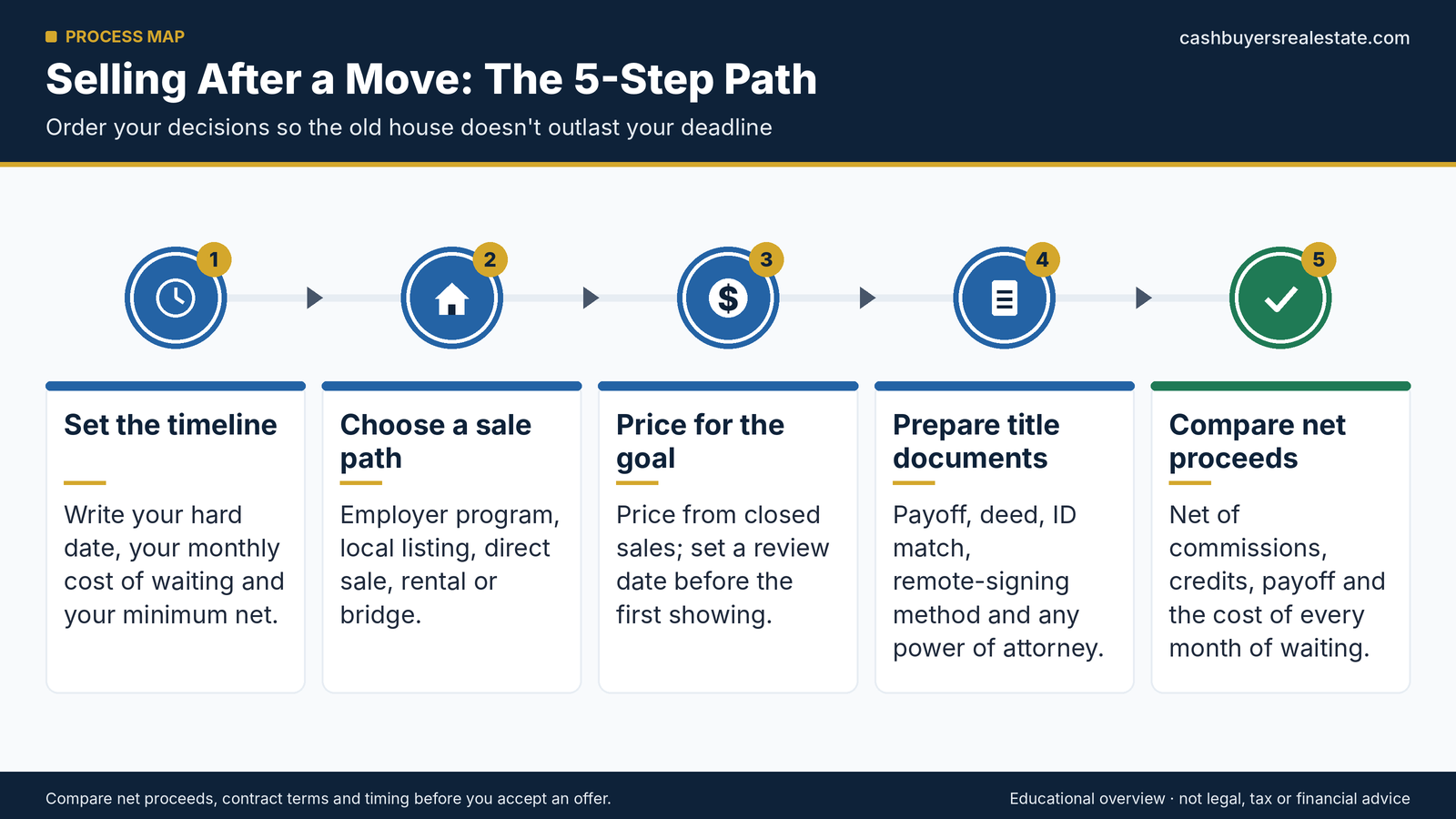
The first infographic summarizes the five-step path for a relocation sale: set the timeline, choose a sale path, price for the goal, prepare title documents, and compare net proceeds. The text covers each of those steps in detail, so the graphic is a quick reference.
Text version of this infographic
- Set the timeline — Write your hard date, your monthly cost of waiting and your minimum net.
- Choose a sale path — Employer program, local listing, direct sale, rental or bridge.
- Price for the goal — Price from closed sales; set a review date before the first showing.
- Prepare title documents — Payoff, deed, ID match, remote-signing method and any power of attorney.
- Compare net proceeds — Net of commissions, credits, payoff and the cost of every month of waiting.
Remote Closing Checklist: Selling From Another State
You don’t need to be at the closing table to sell a house, but the signing has to be done in a way that your state, the title company and the recorder will accept. The right method depends on where the house is and where you are, so check with the closing company early.
Signing Without Being There
There are three common ways to sign closing documents from a distance: remote online notarization, a mobile notary or mail-away package, and a power of attorney. Each has limits.
Remote online notarization, mobile notaries and mail-away signing
Remote online notarization (RON) lets you sign electronically while a notary verifies your identity over live audio-video. Whether it’s available for real estate documents depends on state law and on what the title company and county recorder accept. Florida offers one official example. Under Florida Statutes 117.265, an online notary physically located in Florida may perform an online notarization even when the principal or witnesses are outside the state, the notary must confirm identity using audio-video technology with credential analysis and identity proofing, and the session must be recorded. Other states have different rules, and some do not authorize remote notarization for every document type, so do not assume your state matches Florida.
Before you rely on remote notarization, ask the closing company four practical questions. Do they use a platform that your state and county recorder accept for deeds and other real estate documents? Will you need to upload photo identification and answer identity-proofing questions? Is the buyer’s lender comfortable with electronic signatures on its own documents? And what is the fallback if the technology fails on closing day? A tested plan B, such as a mobile notary on call, is cheap insurance.
Alternatives are common. A mobile notary can meet you where you are, including in your new city, to notarize documents the title company mails or couriers to you. In a mail-away closing, the closing company sends signing packages by overnight delivery, you sign before a local notary, and you return the originals by tracked courier. This often takes several days each way, so build that into the timeline. A hybrid closing mixes electronic signing for some documents with wet-ink signing for others. In attorney-closing states, the attorney may insist on particular procedures, so ask the attorney or closing company which methods are accepted for a seller outside the state.
Power of attorney: when it helps and what to check
A power of attorney lets someone you trust, called an agent or attorney-in-fact, sign sale documents for you. It can be useful when you can’t travel and remote signing isn’t available, but it carries real risk, because you are handing someone authority to sign a deed. Many title companies and lenders will accept one only if it names the specific property or transaction, is signed and notarized correctly, and meets state rules, and some require it to be recorded with the deed. Before you create one, ask the closing company what form it will accept; a form that doesn’t meet its standards can delay closing at the worst moment.
Formalities differ by state. In Florida, for example, Florida Statutes 709.2105 says a power of attorney must be signed by the principal and two subscribing witnesses and acknowledged by the principal before a notary public. Other states ask for different witnessing or notarization, so use a lawyer in the state where you sign or where the property is. Limit the scope to this sale, choose someone who has no conflict of interest, ask for copies of every document the agent signs, and revoke the authority once closing is complete. If anyone pressures you to sign a broad document that would let them sell or borrow against your house, stop and get legal advice.
The Remote-Closing Checklist
Remote closings go smoothly when the logistics are planned in advance. They go badly when a notary, a courier or an identity check fails at the last minute.
Documents, logistics and the last week
Use this sequence as a starting point and adjust it with your closing company’s instructions.
- Ask the closing company or attorney which signing methods they accept for an out-of-state seller, and in what order documents will arrive.
- Confirm the exact name on your deed and make sure your government ID and any marriage or name-change documents match it.
- If using a power of attorney, have the closing company approve the form before you sign it.
- Book a notary or mobile notary, or test the RON platform with the closing company before closing day.
- Arrange overnight, tracked delivery in both directions for any wet-ink originals, and allow for delays.
- Verify wire or payment instructions by phone, using a number you found yourself.
- Arrange key handoff, a final walk-through and a cleared house through your local contact.
- Set up mail forwarding, utility final readings and an insurance cancellation date that follows closing, not precedes it.
- Keep copies of every signed document and the final settlement statement.
| Method | How it works | Best when | Watch for |
|---|---|---|---|
| Remote online notarization | E-sign with a notary by live video | State allows it and the recorder and title company accept it | Not every document or county; technology and ID checks |
| Mobile notary with mailed or couriered package | Notary meets you where you are | You can be reached by courier | Several days each way; wet-ink originals must be returned |
| Power of attorney | Agent signs for you | You can’t sign or attend and others won’t work | Formalities; trust; recording; closing company approval |
| Return for closing | You attend in person | Trip is practical and low cost | Travel cost and scheduling |
| Attorney-led closing | Attorney supervises the closing, including remote steps | State requires or customs favor attorneys | Attorney availability and procedures |
The table shows that there is rarely one right answer. Ask your closing officer or attorney to recommend the method that fits your state and your buyer’s lender, then confirm how long each step takes.
Wire-fraud and identity safeguards for remote sellers
Remote sellers depend more on email and phone, which is what fraudsters exploit. The Consumer Financial Protection Bureau advises in its guidance on mortgage closing scams to never follow payment instructions contained in an email, to verify account details by phone using a number you already trust, to set up two trusted contacts at the closing company before closing, and not to email financial information. The FBI’s page on business email compromise says the same about verifying changes in payment procedures with a number you looked up yourself, and advises contacting your bank immediately and reporting at ic3.gov if money goes to a fraudster.
As a seller you mostly receive funds, so give your closing company your account details through a verified channel, and double-check by phone that they received them correctly. Be suspicious of last-minute changes to instructions, unusual urgency, or requests to move to a new email address. Related safeguards include confirming that anyone claiming to be your agent, notary or attorney is who they say, and checking their license or registration with the state. We cover scam patterns in more detail in the guide to cash home buyer scams and the walkthrough of the cash home sale process.
Sell, Rent or Bridge: Counting the Cost of Two Homes
Everyone who relocates asks some version of the same question: should I sell the house now, hold it and rent it out, or find a way to bridge until it sells? The answer depends on arithmetic more than on instinct. Start by counting what waiting really costs, then compare the options against that number.
A Dual-Housing Cost Worksheet
“Two house payments” is the common shorthand, but it overstates the cost of waiting in one way and understates it in another. A careful worksheet separates what you lose each month from what you merely pay.
Counting both homes, month by month
Begin with the old house. List the mortgage payment, but split it into interest and principal, since principal reduces your debt and comes back to you as equity at closing. Add property taxes, homeowners insurance, utilities you must keep on, lawn or snow service, association dues, and any routine upkeep or security checks. The interest and the other items are the true monthly cost of waiting. Your new housing is a separate cost you’d pay anyway, but it matters for cash flow, because both bills hit at the same time.
Illustrative example (hypothetical numbers, not market data): A relocating homeowner’s mortgage payment is $1,850 a month, of which about $1,350 is interest and $500 is principal. Property taxes are $450 a month, insurance is $160, utilities are $220, and lawn service and minor upkeep average $120. The monthly cost of waiting is therefore about $1,350 plus $450 plus $160 plus $220 plus $120, or $2,300. The total cash the homeowner must pay each month on the old house is $2,800 (including the principal), and the new rental adds $2,100. The monthly cash strain is $4,900, even though the true cost of waiting is $2,300.
| Line item | Monthly cash paid | True cost of waiting | Note |
|---|---|---|---|
| Mortgage interest | $1,350 | $1,350 | Interest is gone for good |
| Mortgage principal | $500 | $0 | Reduces debt; returns as equity |
| Property taxes | $450 | $450 | May be prorated at closing |
| Homeowners insurance | $160 | $160 | Confirm vacancy terms |
| Utilities kept on | $220 | $220 | Needed for showings and inspections |
| Lawn, snow, upkeep | $120 | $120 | Ongoing |
| New rental housing | $2,100 | $0 | Paid either way; affects cash flow |
| Total | $4,900 | $2,300 | Cash strain versus true cost |
The distinction matters in two ways. The true cost tells you what a month of waiting is worth when you compare offers. The cash strain tells you how long you can afford to wait without borrowing, selling investments or taking a bridge loan.
What a month of delay costs versus a price discount
Once you know the monthly cost of waiting, you can translate time into dollars. If waiting costs $2,300 a month, then closing two months sooner is worth about $4,600 of cost saved, before you consider commissions or other differences. That doesn’t mean you should accept any offer that saves two months. It means a lower price that closes sooner should be compared with a higher price that closes later, using net proceeds.
The opposite mistake is common as well: holding out for an extra $5,000 while paying $2,300 a month. If the extra price takes three more months to achieve, the delay can cost more than the gain. A simple rule of thumb: ask how many additional months an improvement in price will take, multiply by your monthly cost of waiting, and subtract that from the improvement. If the result is small or negative, the extra time may not be worth it. Compare the numbers for every real offer, and use the net proceeds calculator as a template for the rest of the sheet, including commission and closing costs. For help understanding the costs, see the guide to closing costs when selling a house.
Sell Now, Rent Out or Bridge
With the cost of waiting in hand, the choice among the three families of options becomes clearer. Each has a different risk profile and a different effect on your taxes and your cash.
Renting out the house
Renting can be attractive when the housing market is soft, when your equity is thin, or when you expect to return. It turns the house into an income property, and it can cover some of the carrying costs. It also makes you a landlord from a distance, with duties to maintain the home, comply with local rental rules, and handle repairs and tenant problems. Many owners hire a property manager, whose fee and terms vary, and who becomes a key part of the team. The guide to selling a rental property fast explains what changes when you decide to sell later.
Illustrative example (hypothetical numbers, not market data): A homeowner could rent the house for $2,400 a month. Property manager fees take 10% ($240), average maintenance and vacancy allowances take another $200, and the interest, taxes and insurance on the house run $1,960. That leaves about nothing after costs, so the rental roughly pays its own way but builds no cash, and the owner’s equity depends on future prices and the principal paydown of about $500 a month. Selling now would end the carrying costs and turn the equity into cash. The owner decides whether the option to return, or a better market later, is worth the landlord workload and risk.
Check three things before you commit. First, your mortgage and insurance: review your loan documents for occupancy terms, and call your insurer, because a rented home often needs a different type of policy than an owner-occupied one. Second, local rules on rental licensing, inspections and tenant rights, which differ by state and city. Third, taxes: rental income is generally taxable, depreciation may be involved, and the IRS notes in Publication 523 that depreciation claimed after May 6, 1997 can’t be excluded from a home sale, and that periods of nonqualified use can limit the exclusion. The two-out-of-five-year test also keeps running while you rent, so a long rental can eventually cost you the full exclusion. Talk to a tax professional before you decide how long to rent.
Bridge financing, rent-backs and selling now
A bridge is anything that carries you from the day you need the cash to the day the old house sells. Options include savings, a home equity line, a short-term bridge loan, help from your employer, or a buyer’s agreement to let you stay in the house for a few days or weeks after closing, called a rent-back. Each has costs and conditions: borrowing against the house you are trying to sell adds a lien and a payoff, lenders have their own approval standards, and a rent-back requires the buyer’s agreement and often a short written lease. If you are weighing a bridge loan, ask for the interest rate, fees, term, and what happens if the house doesn’t sell by the maturity date.
Selling now means accepting the market as it is, which may mean a lower price if you need to close quickly. That can include listing with a local agent, a direct sale to a cash buyer, or a program through your employer. The overview of selling a house for cash and the guide on cash buyers versus listing with an agent explain how those routes compare. The table below lays out the main options for a relocating seller.
| Option | Best when | Cost or condition | Main risk |
|---|---|---|---|
| List with a local agent | Equity is solid and you can wait weeks | Commission, credits, carrying costs | Waiting costs add up; price cuts |
| Employer buyout | Your plan offers one | Plan rules, appraisal, timeline | May be below a marketed sale; deadlines |
| Direct cash sale | Deadline is firm; condition or distance complicates showings | Discount versus market price | Verify buyer and funds; compare on net |
| Rent it out | Soft market or you may return | Property manager, repairs, insurance change | Landlord duties from afar; exclusion clock; tax complexity |
| Bridge loan or HELOC | You need cash now and expect a sale soon | Interest, fees, extra lien | Sale slips past the loan term |
| Sale with rent-back | Your move date is later than the buyer’s closing | Short lease, deposit, insurance | Buyer must agree; your obligations after closing |
The best choice is rarely a single option. Many sellers list with a local agent, set a price review date, and keep a direct sale as a backup. Others rent out the house while they confirm their job is permanent. The point is to decide your rules before the pressure hits.
The second infographic below compares five routes a relocating seller might consider, with the best fit and the main tradeoff for each. The text above states every tradeoff, so the graphic works as a quick reference for the decision.

Text version of this infographic
- Local listing — best for: Time to wait; healthy local market; tradeoff: Waiting cost; showings from afar
- Employer buyout — best for: Your plan offers one; tradeoff: Plan rules; may be below market
- Direct cash sale — best for: Firm deadline; hard-to-show house; tradeoff: Discount; verify buyer and funds
- Rent it out — best for: Soft market or you may return; tradeoff: Landlord duties; exclusion clock
- Bridge or rent-back — best for: Closing and move dates don't match; tradeoff: Loan fees or buyer must agree
Timing the Sale Against Your New Home
Moving gets complicated when two real estate transactions need to land on compatible dates. The sale of the old house and the purchase or lease of the new one pull on each other, and a delay in one ripples into the other. Planning the sequence reduces the chance of a gap or an overlap.
Syncing Two Closings
Sellers who are also buyers face a classic fork: sell first and risk being without a home, or buy first and risk owning two. Neither is wrong, but each shifts the risk to a different place.
Sell-first, buy-first and contingent contracts
If you sell first, you know your proceeds and can shop with a firm budget, but you may need temporary housing and a plan for your belongings. If you buy first, you can choose the new home without time pressure, but you may carry both homes until the old one sells, and lenders typically count both payments when they decide whether you qualify for a new loan. Ask a lender early how they treat the old mortgage and any expected sale proceeds.
A contingent contract ties the purchase of the new home to the sale of the old one. It protects you from owning both, but sellers often view contingent offers as weaker than non-contingent ones, so it can reduce your negotiating power. Conversely, if you receive an offer on your old house that depends on the buyer selling their own home, you take on the same kind of uncertainty. Ask your agent how common contingent offers are in your local market and what protections the contract includes, such as a kick-out clause allowing you to accept a better offer.
Rent-backs, temporary housing and flexible closing dates
Closing-date flexibility is a negotiating asset. A buyer who wants a fast close may pay more for a quick date, and a buyer who is also selling may value a later one. A rent-back lets you stay in the house for a few days or weeks after closing, which can fix a mismatch between closing and your move date, though it requires the buyer’s agreement and the lender’s cooperation if the buyer is financing. A cash buyer may be more flexible on dates than a buyer who depends on a lender’s schedule. For the buyer’s side of that schedule, the Consumer Financial Protection Bureau notes in its guide to the Closing Disclosure that a lender must give the buyer that disclosure at least three business days before closing, which is one reason a mortgage-financed closing date can’t be moved on short notice.
| Week | Old-house task | New-home or move task |
|---|---|---|
| Weeks 1–2 | Read relocation policy; request payoff; choose agent or attorney; order title search | Confirm start date and temporary housing |
| Weeks 2–3 | Photos, listing live or buyout steps begin; set price review date | House-hunting trip or lease search |
| Weeks 3–6 | Showings, offers, inspection; pick signing method | Offer or lease on new home; line up movers |
| Weeks 6–9 | Contract to closing; appraisal if buyer financed; arrange notary | Final move-out plan; utilities transfer |
| Closing week | Sign, verify wire details, final walk-through | Keys, forwarding address, insurance changes |
The table is a planning sketch, not a promise. A quick direct sale can compress the middle weeks, while an appraisal problem or title issue can stretch them. The value of writing a timeline is that you see where one task depends on another, and where a slip in the old house would hit your move.
Selling After You’ve Already Moved
If you’ve already left, the house may be empty, and distance makes every showing and repair a coordination task.
Showings, staging and access when the house is empty
An empty house photographs less warmly than a furnished one, but it’s easier to show and to clean. If your budget allows, a stager or a small set of rented furnishings can help buyers picture the rooms; if not, a thorough cleaning, fresh paint on obvious problem spots, bright bulbs and good photographs go a long way. Use a lockbox or a showing-request app so agents can schedule visits without your involvement, and keep utilities on so buyers can see the house in working order.
Plan access for inspections and appraisals as well, since those are the visits that most often get delayed by absentee owners. Give your local contact authority to let in appraisers and inspectors, and make sure the contact has gate codes, alarm codes and utility details. Ask your agent for a short video of the house after each showing day if there’s any concern about condition, and have the agent confirm that doors, windows and thermostats are set the way you want.
Price-review discipline and when to consider a direct offer
Distance makes it easy to let a listing drift. Put a price-review date on your calendar, such as two weeks after the first showings, and agree in advance with your agent on what happens if showing activity is low: a price reduction, a change of photos, or a switch in strategy. If you receive an offer from a direct cash buyer, evaluate it on a net sheet, compare it with the likely net from a listing, add the cost of the additional months of waiting, and verify the buyer’s funds. The guides on proof of funds, selling a house in 30 days and urgent home sale options help with each step.
Remember that you can always combine routes. A seller might list with an agent for the first few weeks, keep a cash buyer’s written interest on file, and switch if the price review shows the market isn’t moving. What matters is that the decision rests on your numbers and your deadline, not on the stress of the moment.
Net Proceeds and Paperwork for an Out-of-State Seller
When you’re moving, it’s tempting to focus on the closing date and treat the money as an afterthought. The seller who ends up best off usually did the opposite: ran the numbers on each route, counted the cost of waiting, and then picked the route that met the deadline at an acceptable net. This section builds a comparison and then covers the state-level paperwork that surprises sellers who no longer live where the house is.
Net Proceeds Under Three Relocation Routes
A relocation sale usually comes down to three practical routes: a market listing, an employer or relocation-provider buyout if one exists, and a direct sale to a cash buyer. The example below is built from invented assumptions to show how the lines interact.
A worked comparison
Illustrative example (hypothetical numbers, not market data): A relocating homeowner owns a house worth about $340,000 on the open market, with a $190,000 mortgage payoff, and a monthly cost of waiting of $2,300. In the listing route the house sells for $340,000 after about three months. In the buyout route, an employer-sponsored program purchases the house at $325,000 after about two months, with the employer covering no commission and the seller still paying standard closing costs. In the direct-sale route, a cash buyer offers $290,000 and closes in about one month. All three assume plan-specific or buyer-specific terms that would differ in the real world.
| Line item | Market listing | Employer buyout (assumed terms) | Direct cash sale |
|---|---|---|---|
| Sale price | $340,000 | $325,000 | $290,000 |
| Commissions (assumed 5% on listing) | −$17,000 | $0 | $0 |
| Closing costs and prorations | −$4,500 | −$4,500 | −$2,000 |
| Repair credits | −$2,500 | −$2,500 | $0 |
| Cost of waiting ($2,300 a month) | −$6,900 (3 months) | −$4,600 (2 months) | −$2,300 (1 month) |
| Net before mortgage payoff | $309,100 | $313,400 | $285,700 |
| Mortgage payoff | −$190,000 | −$190,000 | −$190,000 |
| Cash to seller | $119,100 | $123,400 | $95,700 |
Read the bottom row, then ask how much each route’s extra weeks and lower price are worth to you. The assumed buyout route comes out slightly ahead in this example only because of the invented terms, and a real program might be better or worse. The direct sale nets about $23,400 less than the listing, but it arrives roughly two months sooner and removes showings, repairs and market risk. Whether that is a fair trade depends on your deadline, your cash strain and your tolerance for uncertainty, not on a general rule.
Adjusting the sheet for your own situation
A net sheet isn’t finished until it reflects the details of your situation. Replace the assumed commission with the actual rate in your listing agreement, and add the buyer’s agent compensation if you’ve agreed to pay it. Add any association transfer fees, the prorated property tax, and the payoff from your lender, using the actual payoff statement, which will include accrued interest. If your employer reimburses part of the selling costs, enter that as a separate line and note whether it will be taxable to you, since the IRS rules described earlier now treat most employer moving-cost payments as wages.
Two items sellers often forget are the second direction of cost and the second direction of benefit. On the cost side, check whether your loan has a prepayment penalty and whether you’ll owe an early-closure fee on a home equity line. On the benefit side, remember that the principal portion of your mortgage payments during the waiting period isn’t lost, and that an escrow balance is refunded after payoff. For payoff mechanics and the questions to ask your servicer, see the guide on selling a house fast with a mortgage.
State Rules and Close-Out Tasks for Sellers Who Have Moved
Once you live in another state, the rules where the house sits still apply, and some are surprising to a seller who has already filed a change of address.
State withholding and tax reporting
Some states require withholding when a person who no longer lives in the state sells real property there, unless an exemption applies. California’s Franchise Tax Board gives one official example. Its instructions for Form 593 describe a withholding amount of 3 1/3% of the sales price, or an alternative calculation based on estimated gain, with full exemptions available in situations that include a sale of the seller’s principal residence, a loss or zero gain, and some small or special transactions. The instructions state that vacation homes and rentals don’t qualify for the principal-residence exemption and that the exemption turns on whether the property was last used as the seller’s principal residence. A relocating seller who turns the house into a rental before selling, then, could face a different result than one who sells straight from the move.
To see the effect, imagine a seller who sells a California home for $600,000 that was last used as a rental after the seller moved away. Under the sales-price method described in the instructions, the withholding would be 3 1/3% of the price, or $20,000, unless an exemption or the alternative gain-based calculation applies. Withholding is generally an advance toward the seller’s own tax liability, not a separate tax, but it reduces the cash the seller receives at closing, and a tax professional can explain how it is credited. This is a hypothetical illustration of how the rule works, and a closing agent and tax professional should handle the actual calculation.
Other states have their own rules, forms and thresholds, and some have none. The closing company in the property’s state will know what applies, but only if you tell them early that you’re no longer a resident and where your tax home is now. On the federal side, if gain is not excluded under the home-sale rules, it’s reported on Form 8949 and Schedule D, and you may receive Form 1099-S from the closing agent, as the IRS describes in Publication 523. A tax professional who handles both states can reconcile the pieces.
Utilities, association, insurance and mail close-out
The final tasks are mundane and easy to miss from afar. Schedule final meter readings for water, gas and electricity for the day after closing or possession, not the day before, so the buyer’s inspectors, appraisers and walk-through aren’t left in the dark. Ask the homeowners’ association for a payoff or resale certificate if there is one, and settle any pending assessments. Keep your insurance active until closing is recorded and possession has changed hands, then ask the insurer about any premium refund. Set up mail forwarding and update your address with banks, the servicer, the IRS and your employer.
Gather and store copies of the settlement statement, the signed deed, receipts for improvements and repairs, and your closing correspondence. You’ll need them to calculate your tax basis and to answer any later questions from the buyer or a lender. If an escrow refund is coming from your servicer, leave a forwarding address so it reaches you in your new state.
Risks and Red Flags When You’re Selling From a Distance
Distance changes the risk profile of a sale. It reduces your ability to check on the house and the people around it, and it raises your reliance on messages from strangers. None of the following is a reason to avoid selling from afar. They are reasons to add checks.
Scams and Pressure Tactics Aimed at Absent Owners
Owners who relocate are often easy to identify: a for-sale listing, a vacant house, an out-of-state mailing address and a job-related deadline. Some of the attention that follows is legitimate. Some isn’t.
Unsolicited offers and deadline pressure
Expect unsolicited calls, letters and messages from investors, wholesalers, service providers and people claiming to have a buyer. Many are honest. A few use your deadline as leverage, pushing for a quick signature, a low price, a large non-refundable deposit from you, or an exclusive agreement you didn’t plan. Be especially cautious with any request for upfront money, any pressure to sign before you’ve had an attorney review the document, and any contract that grants the other party the right to assign your house or market it as their own. None of those features proves bad faith on its own, but they justify slowing down.
Separate the useful from the noisy: a buyer that provides verifiable proof of funds, identifies itself clearly, offers a reasonable timeline and works with a neutral closing company can be a legitimate route; one that avoids questions and pushes secrecy is not worth your time. The checklist-style walkthroughs in the guides on proof of funds and cash home buyer scams cover those checks in detail.
Verifying buyers, helpers and funds from afar
Distance means verification has to happen by phone and document, so make it a routine. Confirm any buyer’s identity and funds with the bank or through the closing company, not through a forwarded email. Check that your agent, attorney, notary or property manager is licensed or registered, using the state’s public lookup. Ask who holds the earnest money and under what terms it’s returned. Confirm wire instructions by phone at a number you found independently, as the Consumer Financial Protection Bureau and the FBI advise, and set up two trusted contacts at the closing company in advance. If anything changes at the last minute, treat that as a reason to call, not to click.
| Risk | Warning sign | Safeguard |
|---|---|---|
| Pressure on your deadline | Demands to sign immediately; offers that shrink as your date nears | Set a minimum net in advance; get a second offer |
| Wire or payment fraud | New instructions by email; urgency | Call a known number; two trusted contacts; no financial details by email |
| Unverified funds | Proof of funds that can’t be confirmed | Confirm with the institution or closing company |
| Power-of-attorney misuse | Broad, open-ended document | Narrow scope; closing company approves the form; copies of everything signed |
| Unsupervised repairs | Upfront payment for work you can’t see | Photos before payment; pay in stages; written estimates |
| Vacancy damage | Water leak, break-in, notices left at the door | Scheduled checks; insurance confirmation; mail forwarding |
| Missed contract deadlines | Silence from the other side; unclear dates | Calendar every date; one local contact with authority to respond |
Reading across the table, most safeguards come down to three habits: verify identities independently, keep authority narrow, and document everything in writing.
Risks to the House and to Your Authority
Two other kinds of risk are easy to underestimate: what can happen to an unattended house, and what can go wrong when others act for you.
Vacancy, insurance and code problems
An unoccupied house loses the small daily attention that catches problems early: a dripping pipe, a broken window, an unlocked door, a stack of mail on the porch. Schedule regular checks, ideally weekly, by a person who sends photos. Set thermostats to protect pipes in cold weather and confirm the water heater and sump pump are working. Ask your insurer in writing what your policy covers while the house is empty and what you must do to keep that coverage, since terms vary by company and policy.
Municipal notices are another hidden risk. Cities and counties send letters about overgrown grass, snow on sidewalks, code violations or utility issues, and if they go to the property address, you may not see them for weeks. Forward your mail, ask your local contact to check the door and mailbox, and respond quickly to any notice. In some places unpaid fines or service charges can become liens, which would then have to be cleared at closing. The guide to selling a vacant house fast goes deeper on vacancy issues.
Contractor, property manager and power-of-attorney risks
Handing tasks to others is necessary, but it should come with limits. For repairs, get written estimates, pay deposits only when necessary, and ask for photos of the finished work before final payment. For a property manager or local helper, define their authority in writing: what they can approve, the spending limit, and how they report. For a power of attorney, keep the scope tied to the sale, name an agent you trust, make sure the closing company approves the form, keep copies of everything the agent signs, and revoke the authority when the sale is complete.
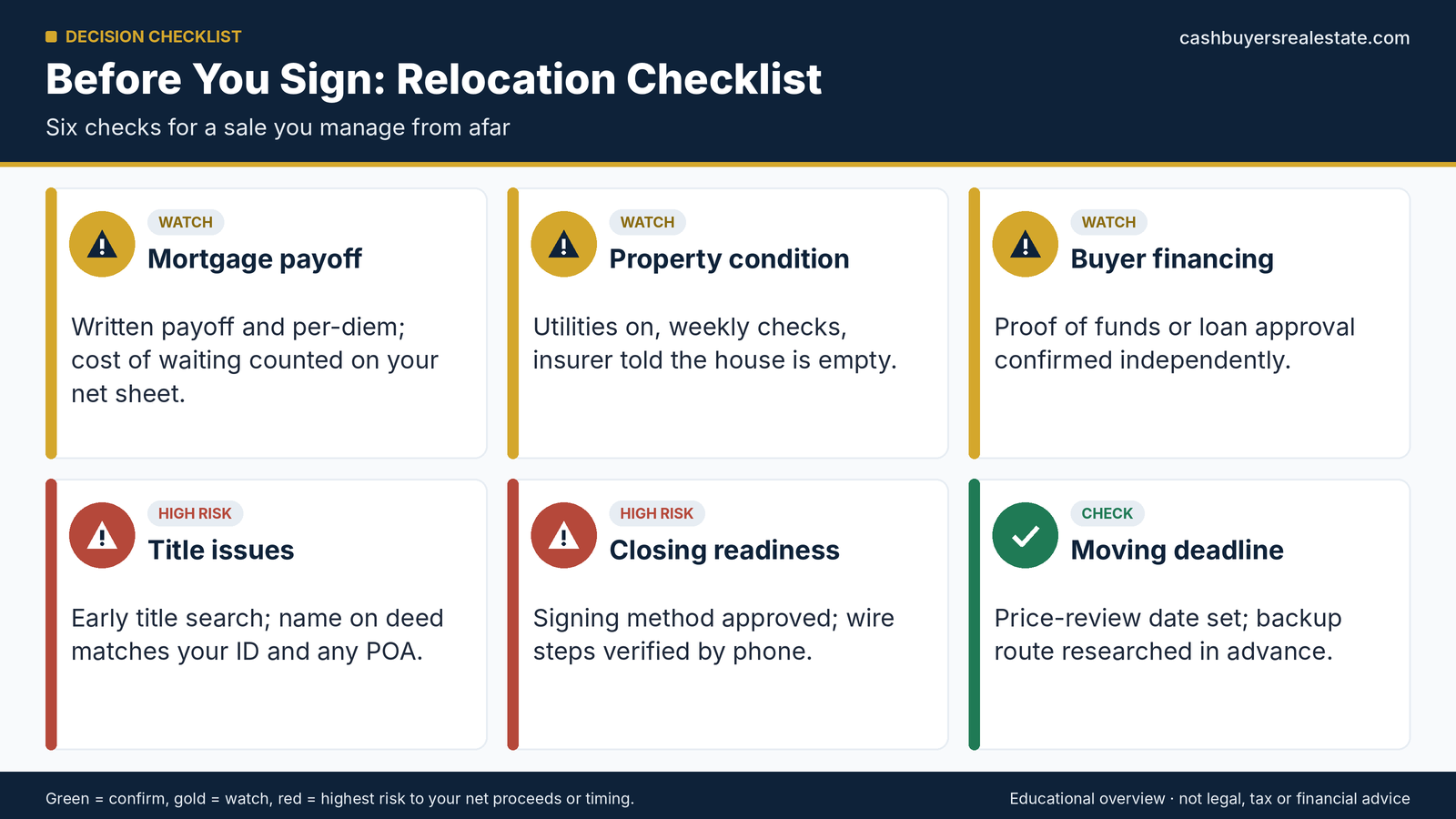
Finally, keep a simple log: dates of calls, names, decisions, and what was sent. A log helps you spot inconsistencies and gives you a record if something later goes wrong. The third infographic summarizes the main checks as a six-item list covering mortgage payoff, property condition, buyer financing, title issues, closing readiness and your moving deadline. Every point is explained in the text, so use the graphic as a quick pre-signing reminder.
Text version of this infographic
- Mortgage payoff — Written payoff and per-diem; cost of waiting counted on your net sheet.
- Property condition — Utilities on, weekly checks, insurer told the house is empty.
- Buyer financing — Proof of funds or loan approval confirmed independently.
- Title issues — Early title search; name on deed matches your ID and any POA.
- Closing readiness — Signing method approved; wire steps verified by phone.
- Moving deadline — Price-review date set; backup route researched in advance.
Frequently Asked Questions about Selling a House After a Job Transfer or Move
These answers cover the follow-up questions relocating sellers raise most often. They stay general because employer plans, state rules and tax outcomes vary by situation.
Questions About Employers, Taxes, Timing and Cost
Questions about relocation benefits and taxes
- Does my employer have to help me sell my house?
Employers decide whether to offer home-sale help, and many don’t. Where a program exists, it’s defined by the employer’s written relocation policy, which may include a guaranteed buyout, cost reimbursement or a lump sum. Ask HR for the full policy and any deadlines before you list the house on your own.
- Are employer relocation payments taxable?
For most employees, generally yes. The IRS’s Publication 15-B (2026) says Public Law 119-21 permanently eliminates the exclusion for qualified moving expense reimbursements, with exceptions for active-duty members of the Armed Forces and certain intelligence community employees. Ask your employer whether any payment is grossed up to cover the tax, and consult a tax professional.
- Can I deduct my moving expenses?
Most civilians can’t. The IRS’s Topic 455 describes a deduction or exclusion for Armed Forces members who move under military orders for a permanent change of station, and for certain intelligence community employees from 2026. If you’re not in one of those groups, assume moving costs are not deductible unless a tax professional tells you otherwise.
- Will I owe tax on the sale of my house?
Many sellers don’t, because of the home-sale exclusion of up to $250,000, or $500,000 for married couples filing jointly, if they owned and lived in the home for at least 24 months of the five years before the sale. A work-related move can qualify for a reduced exclusion if you sell before meeting the two-year tests and the new job is at least 50 miles farther away. Rental use, depreciation and other facts can change the outcome.
Questions about timing and cost
- How fast can I sell a house after I’ve already moved?
That depends on price, condition, buyer financing and your route. A direct sale to a cash buyer can sometimes close within a few weeks when title is clean, while a listing aimed at buyers with mortgages generally takes longer because of marketing, appraisal and underwriting. Treat any quoted number of days as a planning assumption, not a promise.
- Should I rent the house instead of selling?
Renting can make sense if the market is soft, your equity is thin or you might return. It also makes you a long-distance landlord, changes your insurance and tax picture, and keeps the exclusion clock running. Compare the cost of managing a rental with the cost of waiting for a sale, and talk to a tax professional before choosing.
- How do I figure out what waiting costs me?
Add up mortgage interest, property taxes, insurance, utilities and upkeep for the old house, but count only the interest part of the mortgage payment, since the principal portion reduces your debt. That figure is your monthly cost of waiting. Multiply it by the extra months a higher price or slower route would take and compare it with the benefit.
- Is a cash offer a good idea when I’m relocating?
It can be when your deadline is firm and showing the house from afar is hard, but cash offers usually come at a discount. Compare the offer on a net sheet against a listing, including commissions, repair credits and the months of carrying cost, and verify the buyer’s funds. It isn’t automatically better or worse than a listing.
Questions About Remote Closings and Safety
Questions about signing from another state
- Do I have to attend the closing in person?
Often not, but it depends on your state, the closing company and the buyer’s lender. Options include remote online notarization, a mobile notary with couriered documents, a mail-away package, or a power of attorney. Ask your closing officer or attorney which methods they accept for an out-of-state seller.
- What is remote online notarization, and is it available where my house is?
It’s a process in which a notary verifies your identity and witnesses your signature over live audio-video. Availability for real estate documents varies by state and by what the title company and county recorder accept. Florida’s statute, for example, lets a Florida-located online notary serve a principal outside the state, but other states differ, so ask the closing company.
- Do I need a power of attorney to sell from another state?
Not necessarily. If you can sign through a remote or mobile notary, you may not need one. If you do use one, have the closing company approve the form first, check your state’s signing rules, limit it to this sale, and revoke it afterward.
- Can my agent or a family member sign the documents for me?
Only if they hold valid legal authority, usually through a properly executed power of attorney that the closing company accepts. A real estate agent generally can’t sign a deed for you simply because you ask by email. Check with the closing agent before relying on any informal arrangement.
Questions about safety and the empty house
- What if the house is empty while it’s for sale?
Keep utilities on, schedule regular checks with photos, forward your mail, and ask your insurer in writing what your policy covers while the home is vacant. Respond promptly to any notice from the city or county. A vacant house is easier to show but needs more monitoring.
- How do I avoid wire fraud when I’m not there?
Verify any payment or account instructions by phone using a number you found yourself, not one in an email, and don’t send financial details by email. The CFPB also suggests setting up two trusted contacts at the closing company before closing. If money goes to the wrong account, contact your bank immediately and report it at ic3.gov.
- What if a buyer or service wants money from me upfront?
Slow down. Legitimate sellers rarely need to pay a buyer to receive an offer, and large upfront fees to “market” or “guarantee” a sale deserve an attorney’s review. Check the company’s registration, ask for the terms in writing, and compare with offers from other sources.
Choosing Your Route and Taking the First Steps
By now you have the pieces: what your employer might provide, what the IRS says about taxes, how to sign from afar, what waiting costs and where the risks are. The final step is matching a route to your priorities, then taking a handful of low-regret actions this week.
A Decision Framework: Match the Route to Your Priority
Start with the constraint that would hurt most to violate. For some sellers it’s the date, for others it’s cash flow, and for others it’s the price.
If you have an employer program or can afford to wait
If your employer offers a buyout or substantial reimbursements, read the plan first, because it may dictate the order of steps and can rule out other routes if you skip them. If you can afford a few months of waiting and your market is healthy, a listing with a local agent, supported by a price-review date and a clear local team, often produces the strongest price. Use the dual-housing worksheet to see how many months of waiting your cash flow can bear, and keep a direct sale in reserve as a backup you’ve researched in advance.
If your deadline is firm or the house is hard to show from afar
If the date is firm, cash flow is tight, or the property needs work that you can’t supervise, a direct sale to a cash buyer or investor may serve you better, even at a discount. Compare offers on net proceeds after the cost of waiting, verify proof of funds, and use a neutral closing company. If the house is in good shape and you’re wary of landlord duties, selling still may beat renting. If you might return, renting may beat both. Table 9 matches priorities to routes and flags what to double-check.
| Main priority | Route that often fits | Works best when | Double-check |
|---|---|---|---|
| Certainty and a simple handoff | Employer buyout, if offered | Plan terms are acceptable | Value method, timeline, taxes on payments |
| Highest price with time to spare | Listing with a local agent | Your cash flow can absorb several months | Net after commissions and waiting cost |
| Fastest, most predictable close | Direct cash sale | Title is clean; discount is acceptable | Verified funds, complete contract, net versus listing |
| Keeping the option to return | Rent it out | Rent covers costs; you can manage a landlord role remotely | Insurance, local rules, tax and exclusion clock |
| Cash now, sale later | Bridge loan or HELOC | Sale is likely within the loan term | Fees, extra lien, what if it doesn’t sell |
| Move date later than closing date | Sale with rent-back | Buyer agrees to a short lease | Insurance and lease terms |
No row is a recommendation for your house. It is a starting point for a conversation with a closing officer, attorney or tax professional who can see your documents.
What to Do in the Next Seven Days
The first week sets the pace. These steps are inexpensive, reversible and useful on every route.
First steps and the documents to gather
- Ask HR for your written relocation policy and any deadlines on home-sale benefits.
- Write down your hard deadline, your monthly cost of waiting, and your minimum acceptable net.
- Request a payoff statement from your lender and locate your deed, tax bills and association contacts.
- Choose a local agent or attorney, and name a local contact with a backup for access.
- Ask the closing company or attorney which remote-signing methods they accept, and whether a power of attorney would be needed.
- Call your insurer about vacancy coverage, and schedule weekly house checks.
- Set a price-review date and decide what you’ll do if the first weeks bring few showings.
Keep the list short and finish it in order. The first three items define your constraints, the next two build your team, and the last two set your safeguards. Sellers who skip to the team before knowing their deadline and minimum net often end up negotiating with no clear target, which is exactly when pressure works best against them.
Questions to ask your employer, agent, buyer and closing company
- Employer: what does the written policy cover, which deadlines apply, and which payments are taxable?
- Agent: how will showings, access and repairs be handled while I am away, and who has authority to respond to buyers?
- Closing company: which signing methods do you accept, and what documents must I supply and by when?
- Buyer: who is buying, how can the funds be verified independently, and what happens if the deal does not close?
- Everyone: how will wire instructions be verified by phone, and who are my two trusted contacts?
If you’re still weighing options and want a broader sense of how buyers and listings compare, the overview of companies that buy houses for cash can help you set expectations, and the locations hub can help you find local information as it becomes available.